Showing posts with label haida. Show all posts

3/08/2012

The Dry Beam: Bulk Log Carriers and Whole Log Exports

The Dry Beam bulk log carrier, one of the largest in the world,
in Victoria, BC after being damaged at sea. Photo: GVHA
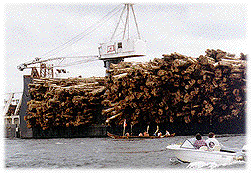
I saw a Washington forest last week without leaving Canada. It was a horizontal forest of raw logs that was laid out on Pier B at Ogden Point in Victoria, BC. Although these weren't trees from Vancouver Island, they reminded me that BC, like Washington, is increasingly sending raw logs to oversea markets.

The forest of logs on Pier B was from one of the world's largest bulk log carriers, the 186 meter (610 ft) Dry Beam. It ran into trouble last December early in its trip from Washington to Japan when a 10-15 meter (32-50 ft) rogue wave hit it, knocked the timber off track, and severely damaged the ship. Many logs went overboard into the north Pacific swells.

Logs on Ogden Point Pier from Dallas Road
The Dry Beam limped into Victoria, unloaded its cargo onto the pier, and underwent repairs so it could continue on its dangerous 8000 km (5000 mile) voyage. But it's not just dangerous for the ship's crew. The more important dangers are in British Columbia's forests.

Our forests, and forest industry, are being irreversibly altered by short term planning. Since 2002, the BC Liberal government has slashed more than 1100 jobs from the Forests ministry, gutting its ability to monitor this precious resource.

During the same time the forest industry lost over 20,000 jobs, and 70 mills shut down. As this has been happening, whole log exports have increased.

Deregulation of coastal forests has relieved forest companies of the requirement to mill their logs locally. This has caused a massive increase in the export of BC whole logs to foreign mills on giant ships like the Dry Beam.

Cutting down trees thousands of years old
is not sustainable, photo: TJ Watt

In 2006, the forests ministry recorded 320,000 cubic metres of whole log exports, rising to 534,000 cubic metres in 2010. Exports jumped 160% last year.

Bulk log carriers are floating our forests, via port facilities in Prince Rupert, to destinations such as China, Japan, and Korea. Along with our whole logs go the jobs that would employ thousands of British Columbians in a variety of value added activities.

We should be as outraged about the practice of shipping whole logs to foreign markets as the Haida were in 1996 when bulk log carriers were leaving Haida land with the very trees that made much of Haida culture possible - its sacred cedars.
"On August 1, 1996 Christian White and crew paddled out into Masset Inlet in a cedar canoe to confront the log carrier the "Haida Brave." The log carrier was loaded with cedar trees that had been cut from MacMillan Bloedel's TFL 39. This action by Christian and crew, and supported by 8 other boats and 70-odd witnesses on the beach was to give notice to MacMillan Bloedel and other forest companies on Haida Gwaii that the current policy of clearcutting the Islands is not acceptable." - from a conversation with C. White, and R. Stocker, spruceroots.org
Read more about the Haida blockade that helped popularize the plight of old growth forests on Haida Gwaii here. The Haida provide a way of viewing nature and the forest that the rest of BC would be wise to follow. They gave notice, as should we.
Haida giving notice in 1996 - "We are re-assuming control
of our forests in order to preserve them for the future"
photo: spruceroots.org
Let's give notice to the government and forest companies that current forest policies are unacceptable. Let's tell them we expect complete protection of all remaining old growth forests in places like southern Vancouver Island where the original forest is near-extinct. Let's tell them we want to stop whole log shipments, and keep forestry-related jobs at home.

Let's become a rogue wave of protest and stop the ships of destruction that are sailing unchecked through our faltering forests.

1/28/2012

Haida Cedar Plank Longhouses

Haida 6-Beam Longhouse, artwork by Gordon J. Miller

The cultures that have thrived on the west coast of North America have lived among some of the biggest trees in the world for thousands of years. In that time, they have used these wood resources in creative and monumental endeavors, including the Haida 6-beam longhouse.

Since time immemorial coastal people have been using the rain forest for an amazing variety of things. Haida Gwaii produced some of the largest Western red-cedar in the world, and they provided lodging, clothes, transportation, and tools - everything the Haida needed. 

Cedar is valuable because its wood and bark are water-resistant. The wood grain is unusually straight with few knots so it's excellent for splitting into the long, even, and smooth planks which the big houses required. Cedar is a solid wood yet is easy to carve and its natural oils resist rot.

Forest resources are just as important today as they ever were, although they have been logged unsustainably since the arrival of Europeans. The once rich resource is being depleted, especially the sacred (and expensive) cedar, the center pole of west coast life. However, the Haida approach logging differently, now and in the past.

When Haida lumberjacks of days gone by needed to harvest huge cedar for a new plank longhouse, they would canoe in a large group to the location of big cedars. While one group set up camp and cooked, another went to fell the giant trees needed for the beams and large planks used in building the massive long houses.

To fell the large cedar, wet mud was packed at breast height all around the base of the trunk. Wood was piled around the tree and set alight. The fire was maintained until the tree was weakened and fell to the ground. Then it would be de-limbed and prepared for the journey by canoe to the building site.

The posts and beams, which weighed several tons, were lifted into place using simple tools and the cooperation of the entire village. The longhouse, which could be up to 120 feet long and 20 feet high, had a number of fire pits for warmth and cooking with smoke holes directly overhead. The Haida raised totem poles in front of their houses while other groups painted the facade with pictures of real and mythical beasts.

The trees were harvested in a process of respect and reverence, then were used in efficient and artistic ways that also showed respect for the resource. When the longhouse was old and no longer used, it would slowly return to the forest, melding in to the greenery without a trace.


Contemporary longhouses at the Haida Heritage Centre


Beautiful longhouses are still being built on Haida Gwaii, although not as large as some of the historical structures. It has only been fairly recently that the Haida regained control of their access to the cedars of their territory, so we can expect to see more of these traditional dwellings as the Haida continue to reclaim their past.
"In the past cultural wood was used mainly for poles, boxes and masks but with the Supreme Court of Canada, Sapier and Gray decision (2006) this has changed. The court decision, in part says, that the use of cultural wood for domestic purposes is a constitutional right much like the right to harvest wood for poles and weaving. This means that Haida and other First Nations are now able to take wood to build houses or use wood for siding a house."
- from: Haida Laas, September 2009
The Haida Gwaii Land Plan, and the implementation of Ecological Based Management, will ensure that there are trees available in the future for canoe logs, longhouse beams, posts, and planks, totem poles, and other cultural uses.

The Haida Heritage Centre has new longhouses that contain exhibits for the public to enjoy. The totem poles and canoes shown here are incredible.

Check here for photos of some amazing contemporary cedar structures built by a local company.