Showing posts with label conservation. Show all posts

12/19/2021

More Tree Advocates Needed


"Every tree has its enemy, few have an advocate. In all my works I take the part of trees against all their enemies."

- JRR Tolkien


With the state of our forests in Canada and around the globe, we could use more tree advocates. 


There are many today who are doing a wonderful job of protecting the old growth for future generations to enjoy, and I thank them all from the depths of my tree-loving heart. 


But they need our help, and they need it soon.


The world needs all of us to advocate for the trees. Because they can't advocate for themselves.


The big trees have their enemies that must be stopped. Consider becoming an advocate before all the old growth is gone.


8/22/2020

Standing Up For Big Trees In Fairy Creek Valley


"If you wanna see real change, you're gonna have to stand up for it."

- Old growth protector at roadblock camp


Old growth forest protectors are standing up for big trees near Port Renfrew (Big Tree Capital of Canada) and blockading the construction of new logging roads into Fairy Creek Valley, the last pristine valley outside of a park on southern Vancouver Island.

In a saner world we would not allow the destruction of such a treasure on Vancouver Island's south coast. But we don't live in a sane world. 

Yet. 

When those that work for us in government fail in their responsibility to protect what is collectively ours, it is up to us to be the real stewards of the land, and protect its inherent right to be. 

If our public servants in government won't speak for a voiceless and defenceless nature, we have to.

Case in point is what is happening outside of Port Renfrew, town to an area long known for its (disappearing) big trees. There, just a few kilometres outside of town, Teal Jones is hacking through previously unhacked forest on their way to get to a pristine valley of big, ancient trees. 

The valley contains an ancient forest that has existed, relatively unchanged, since the last ice age, 10,000 years ago. It is a unique, irreplaceable ecosystem.

Some of the ancient yellow cedars there could be upwards of 2000 years old. 

Cutting trees that old in 2020, when we know better, should be an obvious crime against nature, and all around excellent example of the ongoing ecocide currently plaguing our planet.

Show me nature that has been preserved and protected from industrial butchery, and I will show you a scrappy, dedicated group of caring people that put their bodies on the line to do what is right.

It was such citizen groups dedicated to direct action that saved places like Clayoquot, Elaho, Stein Valley, Carmanah, Strathcona Park, and so many more beautiful places.

Respect, and a heartfelt thanks, to everyone on the Fairy Valley logging road blockades.

We appreciate you standing up for some of the last remaining old growth on south Vancouver Island. 

We support you 100%.


8/15/2020

Big Trees Matter


Big trees are miracles of nature, and should be protected and preserved as such.

In the past we cut gigantic, century (or eons) old trees, sometimes for firewood. We didn't know as much back then as we know now, but how could a person even back then not have reverence for such a tree upon meeting it for the first time?

Who among us, upon seeing one of these incredible beings for the first time, would think, "I want to cut that down"? Even back then it seems odd to a tree enthusiast like myself.

One would think that such miracles of nature would instead be celebrated, honoured, revered, protected and preserved for the miracles that they are. 

Some people and cultures had that approach back then, and still do. In the west we don't (with "we" being non-indigenous residents), or at least we don't enough to stop their destruction once and for all. 

We continue to fell the largest ancients that remain. 

Some is still used for firewood, while old growth fibre ends up supplying ass wipe to the pandemically panicked. 

Who among us today, with what we know about our depleted forests globally, thinks that razing the little old growth that is left benefits people and the planet?

The big trees that are left, wherever they exist on Earth, deserve to be protected and preserved in perpetuity. 

Isn't that what most of us (that don't profit from their destruction) really want?


Big Trees Matter.


8/14/2019

Declaring A Forest Emergency


At this late stage in our ongoing global environmental emergency, the continued cutting of old growth forests in BC (or anywhere) should be considered a crime against humanity. 
We are losing the forests and we are losing the forest creatures. We are losing the soil and the sea, and the atmosphere. All life is in peril. 
For what? Short term profit, another successful election win, unmitigated greed.

“Forests are complex systems that depend on the wildlife that live in them to keep them healthy, and the rapid decrease in forest wildlife in recent decades is an urgent warning sign. 
Forests are our greatest natural ally in the fight against climate breakdown. We lose them at our peril. 
“We need global leaders to declare a planetary emergency and kickstart a global programme of recovery to keep our forests standing to protect our planet.” 
- Baldwin-Cantello, WWF forests specialist

Read "Below The Canopy" here. 


4/14/2019

400 + Foot Douglas Fir Trees More Than Mythical


Some articles you read on historical big trees in Cascadia's region talk about the biggest of the big (the +400 footers) in mythical terms, as if they were no more than loggers tall tales. 

But big tree people know differently - the huge Douglas fir trees existed. What a shame that they don't any more. As far as we currently know...


3/02/2019

The Man Who Saved Big Lonely Doug

Dennis Cronin standing in front of the giant tree he saved.
Photo credit: Lorraine Cronin

In 2014, just as I was moving from Vancouver Island, BC to Nova Scotia, the tree which has become to be known as Big Lonely Doug was discovered by big tree protectors in a former stand of old growth not far from Port Renfrew. 

The giant Douglas fir tree was not hard to find - it was the only tree left in a clear cut block that used to be an ancient grove, and it was hard to miss.


As it turns out, the tree still stands due to the efforts of Mr. Cronin, an industry engineer, that may have been the first person to ever see it. 


To read the fascinating story of how this amazing specimen, the second largest fir in Canada, was saved, click here.


The only Douglas fir tree larger is the Red Creek Fir. This is another significant tree that was also destined for destruction, but was preserved by a logging crew that could not bring themselves to cut such a gigantic tree down.


There goes the neighbourhood.
This is why Big Lonely Doug is so lonely. 
But, better lonely than dead.
Photo credit: TJ Watt

I have never seen the tree that Dennis Cronin, who after decades in the woods and marking untold numbers of giant Pacific Forest trees for removal, decided to save. But the next time I am in Canada's big tree country again, I will.

And when I do, I will think about the man who chose to save Big Lonely Doug, one of the tallest trees (70.2 metres, 230 ft - the height of an 21 story building) he had ever seen, and I will give thanks for his decision.


On a final note, Mr. Cronin died shortly after retiring from his forestry job. By that time he could see that the end of the big trees had come. 


Perhaps his signature tree was one small (or big, depending on how you look at it) way of making amends.


Click here to see the Ancient Forest Alliance Big Trees Map "created with driving directions to Avatar Grove (home to Canada’s “Gnarliest Tree”), Big Lonely Doug (Canada’s 2nd largest Douglas-fir), the Red Creek Fir (the world’s largest Douglas-fir tree), San Juan Spruce (one of Canada’s largest spruce trees), Harris Creek Spruce (another giant sitka spruce), and more!"

9/07/2018

Moving On

This is my new forest - the Acadian Forest of Nova Scotia.


The Vancouver Island Big Trees blog began as a way to share my experiences visiting some of the biggest trees around Victoria, Sooke and up West Coast Road to Port Renfrew and beyond. I wanted it to be both a celebration of the west coast's primal forests and trees, and a warning that if we don't start fighting for what is left, it will be gone forever.

Even before moving to the Pacific temperate rain forest for a decade, I visited from the prairies annually from the time I was old enough to drive. It was then that I fell in love with walking the beaches and forest trails of Vancouver Island. I found the trees to be huge and magical.

When I started this blog I lived in the midst of big tree country in the former logging town of Sooke, BC. Even after 20 years of exploring the big trees, I was still mystified how a human that would be lucky to get 100 years, could destroy a tree 1000s of years old.

Over this time I have been rewarded by ancient tree encounters that were life changing, as well as encounters with the ugly side of industrial liquidation and government neglect, that were equally as moving.

I have since moved to my new forest, and one that is perhaps not as tall, but every bit as magical - the Acadian forest of Nova Scotia. They are smaller, but there are big trees here, too. And the diversity of trees in this forest is an amazing thing that will keep me busy learning for years to come.

Nova Scotian forests are also under relentless assault from industrial, profit-minded businesses that don't care if they are destroying an entity that has been living and thriving since the last ice age. It is too bad, because in Canada this forest is every bit as unique as the great Western Rainforest of Vancouver Island.

This is not boreal forest (the largest intact forest left on our planet... for now). It is not the great deciduous forest of the southern USA. This forest is a unique blend of both, and I intend on exploring it every bit as much as I did the forest out west.

Having said that, I do like to keep up on what is happening in the west coast forest, and plan on doing the occasional post on this blog as well. In the meantime, I hike and photograph the Acadian Forest looking for the biggest of the big trees out here.

You can visit my new blog, "Acadian Forest Big Trees" here. I hope to add to it and develop the same following this blog has had since 2009. Thank you to everyone that has made keeping this blog so satisfying. Your interest, and visits, are appreciated.

Long live the big trees, wherever they may be.


12/24/2014

Al Carder: Big Tree Defender Honoured By AFA

Al Carder - big tree lover and protector.
When it comes to promoting the beauty of big trees, there are few humans as influential as Al Carder.
It was great to see this big tree hero honoured recently. Al Carder, long a big tree lover and protector, was acknowledged for his work by The Ancient Forest Alliance. Call it an early Christmas present.

Al, author of "Forest Giants of The World: Past and Present" and "Giant Trees of Western America and The World" is as old and wise as some of the trees he has written about.

After personally discovering his books he became one of my big tree heroes. I mean, how many people do you know that go on global tree tours in their retirement, then write books about the experience upon arriving home? Who knows how many trees he has brought attention to, and thus saved for future generations to see?

Mr. Carder was largely responsible for the preservation of Port Renfrew's Red Creek Fir (largest known Douglas fir in the world) after it was discovered by timber industry workers in 1976. If not for him I, and many others, may never have seen this majestic tree.

If you haven't caught the tree bug yet, I urge you to go to the nearest public library and check out Al's books. If you aren't a convert afterwards perhaps clear cuts are more to your liking, because that is what happens when we forget to love the trees.

Thank you Mr. Carder for sharing your love and passion for our primal trees and forests with all the world.

Congratulations on your AFA Sustainability Award.

5/18/2014

What Is A Tree Worth?

Amrita Devi and her daughters gave their lives to protect trees near their Rajasthan home
in a confrontation with tree cutters in 1730AD. The Bishnois people are consider
among the earliest conservationists in the world.

An older tree is worth at least $200,000 - alive. That is the estimate made by a scientist in India, a country known for protecting precious forest resources.

The Indian Chipko activists were the original tree-huggers, risking their own lives to save the lives of valuable trees. I am sure the scientist would agree that the trees are worth the risks brave defenders take.

According to T.M. Das, a professor at the University of Calcutta, a living tree 50 years old will generate:

  • $31,250 dollars worth of oxygen, 
  • provide $62,000 worth of air pollution control, 
  • control soil erosion and increase soil fertility to the tune of $31,250
  • recycle $37,500 dollars worth of water, and 
  • provide a home for animals worth $31,250.

This figure does not include the value of nuts, fruits, wood products like lumber, or the beauty derived from trees.

If a 50 year old tree is worth $200,000 dollars, how about a 500 year old tree? A 2,000 year old tree? A whole forest of old growth trees?

They are priceless.

The professor's work highlights more reasons to ensure the health of our forests now and for the future. Old growth trees are worth hugging, and their forests worth protecting.


"We have risen, we are awake: No longer will thieves rule our destiny. 
It is our home, our forests; No longer will the others decide for us. 
Soil ours, water ours, ours are these forests too."
- Dhan Singh Rana, Indian Chipko Movement

9/02/2013

Vancouver Island's Urban Forests At Risk

Urban trees enhance the environment and add to our quality of life.

"New mapping by Habitat Acquisition Trust has revealed that in the six years between 2005 and 2011 the thirteen CRD municipalities lost 1037 hectares (2564 acres) of tree cover."

"Trees are falling in every municipality from Sidney to Sooke." So states a new study by the Habitat Acquisition Trust that looks at the state of the Victoria region's forest cover.

Trees are important wherever they grow, and their services are wide-ranging and irreplaceable. Fewer trees means a degraded environment that is less suitable for human and wildlife habitation. Therefore the loss of urban forests represents a serious threat to the quality of life on south Vancouver Island.

Highlights of the Results

Of the 13 CRD municipalities, in the 6 years between 2005 and 2011:

• The District of Saanich lost the most tree cover: 378 hectares. Langford was next losing 118 hectares of tree cover.
• The City of Victoria lost the largest percentage of its remaining tree cover - 8.8%. In absolute terms, this was only 42 hectares, but the City of Victoria has a relatively small amount of tree cover.
• The Town of Sidney lost the least amount of tree cover at 7 hectares, but that accounts for 7.5% of the small municipality’s remaining tree cover.
• Metchosin lost just 1.3% of its tree cover (66 hectares), the lowest percentage of any municipality. Highlands was next best, losing only 1.4% (46 hectares) of its tree cover.
• Highlands also has the highest level of tree cover in the region: 84% of the municipality is treed. Sidney is the least treed - only 18.3% of the town has tree cover.

The biggest losses resulted from urban development and expansion of agricultural operations. Many trees are cut on private property and not just development properties. 


Recommendations
  • Reduce the rate of tree loss, and plant new trees when appropriate.
  • Encourage municipalities to formulate and implement an Urban Forest Strategy aimed at achieving a sustainable urban forest with no net loss of cover.
  • Solicit the help of private landowners who can care for existing trees, and plant new ones, and agree to permanently protect their property with a conservation covenant, or as a park or nature sanctuary.
  • Landscape with native trees and other plants.
  • Leaving buffer zones of native trees and plants between developments and waterways helps control erosion, filter water, and enhance salmon habitat.

Read the full Habitat Acquisition Trust report here (pfd).

6/24/2013

Tall Tree Music Festival


If you like music, big trees, and the great outdoors on Vancouver Island, consider checking out the Tall Tree Music Festival taking place June 28 - 30 on Browns Mountain near Port Renfrew.

Mike Hann, the festival's director, says that this year is fourth year of the event. He also points out that they support the important work of the Ancient Forest Alliance (AFA) as much as they can. The AFA has done awesome work in the region to preserve and promote local big trees.

You can see video of the stunning festival location, which is perched overlooking the Pacific Ocean and the setting sun.


Browns Mountain, site of the Tall Tree Music Festival

Music, trees, views, good people, supporting the AFA, and the great outdoors in summer. What's not to like?

If you go, take some time to see the Red Creek Fir (largest Douglas-fir in the world), or Avatar Grove (including Canada's gnarliest tree, a unique Western red cedar), or the San Juan Bridge Spruce (Canada's largest Sitka spruce) which are all within a few minutes of Port Renfrew.

4/22/2013

Earth Day Quotes

Save a tree - Save the Planet

Happy 43rd Earth Day. In this post I am sharing some Earth-related quotes that inspire me to live more harmoniously with nature, and make every day Earth Day.


"He that plants trees loves others beside himself."

- Thomas Fuller

"There is a great need for the introduction of new values in our society, where bigger is not necessarily better, where slower can be faster, and where less can be more."

- Gaylord Nelson

"It is possible for a nation to have high well-being with a low ecological footprint."

- The Happy Planet Index

"For 200 years we've been conquering nature. Now we're beating it to death."

- Tom McMillan

"If we aim for what is no longer possible, we will achieve only delusion and frustration. But if we aim for genuinely worthwhile goals that can be attained, then even if we have less energy at our command and fewer material goods available, we might nevertheless still increase our satisfaction in life."

- Richard Heinberg

"We can pay the ecological debt by changing economic models, and by giving up luxury consumption, setting aside selfishness and individualism, and thinking about the people and the planet Earth."

- Evo Morales

4/08/2013

Getting Naked For Old Growth Preservation

Julianne Skai Arbor hugs the San Juan spruce, Canada's largest Sitka spruce tree
near Port Renfrew. - TJ Watt photo
The naked tree hugger strikes again. And this time local photographer and big tree activist TJ Watt was there to record the sighting.

Judith Lavoie of the Times Colonist writes:

Arbor, a 43-year-old California college professor who teaches environmental conservation, travels around the world photographing herself naked with old or endangered trees. She is lending her support to the Ancient Forest Alliance’s efforts to push the B.C. government into coming up with a strategy to protect big trees and remaining patches of old-growth forest. 
“The most fragile ecosystems that are still intact should be put aside,” said Arbor, who posts photos of her tree travels on her treegirl.org website and is writing a book about her love of big trees. 
“It’s amazing for me to see the forests on this Island and I wonder how the people who live here can watch the cutting of the forest. There is only so much you can do before it’s gone.”
Read Lavoie's whole article here.

The San Juan spruce is Canada's largest Sitka spruce, and the second largest in the world. It grows in relative obscurity in the San Juan Forest Recreation Site next to the San Juan River. It is about a 35 minute drive from the former logging town of Port Renfrew.

The massive tree is 62 meters (205 ft) tall, 11 meters (38.3 ft) in circumference, and has a crown spread of over 23 meters (75 ft). The centuries old column of wood has a volume of 333 cubic meters.

This amazing old growth tree does not have official protected status, so it is fitting that the team of Julianne Arbor, TJ Watt, and the Ancient Forest Alliance have come together to keep ancient, disappearing, and at-risk forests and trees in the news.

You can read more about the San Juan spruce in our post here. You will find driving directions, and photographs of the tree. Thankfully, there are no pictures of me doing any naked tree hugging. I am not nearly as photogenic as Ms. Arbor.

3/20/2013

The People Save The Forests From The Timber Pirates - Again

Beware the timber pirates - they want the trees... and the land as well. 

Beware the timber pirates - they are coming for our trees. How much of them do they want? 100%, and no less. Oh, they want the land the trees are on as well, and they are willing to wage an epic battle to get all the booty and plunder that they are after.

However, as might and muscle always does, they underestimate the power of the little people, the every day citizens that are willing to fight back and halt the pillaging of our public resources.

Yes, the forest-loving people of British Columbia have successfully defended the trees once again.

The biggest, most recent battle was over who controls our coveted public forest lands. The government would love to give (yes, give) the land to pirate companies to use as they wish in tree farm licence roll overs. The people said, "No", and for good reason.

There was nothing in the proposed land grab that would benefit the pubic interest, ecological integrity, or a move to a sustainable forest industry.

Thousands responded to a call for action and contacted their elected representatives in the legislature to tell them that the forest give-away was a bad idea that would not be tolerated.

The provincial Liberals, currently the official representatives of a variety of unsustainable resource extraction industries, were forced to back down.

Their disappointed pals sailing along in their New York ghost towers must have had to drink copious amounts of rum and sing raucous songs to deal with their disappointment.

Lamenting their failed plans of corporate pirate domination of Vancouver Island's last wild places, they dry their tears with extra-plush, pillowy soft, pirate-strength tissues made from 100% old growth trees.

The little people have joined together to win yet another battle in the ongoing war in our woods. But beware! The pirates are only regrouping, and will again sail into theses harbours with more lobbying, more bribe money, and more lame promises.

We are the only thing standing between the pirates and the treasure chest full of timber and land doubloons. We will win future battles, and ultimately, we will win the war.

We will end the logging of old growth, the degradation and takeover of our public lands, raw log exports, and disappearing jobs.

I celebrate the current victory, while preparing for the next battle.

3/05/2013

Rolling Over Crown Forests


BY BRIONY PENN, MARCH 2013 Focus on Line http://www.focusonline.ca/?q=node/513BC


Liberals go ahead with another giveaway of publicly-owned land to corporations.


Three years ago, in a feature report entitled “The Big Burn,” Focus revealed the findings of a dozen retired forest service professionals about BC Liberal plans to privatize BC’s forests under pressure from what are called “distressed asset managers.” These are the mega-corporations like BAM (Brookfield Asset Management; now the top performing company in Canada) and TAM (Third Avenue Management) that buy up majority interests in distressed logging companies (including Canfor, Weyerhauser, Catalyst, Western Forest Products, TimberWest, Island Timberlands etc).

Through political pressure for deregulation (eg lobbying to get rid of riparian zone and watershed regulations), they manage to enhance their lands’ value. Then they strip off the timber and rationalize the lands into categories of real estate, bioenergy plantations, etc. Then they flip them. They’ve been incredibly successful in liquidating hundreds of thousands of hectares of heavily-subsidized private forests on Vancouver Island.

Now the BC Liberal government is amending the Forest Act in ways that will help such companies gain more control over public forestlands.

Distressed asset companies have been lobbying behind the scenes for a decade for their ideal tenure reform: changing volume licences—where they just get the trees, to the more lucrative area licences—where they get everything, including the underlying land.

The aftermath of a tragic fire at a Burns Lake sawmill and the perceived need to leverage money for a new sawmill to restore jobs in a distressed community—with an election looming—was just the prompt the Liberals needed to introduce “area-based tree farm licences at the minister’s invitation.”

Of course this legislative change may also open up a Pandora’s box for the Liberals just before an election. In 1988, the Socreds tried sneaking in this form of privatization—which is called “rollover”—and failed.

Forest licences were originally set up with checks and balances to limit companies from creating excessive “shareholder value” and to ensure some benefits came back to the public—either in the form of royalties or leaving the forest standing to provide all the ecosystem services that we enjoy. In the last 10 years, however, regulations governing licence holders have been eroded to such an extent that those checks and balances just aren’t there anymore.

With forest legislation and regulations gutted, licence holders don’t even have to provide management plans anymore. The natural next step for an aggressive, corporate-friendly government has now been taken: allowing companies to roll over their volume-based licences into area-based Tree Farm Licences. Many see this process as de facto privatization of public forests. Anthony Britneff, a retired government forester, says, “These tenures are like the granting of fiefdoms in which the company can strip and sell whatever they want without any requirement to invest in local infrastructure and to manufacture timber locally as a condition of holding tenure. There is no social contract in the public interest.”

A leaked Ministry of Forests, Lands and Natural Resource Operations document dated April 7, 2012 revealed the Liberals were considering tenure reform back then to address an apparent request from Hampton Affiliates, the American company that owns 89 percent of Babine Forest Products, for government assurance of an adequate, secure timber supply before it would rebuild the mill at Burns Lake.

The memo suggests the annual allowable cut to feed the mill could be expanded far beyond what the region can sustain, leaving it decimated even by Ministry of Forests’ own internal accounts. The document also posits reducing the rules around old-growth timber, wildlife management and viewscapes. It notes that it may be necessary to suspend the chief forester’s authority to set the annual allowable cut and have those decisions made by the cabinet instead, without any public consultation. And it warns that such a dramatic policy change could trigger legal challenges.

Bob Simpson, independent MLA for Cariboo, first drew attention to the leaked document and correctly predicted new legislation would consist of “a few short paragraphs that will enable a designated politician to set the rules by which a private corporation can be given exclusive rights over areas of our public forests.”

Hampton Affiliates has a history of acquiring distressed forestry assets, stripping the timber and later selling the sawmills and underlying land. Their website currently features three sawmill sites in Washington and Oregon, levelled and ready for sale. One wonders how many jobs disappeared with closure of the sawmills in Leavenworth, Fort Hill and Packwood. Hampton also has a relationship with Brookfield Asset Management, having sold 67,700 acres of North Cascade Tree Farm to them in 2008 after it was stripped.

The details of Minister Thomson’s capitulation to Hampton’s demands are confusing. In a September 2012 letter to Hampton Affiliates, Thomson stated: “Based on the recommendations of the Timber Supply Committee regarding conversion of volume-based licenses to area-based licenses, we will bring legislation to the House at the next session.” And the Timber Supply Committee’s “approval” was front and centre again at the February 20 press release announcing the Forest Act amendments.

But the report of the bipartisan Timber Supply Committee, which is made up of sitting MLAs, didn’t make any such recommendations. Instead, it called for maintaining the past, cautious approach under the Forest Act, and if any conversions of tenure are to be made, the Committee suggested they should be towards more community-based tenures with public consultation. There’s also a discrepancy in timing. Thomson claims in the September letter to be listening to the Timber Supply Committee, but the leaked document from April suggests his mind was already made up a month before that committee was even struck.

But problems with the Liberals’ plan go deeper than the bad optics of misrepresenting the facts. No proper inventory of forest resources has been done in the last ten years in BC, so the Liberal government has no idea of the value of the forest being traded. As well, Thomson seems to be guaranteeing Hampton Affiliates—in addition to an increased annual allowable cut of saw logs—virtually every standing stick or shrub for their bioenergy plant. That kind of scorch-and-burn policy doesn’t leave any room for climate and biodiversity protection. And Thomson is offering this to a company that has a record of consolidating assets, dismantling sawmills and flogging the underlying land for higher earning ventures. Hampton will also be eligible for what such companies refer to as “entitlements in progress,” including potential compensation from First Nations’ claims, having say over other resource uses, and, of course, selling their TFL to whomever they want.

The worst-case scenario sees Hampton getting its TFL, decimating the region in search of fibre, not finding enough, coming up against legal challenges from everyone, launching a few of its own by claiming the fibre supply was misrepresented to get them to invest in the mill, and then walking away with compensation from taxpayers. The public would be left with devastated lands and “For Sale” signs for the abandoned sawmill.

There is also this precedent-setting issue: If one corporation gets a more secure forest tenure then what about all the others? And what expensive legal challenges will result if British Columbians vote for a new government in May, one that wants to change course?

Perhaps the most predictable aspect of the Hampton tenure question is that a debate over how Crown land is used was hijacked by the separate issue of how to get Burns Lake millworkers and others in the pine-beetle-impacted areas back to work. It’s a typical “shock doctrine” maneuver in which an important debate gets suppressed because of the urgent necessity of dealing with an emergency. Who wants to get between a man and the prospect of a return to his job?

But if we continue to carve up and lose our forests to short-term, private interests, our ability to fight climate change and keep functioning ecosystems that sustain life will be gone forever.

Briony Penn has been reporting on Crown land issues for many years; she believes a public forum on how we value our Crown lands is long overdue.See “The Big Burn” (August 2010) at http://www.focusonline.ca/?q=node/71.
2/27/2013

Green Forestry Jobs Now


Creating a green economy, including a green forestry sector, is going to be essential for BC as it heads into a rapidly changing world.

British Columbia's current government is intent on the status quo, and is even recommending increasing the export of whole logs harvested in the province's public forests. That is not sustainable, not green, and not in the best interests of the forests, or the people of BC.

Forward thinkers are outlining alternatives that will restore our forests at the same time as thousands of new jobs are created.

If the BC Forest Service was restored to pre-2001 levels it alone would add 1000 new jobs. It would also ensure that no government could plead ignorance while making crucial forestry decisions.

In a 2012 report the BC Auditor General warned that, "existing management practices are insufficient to offset a trend toward future forests having a lower timber supply and less species diversity."

It is time for the greening of BC's forestry industry. Read more at Green Jobs BC.

2/16/2013

Healthy Trees - Healthy Humans

Connect with nature - your health depends on it

When I say that if I weren't around trees I would die, you may think I am exaggerating. But am I? A growing line of research is revealing the importance of trees to human health.

It is vital for us to remain connected to healthy natural areas, like our old growth forests. Our own health depends on it.

In an article called When Trees Die, People Die Lindsay Abrams writes about "the entanglement of our health with that of nature."

"Roger Ulrich demonstrated the power of having a connection with nature, however tenuous, in his classic 1984 study with patients recovering from gall bladder removal surgery in a suburban Pennsylvania hospital. 
He manipulated the view from the convalescents' windows so that half were able to gaze at nature while the others saw only a brick wall. Those with trees outside their window recovered faster, and requested fewer pain medications, than those with a "built" view. They even had slightly fewer surgical complications. 
Environmental psychologists Rachel and Stephen Kaplan attributed nature's apparent restorative ability to something they termed "soft fascination": Natural scenes, they theorized, are almost effortlessly able to capture people's attention and lull them into a sort of hypnotic state where negative thoughts and emotions are overtaken by a positive sense of well-being. 
Indeed, an analysis of numerous studies in BMC Public Health found evidence for natural environments having "direct and positive impacts on well-being," in the form of reduced anger and sadness."

Healthy, happy trees means healthy, happy humans.

Take a walk in the forest today, and get connected.

1/30/2013

Big Trees, Not Big Stumps

We want big trees, not big stumps!

...unless after we log we replant, then let the forest grow unmolested for the next 250 - 1000 years.

Instead, "crop" rotations are in the span of a few short decades, ensuring that bleak mono-culture tree plantations replace vibrant, ecologically diverse old growth.

We want big trees, not big stumps.

1/28/2013

BC Government Planning Huge Forest Giveaway

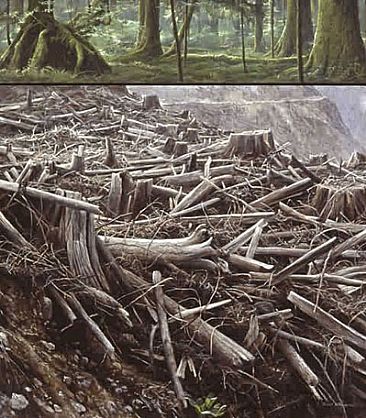
You will be seeing a lot more Vancouver Island clear cuts if the BC government has its way. 
Carmanah Contrasts, 1989, Robert Bateman

The BC Liberal government has never seen a tree that it didn't want to cut or give away to their business buddies. Now, the bad news for our forests continues.

With our provincial government's continued giveaway of our public forests to corporate entities, how does a dedicated tree-lover find the time to enjoy what is obviously slipping out of our control? 

If we could get a break from this relentless assault on public forests we might be able to actually get out there and enjoy them before they are gone. 

Recently revealed is that our nefarious government plans, according to Canadian Centre for Policy Alternatives analyst Ben Parfitt writing in Sunday's Province, to:

"introduce a scant two-paragraph bill granting it powers to fundamentally alter the course of forestry in B.C.

"...the bill would give the provincial cabinet powers to grant forest companies de facto private control over public forestlands without first having to notify or consult with the public.

Instead of companies enjoying rights to log set volumes of trees on public forestlands, companies would gain dramatically expanded powers to log trees on defined areas that in effect become their own semi-private fiefdoms.


"...the provincial cabinet could grant forest companies the rights to roll over numerous volume-based forest licences into area-based Tree Farm Licences. TFLs bestow by far the most secure rights of access to publicly owned trees of any arrangement with the provincial government. The new legislation could massively expand their use, beyond the limited number now issued.


"...various government documents were leaked indicating that the provincial government was revisiting a controversial “rollover” idea first pursued 25 years ago. At that time it met with such a groundswell of political and public opposition that the initiative was scuttled.

Then-provincial forest critic and MLA for Prince Rupert, Dan Miller, called it “privatization on a massive scale” and warned: “Never before in the history of the province has this kind of giveaway been contemplated.”

The policy as then envisioned is precisely the one now being contemplated by the... Minister of Forests, Lands and Natural Resource Operations Steve Thomson.

"...giving what remains of our forests away is lunacy. A responsible government would delay implementing such contentious legislation and give the public time to digest the implications of such a move. Or the Opposition could signal now that should such a bill pass it would be immediately repealed upon a change in government."


Read more here.

Enough! It is time to let our pro-corporate, anti-environmental 'leaders' that we want responsible stewardship of our resources NOW!

Stop the further privatization of our public forestry resources. Everything is linked and interdependent. When trees die, people die. 


1/24/2013

Services Provided By Intact Old Growth Forests

We convert high quality old growth forests into low quality, over-sized houses

It is true that different people see the same tree in quite different ways.

The logging industry views old growth trees as a cheap source of valuable timber that will maximize their profits. From a business point of view it would be best to log 100% of old growth, then when the low cost, high grade timber is gone, move on to younger forests.

While investors and the BC government may prefer this view, it is one that fails in all other regards. What about those that see the forest as pristine nature to be protected for all time? What about all the creatures that see the forest as home?

Never calculated in the decision whether to cut or not cut our degraded primal forests, are the valuable services provided by healthy, intact trees and forests. The price of the trees from a clear cut can be accurately calculated, but what price tag do we put on the services provided by leaving the old growth standing?

We know the price of the trees, but know very little about their value.

Services Provided By Intact Old Growth Forests
William J. Reed, 1992

"The value of standing old-growth forest comprises many components. Old-growth forest can provide positive amenity services such as one or more of the following:

  1. a locus for recreational and tourism activities
  2. a habitat for wildlife
  3. a generator of oxygen
  4. an environmental sink for carbon
  5. a regulator of water flow
  6. a repository of genetic diversity
  7. a regulator of local and even possibly global climate

In addition many people are coming to recognize that old-growth has an intrinsic existence value (apart from the 'use' values listed above), simply because it is a part of a vanishing pristine Nature. Like diamonds or any other economic good it has value simply because it is simultaneously wanted and scarce."


Because of our massive miscalculation of the value of protected primal forests, we end up liquidating a high value resource that could continue delivering services we need, in a self-sustaining manner for centuries. 

We trade these irreplaceable services for low value products like cheap homes unlikely to last longer than a few decades.

If we continue on our present path we will fail to appreciate the true value of old growth until it is gone.  The price we will pay is too high.

Everyone will suffer, including the logging industry, governments, and investors.