Showing posts with label big trees. Show all posts

7/14/2025

The Big Trees of Vancouver Island


Giant Sequoia in Victoria's Beacon Hill Park


Welcome to Vancouver Island Big Trees.

The best way to learn about trees is to hang out with trees. People that take time to see the trees will also take the time to save them. That is why I am sharing the following list of some of my favourite places to see big trees. 

Because I used to live in Sooke, BC, the list leans more toward south Vancouver Island locations, and trees that are easily accessed by car. 

Many of these trees are hundreds of years old - some well over 1000. You may feel little (and brief) standing in the presence of such size and antiquity. 

Click on highlighted titles to link to more information.

Do you have a favorite big tree location? Please share it in the comments below.


Goldstream Park near Victoria - Upper Goldstream River runs through old growth trees


Victoria Area

Native Tree Species


    1.    Francis/King Regional Park (some of the biggest trees closest to Victoria, including one on the B.C. Big Tree Registry - largest Douglas-fir in the CRD)
    2.    Beacon Hill Park (designated Heritage Tree Status)
    3.    Thetis Lake (Hiking trails link Thetis and Francis/King parks)
Adrmore's Th-Kuat Tree
1100 years old, 110 feet tall
    4.    Royal Roads/DND Lands (Urban big trees in Colwood, including the 2nd and 3rd largest Douglas-firs in the CRD)
    5.    Goldstream Park (very accessible old growth 16 km from downtown Victoria)
    6.    East Sooke Road/East Sooke Park (along East Sooke Rd. is one of the biggest Western red-cedars in the CRD)
   7.     Ardmore Golf Course (North Saanich - massive Douglas-firs up 1100 years old. This link is to the golf course web page - scroll to the bottom to read about their Th-Kuat Tree, a massive Douglas-fir guarding the third tee of the course.)
   8.    Witty's Lagoon Beach parking lot (Metchosin)
   9.    Royal Colwood Golf Club (has the most extensive collection of varied-age Douglas-fir and Garry oak forest in an urban setting)
10.    Victoria Area Arbutus (Arbutus are coast-hugging, broad-leafed, evergreen trees. They are abundant in parks and urban areas. The largest is found on Thetis, one of the Gulf Islands)


Non-native Tree Species

   1. Beacon Hill Park (Heritage Tree Site: many exotic trees such as Giant sequoia)
   2. Victoria Area (Urban Giant sequoia of huge proportions)


500 year old Douglas-fir on Royal Colwood Golf Course


Sooke Area

    1.    Sooke River Road/Galloping Goose Trail (scattered big trees)
    2.    Sooke Potholes Park  
    3.    Sunriver Park  (Phillips Road)
    3.    Matheson Lake Regional Park
    4.    Humpback Road (Langford)
    5.    Muir Creek (threatened by logging) - west of Sooke
    6.    Roche Cove Regional Park (the map in this post has directions to big Douglas-fir and Arbutus in a shore line area of this beautiful park)
    7.    Juan de Fuca Provincial Park - China Beach 
    8.   French Beach - nice, older second growth forest with lots of Sitka spruce
    9.   Chin Beach Trail Lone Cedar - grows on the Juan de Fuca Rural Resource Lands west of Sooke, 13 km past China Beach parking lot. 


Eagles need old growth trees for perching and nesting


Port Renfrew Area 


Avatar Grove
      
    1.    Avatar Grove (once threatened by logging, but now saved due to the efforts of Ancient Forest Alliance and big tree supporters)
    2.    Red Creek Fir (Champion tree - largest Douglas fir in Canada, not protected)
    3.    San Juan Bridge Spruce - (Champion tree - former largest volume Sitka Spruce in Canada until the top blew off, not protected)
    4. Juan de Fuca Provincial Park (smatterings of remnant old growth can be found in different areas of the park)

    5.    Loss Creek (has an old growth grove of Stika spruce)
    6.   Harris Creek Spruce (short walk off logging road, not protected)
    7.   Chester's Grove/Lens Creek Trail (huge Sitka spruce, Western redcedar, Western hemlock, and record-sized Black cottonwood, beside the San Juan river) 


Pacific Rim National Park


Other Areas

    1.    Carmanah/Walbran Provincial Park (Largest Sitka spruce: West Walbran Creek, Tallest Sitka spruce, Caramanah Creek) 
    2.    Pacific Rim National Park/West Coast Trail
    3.    Cathedral Grove (one of the most accessible stands of giant trees on the island)
    4.    Clayoquot Arm/Clayoquot Plateau Provincial Park
    5.    Clayoquot Arm Beach Forestry Site
    6.    Flores Island Provincial Park
    7.    Rathtrevor Beach Provincial Park (Parksville) - contains towering old growth trees.
    8.    Cheewhat Cedar (Champion tree - largest tree in Canada, largest Western red cedar, protected within Pacific Rim National Park)
    9.    Koksilah River Provincial Park
   10.   Brooks Peninsula (this remote and mysterious area contains the largest diameter Sitka spruce in the world, plus a host of other potential record breakers, some protected areas)
   11.    South Vancouver Island is a good place to see Arbutus in a variety of coastal locations. 


Enjoy the trees. Then, save the trees.


Thanks for visiting the Vancouver Island Big Trees blog.


2/10/2024

Forests For Life


If we are looking for effective carbon sequestration, never mind feeble and overpriced industrial solutions. We need to look at a real leader in the sector.


I am referring to forests. 


Home to about 80% of the world's biodiversity, forests are collectively the second biggest storehouse of carbon after oceans, absorbing significant amounts of greenhouse gases. 


They also enhance biodiversity, while protecting waterways, enhancing soil nutrition, and providing buffers from natural disasters.


All of that, and they are beautiful places to live or visit. How dull life would be without trees and forests. And how different life would be. 


Some believe that civilization would have been impossible without trees. 


How sad it would be if we destroyed all the primal/old growth forests of the world, a task that is frighteningly close to completion.


Not only are such forests living history books, but they are also carbon sinks that rival any kind of expensive human solution in industrial sequestration.


Once those forests are gone, they will take centuries, eons in some cases, to replace. And for what? A few jobs and temporary profits. 


How sad. 


Considering their importance, we should show trees and forests respect and gratitude more often.


We should also do everything within our power to protect what little old growth that is left. It is those ancient forests that absorb and hold the most carbon, if that is to be one of our goals.


Protect forests and we retain one of our best ways of mitigating our effects on the atmosphere.


Trees are our friends. Forests for life.


12/19/2021

More Tree Advocates Needed


"Every tree has its enemy, few have an advocate. In all my works I take the part of trees against all their enemies."

- JRR Tolkien


With the state of our forests in Canada and around the globe, we could use more tree advocates. 


There are many today who are doing a wonderful job of protecting the old growth for future generations to enjoy, and I thank them all from the depths of my tree-loving heart. 


But they need our help, and they need it soon.


The world needs all of us to advocate for the trees. Because they can't advocate for themselves.


The big trees have their enemies that must be stopped. Consider becoming an advocate before all the old growth is gone.


8/22/2020

Standing Up For Big Trees In Fairy Creek Valley


"If you wanna see real change, you're gonna have to stand up for it."

- Old growth protector at roadblock camp


Old growth forest protectors are standing up for big trees near Port Renfrew (Big Tree Capital of Canada) and blockading the construction of new logging roads into Fairy Creek Valley, the last pristine valley outside of a park on southern Vancouver Island.

In a saner world we would not allow the destruction of such a treasure on Vancouver Island's south coast. But we don't live in a sane world. 

Yet. 

When those that work for us in government fail in their responsibility to protect what is collectively ours, it is up to us to be the real stewards of the land, and protect its inherent right to be. 

If our public servants in government won't speak for a voiceless and defenceless nature, we have to.

Case in point is what is happening outside of Port Renfrew, town to an area long known for its (disappearing) big trees. There, just a few kilometres outside of town, Teal Jones is hacking through previously unhacked forest on their way to get to a pristine valley of big, ancient trees. 

The valley contains an ancient forest that has existed, relatively unchanged, since the last ice age, 10,000 years ago. It is a unique, irreplaceable ecosystem.

Some of the ancient yellow cedars there could be upwards of 2000 years old. 

Cutting trees that old in 2020, when we know better, should be an obvious crime against nature, and all around excellent example of the ongoing ecocide currently plaguing our planet.

Show me nature that has been preserved and protected from industrial butchery, and I will show you a scrappy, dedicated group of caring people that put their bodies on the line to do what is right.

It was such citizen groups dedicated to direct action that saved places like Clayoquot, Elaho, Stein Valley, Carmanah, Strathcona Park, and so many more beautiful places.

Respect, and a heartfelt thanks, to everyone on the Fairy Valley logging road blockades.

We appreciate you standing up for some of the last remaining old growth on south Vancouver Island. 

We support you 100%.


4/14/2019

400 + Foot Douglas Fir Trees More Than Mythical


Some articles you read on historical big trees in Cascadia's region talk about the biggest of the big (the +400 footers) in mythical terms, as if they were no more than loggers tall tales. 

But big tree people know differently - the huge Douglas fir trees existed. What a shame that they don't any more. As far as we currently know...


3/02/2019

The Man Who Saved Big Lonely Doug

Dennis Cronin standing in front of the giant tree he saved.
Photo credit: Lorraine Cronin

In 2014, just as I was moving from Vancouver Island, BC to Nova Scotia, the tree which has become to be known as Big Lonely Doug was discovered by big tree protectors in a former stand of old growth not far from Port Renfrew. 

The giant Douglas fir tree was not hard to find - it was the only tree left in a clear cut block that used to be an ancient grove, and it was hard to miss.


As it turns out, the tree still stands due to the efforts of Mr. Cronin, an industry engineer, that may have been the first person to ever see it. 


To read the fascinating story of how this amazing specimen, the second largest fir in Canada, was saved, click here.


The only Douglas fir tree larger is the Red Creek Fir. This is another significant tree that was also destined for destruction, but was preserved by a logging crew that could not bring themselves to cut such a gigantic tree down.


There goes the neighbourhood.
This is why Big Lonely Doug is so lonely. 
But, better lonely than dead.
Photo credit: TJ Watt

I have never seen the tree that Dennis Cronin, who after decades in the woods and marking untold numbers of giant Pacific Forest trees for removal, decided to save. But the next time I am in Canada's big tree country again, I will.

And when I do, I will think about the man who chose to save Big Lonely Doug, one of the tallest trees (70.2 metres, 230 ft - the height of an 21 story building) he had ever seen, and I will give thanks for his decision.


On a final note, Mr. Cronin died shortly after retiring from his forestry job. By that time he could see that the end of the big trees had come. 


Perhaps his signature tree was one small (or big, depending on how you look at it) way of making amends.


Click here to see the Ancient Forest Alliance Big Trees Map "created with driving directions to Avatar Grove (home to Canada’s “Gnarliest Tree”), Big Lonely Doug (Canada’s 2nd largest Douglas-fir), the Red Creek Fir (the world’s largest Douglas-fir tree), San Juan Spruce (one of Canada’s largest spruce trees), Harris Creek Spruce (another giant sitka spruce), and more!"

2/15/2019

Big Trees + Big Wind = Power Outages and Crushed Cars

After a fierce winter storm I toured Sooke, BC to assess the damage. It was extensive.


The west coast has had its share of gnarly weather this winter, with vast and prolonged power outages. And probably more than a few crushed vehicles.

It reminds me of when I was living on Billing Spit in Sooke, BC. It was there, on the top floor of an older 3 floor waterfront apartment building, that I experienced one of the scariest weather events of my life.


A December wind storm hit just before Christmas. With gusts over 100km, the storm initially woke me up as my bed, and the whole building, was shaking. 


The air pressure had blown all the water out of the sink drain traps in our apartment, and the air rushing through the pipes was making a wailing sound like I have never heard before, or since.


My wife and I retrieved our Bug Out Bags, and set them by the front door. We were ready to evacuate and seek shelter somewhere safer. Preferably, somewhere where there weren't waves crashing over the sea wall and spraying on to our front balcony.


We looked out our back window to see our building caretaker fighting off a large piece of vinyl siding wrapped around him, threatening to launch him into the dark night sky.


In the end, we rode out the storm in our shaking and vibrating unit. Escape was impossible, unless we left on foot, since there were large trees down everywhere, including in our parking lot. 


The next morning, when the wind subsided, I went out to see that the roof of the twin building next door ripped completely off, and landed in the parking lot behind the building. Our neighbours were homeless for weeks until repairs were completed.


We were all without power for almost a week.


Our roof stayed put, perhaps due to the fact that our building, unlike the one next door, had large trees protecting it. 


The big trees giveth, the big trees taketh away. 


But I love them all the same.


12/25/2018

Big Coastal Christmas Trees

One of the big conifers in the distance is decorated with two bald eagles at the top
Note: originally posted December 18, 2011.

I went for a walk today to look for Christmas and it was nowhere to be seen. There was no snow or hanging icicles, and it was sunny and a balmy +9 degrees Celsius. However, we do have some of the largest Christmas trees in the world growing here, and I discovered some nice ones.

Conifers are the traditional Christmas trees of choice, and the Pacific coastal forest is dominated by conifers. Douglas-fir is the second most popular Christmas tree sold in North America. Young trees have a nice conical shape, and the needles are sweet smelling when crushed. But if you like your trees big, and alive, this is the place to see them. We are at the edge of coastal Douglas-fir territory in Sooke.

The biggest Douglas-fir in the world grows near here in the woods close to Port Renfrew. You would need a lot of tinsel for that behemoth, which is 73.8m (242') in height, 13.3m (43.7') in circumference, and 4.2m (14') in diameter. But I wasn't looking in Port Renfrew for big trees as I wanted to stick closer to home.

Big Sitka spruce overlooking beach
The place I went exploring for giant conifers was in the Wiffen Spit neighbourhood. There I found a right of way leading to a set of stairs down to the beach. It is a great place to see big trees on the top of the high banks, as well as those that have fallen below or washed in off the Strait of Juan de Fuca.

We celebrate trees and their importance this time of year when we hack one out of the forest and bring it into our homes to dry up and die. Then they are unceremoniously dumped at the curbside. Here in clear cut territory, it seems like an extravagant waste.

If you go without the traditional indoor dead tree this year, and you are in the Sooke region, Wiffin Spit is the place to go to see a live tree that is anonymously decorated every year.

The Wiffin Spit tree is a short hike from the parking lot, and is now the most notable live decorated tree in town since town council grinches gave the green light about a year ago to remove two beautiful, completely healthy heritage Douglas-fir trees right in the center of town. Read about their sad demise here.

Biggest Christmas tree on Vancouver Island until being
unceremoniously cut down by The Grinch
The 150 year old Douglas-fir trees were replaced by two 2m tall exotic Norway spruce. I noticed the other day that one was decorated, but it just doesn't measure up to the giant it replaced.

Happy holidays.

9/07/2018

Moving On

This is my new forest - the Acadian Forest of Nova Scotia.


The Vancouver Island Big Trees blog began as a way to share my experiences visiting some of the biggest trees around Victoria, Sooke and up West Coast Road to Port Renfrew and beyond. I wanted it to be both a celebration of the west coast's primal forests and trees, and a warning that if we don't start fighting for what is left, it will be gone forever.

Even before moving to the Pacific temperate rain forest for a decade, I visited from the prairies annually from the time I was old enough to drive. It was then that I fell in love with walking the beaches and forest trails of Vancouver Island. I found the trees to be huge and magical.

When I started this blog I lived in the midst of big tree country in the former logging town of Sooke, BC. Even after 20 years of exploring the big trees, I was still mystified how a human that would be lucky to get 100 years, could destroy a tree 1000s of years old.

Over this time I have been rewarded by ancient tree encounters that were life changing, as well as encounters with the ugly side of industrial liquidation and government neglect, that were equally as moving.

I have since moved to my new forest, and one that is perhaps not as tall, but every bit as magical - the Acadian forest of Nova Scotia. They are smaller, but there are big trees here, too. And the diversity of trees in this forest is an amazing thing that will keep me busy learning for years to come.

Nova Scotian forests are also under relentless assault from industrial, profit-minded businesses that don't care if they are destroying an entity that has been living and thriving since the last ice age. It is too bad, because in Canada this forest is every bit as unique as the great Western Rainforest of Vancouver Island.

This is not boreal forest (the largest intact forest left on our planet... for now). It is not the great deciduous forest of the southern USA. This forest is a unique blend of both, and I intend on exploring it every bit as much as I did the forest out west.

Having said that, I do like to keep up on what is happening in the west coast forest, and plan on doing the occasional post on this blog as well. In the meantime, I hike and photograph the Acadian Forest looking for the biggest of the big trees out here.

You can visit my new blog, "Acadian Forest Big Trees" here. I hope to add to it and develop the same following this blog has had since 2009. Thank you to everyone that has made keeping this blog so satisfying. Your interest, and visits, are appreciated.

Long live the big trees, wherever they may be.


10/17/2015

Sooke River Bridge Candelabra Tree Now Gone

When some trees lose their tops they will grow multiple stems in a candelabra effect.

A reader of Vancouver Island Big Trees sent me an email recently. It reminded me of all the big trees that have been (and will be) sentenced to death for the crime of being in the way of progress.

Unless you live on the prairies, any kind of new development means trees and forests need to be cleared out of the way.

Ever since Europeans arrived in this part of the world "progress" has the ring of axes, chainsaws, and big trees hitting the dirt.

One such example was when the Sooke River Bridge was replaced in 1967. An interesting tree, it looks like it had been pruned or lost its top. The candelabra that results can be seen in a variety of tree species.

The email I received contained the short message that follows, and the photo shown above.

"Your pencil sketch of the Sooke River Bridge on your Vancouver Island Big Trees blog reminded me of a unique tree that was removed to make way for the building of that bridge. 
The bridge was built around 1965 to replace a wooden one that was a few feet downstream. The tree was on the east bank of the river, right in the way of  the project, and had to go. 
I don't know who owned the house in the photo but I suspect the tree artist lived there. Or maybe BC Hydro was responsible! 
Not sure what species of tree it was, maybe a true fir (Abies) of some kind. Photo taken by me in December, 1964."


Thank you, Art, for sharing your historical big tree photo with us.

5/08/2015

Wisdom Of The Trees

Visiting an increasingly rare 1000+ year old Western Red Cedar along West Coast Road
between Sooke and Port Renfrew.


"Because they are primeval, because they outlive us, because they are fixed, trees seem to emanate a sense of permanence.  And though rooted in earth, they seem to touch the sky.  

For these reasons it is natural to feel we might learn wisdom from them, to haunt about them with the idea that if we could only read their silent riddle rightly we should learn some secret vital to our own lives." 
- Kim Taplin

Find out more about the tree shown above, and how to get to it, on my post about the Chin Beach trail cedar. Enjoy the big trees while they last.

12/24/2014

Al Carder: Big Tree Defender Honoured By AFA

Al Carder - big tree lover and protector.
When it comes to promoting the beauty of big trees, there are few humans as influential as Al Carder.
It was great to see this big tree hero honoured recently. Al Carder, long a big tree lover and protector, was acknowledged for his work by The Ancient Forest Alliance. Call it an early Christmas present.

Al, author of "Forest Giants of The World: Past and Present" and "Giant Trees of Western America and The World" is as old and wise as some of the trees he has written about.

After personally discovering his books he became one of my big tree heroes. I mean, how many people do you know that go on global tree tours in their retirement, then write books about the experience upon arriving home? Who knows how many trees he has brought attention to, and thus saved for future generations to see?

Mr. Carder was largely responsible for the preservation of Port Renfrew's Red Creek Fir (largest known Douglas fir in the world) after it was discovered by timber industry workers in 1976. If not for him I, and many others, may never have seen this majestic tree.

If you haven't caught the tree bug yet, I urge you to go to the nearest public library and check out Al's books. If you aren't a convert afterwards perhaps clear cuts are more to your liking, because that is what happens when we forget to love the trees.

Thank you Mr. Carder for sharing your love and passion for our primal trees and forests with all the world.

Congratulations on your AFA Sustainability Award.

8/02/2014

West Coast Big Trees - Spectacular, Unique and Disappearing

There are not many places in the world that have trees as spectacular as those on BC's west coast.
This photo from the local museum supposedly depicts Sooke's Grant Road in the 1940's.

There are a lot of trees between Sooke, BC and the Anappolis Valley of Nova Scotia. A lot. All of them are beautiful in their own way, but few are as spectacular as those in the Pacific temperate rain forest that I just left behind.

Whether we are talking historically or present day, the Pacific rainforest is unique and spectacular. While I look forward to exploring and learning about my new NS forest, I miss the biggest trees in Canada already.

Too bad British Columbia has no idea of what they've got, and what they are currently losing at an alarming rate. If they did, they would be out in the streets, up logging roads, and chained to the last ancient giants before rapacious profiteers carry the last trees and profits away.

So many big trees have been taken already that people can hardly believe the size of the trees in historical photographs. While they may be gone from places like Grant Road, such trees exist in isolated pockets all along the coast.

There are lots of trees in Canada, but surely we should be saving the biggest and rarest of these that call the rainforest home.

6/09/2014

Big Lonely Doug A Big Climb

Tree climbers on the first ascent of Big Lonely Doug near Port Renfrew.

How do you climb the 66 meters (216 ft) of the recently discovered second largest (known) Douglas fir tree in Canada?

Very carefully.


Tiny people give scale to the enormity of this amazing tree.

Why do you climb a tree like Big Lonely Doug?

To raise awareness of Vancouver Island's vanishing old growth trees and forests.


Climbers descended with samples of soil and moss from the tree's canopy. It is possible
that the samples may contain insects completely new to science.

British Columbia’s threatened old-growth forests are being logged to extinction by industrial logging aided by lax government regulation. But many people, including those in the former logging town of Port Renfrew, realize that trees like the Red Creek Fir and Big Lonely Doug are more valuable standing than cut down.

On Vancouver Island about 75% of the original productive old-growth forests have already been logged, including 90% of the valley bottoms where the richest biodiversity and biggest trees are found.

Once gone, the big trees and primal forests will never be seen again. What a wasted opportunity.

Read more about the first ascent of Big Doug here.

Join the fight to preserve these unique trees by writing a letter here.

5/18/2014

What Is A Tree Worth?

Amrita Devi and her daughters gave their lives to protect trees near their Rajasthan home
in a confrontation with tree cutters in 1730AD. The Bishnois people are consider
among the earliest conservationists in the world.

An older tree is worth at least $200,000 - alive. That is the estimate made by a scientist in India, a country known for protecting precious forest resources.

The Indian Chipko activists were the original tree-huggers, risking their own lives to save the lives of valuable trees. I am sure the scientist would agree that the trees are worth the risks brave defenders take.

According to T.M. Das, a professor at the University of Calcutta, a living tree 50 years old will generate:

  • $31,250 dollars worth of oxygen, 
  • provide $62,000 worth of air pollution control, 
  • control soil erosion and increase soil fertility to the tune of $31,250
  • recycle $37,500 dollars worth of water, and 
  • provide a home for animals worth $31,250.

This figure does not include the value of nuts, fruits, wood products like lumber, or the beauty derived from trees.

If a 50 year old tree is worth $200,000 dollars, how about a 500 year old tree? A 2,000 year old tree? A whole forest of old growth trees?

They are priceless.

The professor's work highlights more reasons to ensure the health of our forests now and for the future. Old growth trees are worth hugging, and their forests worth protecting.


"We have risen, we are awake: No longer will thieves rule our destiny. 
It is our home, our forests; No longer will the others decide for us. 
Soil ours, water ours, ours are these forests too."
- Dhan Singh Rana, Indian Chipko Movement

5/05/2014

A Few Favourite Tree Friends

This ancient cedar is on one of my favourite bike rides along the Sooke River. These
trees are hard to age, but this one could be pushing 1000.

We initially moved to the rainforest from the city to be surrounded by wilderness, to experience a landscape and everything living in it more than we ever had before. We gave ourselves time to explore and followed every little whim.

Because of this mandate we have made friends with a lot of trees.

Here are a few of the gentle giants that we have had the privilege of visiting.


This large Douglas-fir is in Devonian Park, Metchosin. There are a few older trees here, and
access to the beach and ocean below.


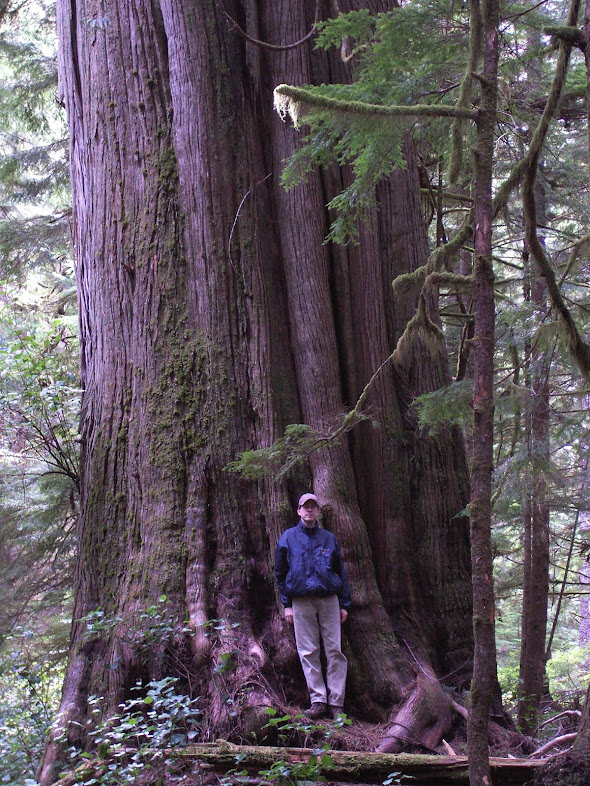
This is the largest tree I have stood next to in my nine years of tramping through the forest
searching for the big ones. Western red cedar like this one could live for thousands of years.
Yes, thousands.


This old growth Sitka spruce is on a trail leading to China Beach. All along the coast the
last holdouts of the primeval 10,000 year old forest hang on… for now.


4/11/2014

Witty Beach Road Trail Closure


Two large Douglas-fir trees greet visitors to the parking lot at the end
of Witty Beach Road in Metchosin, BC.

Following the short, but scenic Witty Beach Road in the rural Vancouver Island community of Metchosin, takes you to a small parking lot by the ocean. For most people the beach is the destination, and a beautiful one it is, but there are other attractions.


While beach access from this spot has been restricted recently by a closed set of crumbling stairs, my favourite features remain - two large, old Douglas-fir that dominate the area.


Witty Beach can still be accessed via the main parking lot
 at Witty's Lagoon Regional Park.


Access stairs in better times. The steep slope they were
anchored on is unstable.


There are not many big Douglas-fir left, let alone ones you
can drive right up to like these.
Officials are uncertain as to when the beach access at Witty Beach Road will reopen. For the time being it is worth a drive to visit the trees before going to the main parking lot down the road to access the beach.

3/18/2014

Beginner Bracket Fungus

I was fascinated by these fungal forms on a recent hike. It looks like the start of bracket fungus.


Yes, the big trees in the rainforest are of truly epic proportions. But just as fascinating are the smaller things that live among (and on) the giants. The varieties of fungal life in the forest provides an example of smaller life forms that make this ecosystem work.

Bracket fungus, or shelf fungus as it is also known, is a common sight in the Pacific rainforest.


Here the smears of fungus are developing the bracket seen in the more mature form.


Bracket fungus can be found on standing and fallen trees. If the tree is not already dead, bracket fungus can get so large as to kill the tree.

I have seen large specimens, but have never noticed small ones, or noticed how they start out.


Several small bracket fungus hiding in the moss growing on a dead red alder.

Fungus and other decomposers are important parts of the nutrient cycle in the rain forest, and act as Nature's recyclers. If they couldn't do their job (as is happening around the Chernobyl NPP), the system would cease to function properly.


12/14/2013

"Emily Carr: Deep Forest" At Vancouver Art Gallery

A Rushing Sea of Undergrowth, Emily Carr, 1932-35.

This weekend is a celebration of Emily Carr's 142nd birthday. The local artist was born in Victoria on December 13th, 1871.

Emily Carr was a friend of Vancouver Island's forests. Throughout her life she sought to plumb their mossy green depths to hopefully some day say she really knew this magnificent ecosystem.

Her paintings document her quest to learn as much from the Victoria area's big trees as she could, then depict that in her images.

“This perhaps is the way to find that thing I long for: go into the woods alone and look at the earth crowded in growth, new and old bursting from their strong roots hidden in the silent, live ground, each seed according to its own kind expanding, bursting, pushing its way upward towards the light and air, each one knowing what to do, each one demanding its own rights on the earth. Feel this growth, the surging upwards, this expansion, the pulsing life, all working with the same idea…life, life, life…”
From "Hundreds and Thousands: The Journals of Emily Carr." 


Soon you will be able to experience Carr's vision in a new exhibit of her work. "Emily Carr: Deep Forest" at the Vancouver Art Gallery will exhibit over 40 paintings starting December 21, 2013.

Most of the paintings are scenes within 25 km of Carr's home near Victoria, and were completed in the 1930s.


Scorned as Timber Beloved of the Sky, Emily Carr, 1935.


After a trip to view the exhibit, one can get first hand exposure to some of the same forests that the artist enjoyed on the south island. While vastly altered, the green fuse still drives growth and the trees still pulse with life.

"I glory in our wonderful west and I hope to leave behind me some of the relics of its first primitive greatness. These things should be to us Canadians what the ancient Briton's relics are to the English. 
Only a few more years and they will be gone forever into silent nothingness and I would gather my collection together before they are forever past."

One can visit the forest here and be surrounded by the power of nature that so gripped Emily Carr. The natural power of trees that kept her mesmerized is still to be found.

But how long before a trip to the trees yields a vast "silent nothingness"?