Showing posts with label logging. Show all posts

11/30/2021

BC Floods and Clearcut Logging


The discussion following record-breaking rains and floods in British Columbia include speculation about the effects of fires.


We should also be wondering about the effects of unprecedented levels of damaging logging practices.


In the future, will logging companies be sued for their negligence?


Water Logged | new ending from Ramshackle Pictures on Vimeo.

8/22/2020

Standing Up For Big Trees In Fairy Creek Valley


"If you wanna see real change, you're gonna have to stand up for it."

- Old growth protector at roadblock camp


Old growth forest protectors are standing up for big trees near Port Renfrew (Big Tree Capital of Canada) and blockading the construction of new logging roads into Fairy Creek Valley, the last pristine valley outside of a park on southern Vancouver Island.

In a saner world we would not allow the destruction of such a treasure on Vancouver Island's south coast. But we don't live in a sane world. 

Yet. 

When those that work for us in government fail in their responsibility to protect what is collectively ours, it is up to us to be the real stewards of the land, and protect its inherent right to be. 

If our public servants in government won't speak for a voiceless and defenceless nature, we have to.

Case in point is what is happening outside of Port Renfrew, town to an area long known for its (disappearing) big trees. There, just a few kilometres outside of town, Teal Jones is hacking through previously unhacked forest on their way to get to a pristine valley of big, ancient trees. 

The valley contains an ancient forest that has existed, relatively unchanged, since the last ice age, 10,000 years ago. It is a unique, irreplaceable ecosystem.

Some of the ancient yellow cedars there could be upwards of 2000 years old. 

Cutting trees that old in 2020, when we know better, should be an obvious crime against nature, and all around excellent example of the ongoing ecocide currently plaguing our planet.

Show me nature that has been preserved and protected from industrial butchery, and I will show you a scrappy, dedicated group of caring people that put their bodies on the line to do what is right.

It was such citizen groups dedicated to direct action that saved places like Clayoquot, Elaho, Stein Valley, Carmanah, Strathcona Park, and so many more beautiful places.

Respect, and a heartfelt thanks, to everyone on the Fairy Valley logging road blockades.

We appreciate you standing up for some of the last remaining old growth on south Vancouver Island. 

We support you 100%.


4/14/2019

400 + Foot Douglas Fir Trees More Than Mythical


Some articles you read on historical big trees in Cascadia's region talk about the biggest of the big (the +400 footers) in mythical terms, as if they were no more than loggers tall tales. 

But big tree people know differently - the huge Douglas fir trees existed. What a shame that they don't any more. As far as we currently know...


3/20/2018

Killing Ancient Trees Until They Are All Gone

You have to work hard to bring down an ancient red cedar that has been standing
in the primal forest for a thousand years, or more.


I found the photo above on a friend's Facebook account. It reportedly depicted a logging incident sometime recently on Vancouver Island. 

Like so much on social media, one can not be sure of what one is seeing. Is it one tree, or two? Even if it two, these represent large, old trees, the likes of which are disappearing in our coastal temperate forests.

Upon doing a bit of research, I found information that lent some credibility to this photo and the time in which is was taken. I hoped that it was a photo from decades ago when we were less enlightened. Maybe it is.

But the fact of the matter is that B.C.'s old growth trees, most of which are massive and ancient, continue to be cut down. When these trees go, so goes the health of the forest ecosystem.

When do we stop? Is the plan to cut all old growth down, for the profit of Wall Street hedge funds? What will the logging industry do then? 

Whatever they plan on doing when the old growth is driven to extinction, should be done now. BEFORE all the big, old trees are gone.

At this point, all remaining old growth forests on Vancouver Island and the B.C. mainland are worth much more left standing than they are by cutting them down. People want to see these magical forests. There is no such thing as a magical clearcut.

If we allow corporate logging interests to kill the ancient trees until they are all gone, B.C., and the world, will be at a great loss. Our ancestors will wonder what was wrong with us, and why we allowed such beautiful living things to be liquidated.


2/08/2015

BC Exporting Record Amount Of Raw Logs (And Jobs)

“Growing up in small-town Vancouver Island, I never met anyone who agreed with raw log exports. Even my most conservative, pro-extraction relatives froth with anger at the mere mention of this practice.”  
- Torrance Coste

The following is from Northern Insight/Perceptivity - March 14, 2012
In the last year, the Pacific Northwest (BC, WA, OR) exported well more than $1 billion worth of raw softwood logs to China. Shipments for 2011 were more than in the preceding five years combined. 
Increased demand for logs might be great for the logging industry, but it results in closures and layoffs at sawmills and other wood processing facilities. 
A few corporations do well harvesting logs in British Columbia but, without subsequent processing, many service and supply businesses that serve the industry are starving. We are not merely shipping logs to China; we are exporting jobs that ensured our own prosperity. 
BC government policy once allowed only for export of logs surplus to local needs. They still make the claim but, from the time Gordon Campbell's Liberals took power in 2001, raw log exports soared. 


Political and economic pressures prevent BC mills from interfering with overseas shipments. One of the province's largest sawmill operators told a public meeting that he was pressured to NOT bid on logs slated for export even though his mills were critically short of fibre. 
BC sends trade missions to China to sell more unprocessed logs while people in small communities all over the province witness the closure of sawmills and other wood manufacturers. 
When the last BC mill closes, will we be able to afford finished lumber to build our homes? Actually, the plutocracy has an answer for that: "Home ownership is an unrealistic dream of today's young people." 

See much more on raw log exports (and many other things of interest to British Columbians and other concerned Canadians) at the Northern Insight/Perceptivity Blog lovingly researched and written by super-citizen Norm Farrell.

Read Terrance Coste's recent article concerning BC's troubling raw log export addiction on the Tyee website.

3/23/2014

Canada's 2nd Biggest Douglas-fir Tree Identified in Recent Clear Cut

Big Lonely Doug, the second largest known Douglas-fir tree in Canada.
Photo by TJ Watt


The second largest known Douglas-fir tree in Canada was recently discovered by big tree defenders on Vancouver Island. Named "Big Lonely Doug" by the Ancient Forest Alliance members that found it, this magnificent tree has been left stranded in the middle of a 2012 clear cut by forest liquidators Teal-Jones.

But don't be distressed by the sad scenes depicted in TJ Watt's amazing photos of this notable tree that had a close brush with death in 2012, or its surroundings. Teal-Jones, the logging company that share the responsibility for this tragic mess with negligent MLAs in the BC Liberal Party, assure us on their website that

"There is virtually no waste in manufacturing wood products".


Thank goodness people like those at Ancient Forest Alliance are out doing the work in the woods to try and stop the waste, not to mention the extinction of the primal forests that remain on Vancouver Island.

If you want to help them help us, please consider donating to this worthy organization of hard-working big tree campaigners.


12 meters (39 feet) in circumference or 4 meters (13 feet) in diameter, and 69 meters(226 feet) tall.
Photo by TJ Watt

The following information is from the AFA Facebook page:

Port Renfrew - Conservationists with the Ancient Forest Alliance have found and measured what appears to be Canada’s second largest recorded Douglas-fir tree, nick-named “Big Lonely Doug”, standing by itself in an area clearcut in 2012. 
Preliminary measurements of the tree taken yesterday found it to be about 12 meters (39 feet) in circumference or 4 meters (13 feet) in diameter, and 69 meters(226 feet) tall. Big Lonely Doug is estimated to be about 1000 years old, judging by nearby 8 feet wide Douglas-fir stumps in the same clearcut with growth rings of 500-600 years. 
Big Lonely Doug’s total size comes in just behind the current champion Douglas-fir, the Red Creek Fir, the world’s largest, which grows just one valley over. 
Big Lonely Doug grows in the Gordon River Valley near the coastal town of Port Renfrew on southern Vancouver Island, known as the “Tall Trees Capital” of Canada. It stands on Crown lands in Tree Farm Licence 46 held by the logging company Teal-Jones, in the unceded traditional territory of the Pacheedaht First Nation band. 
The fact that all of the surrounding old-growth trees have been clearcut around such a globally exceptional tree, putting it at risk of being damaged or blown down by wind storms, underscores the urgency for new provincial laws to protect BC’s largest trees, monumental groves, and endangered old-growth ecosystems. 
The days of colossal trees like these are quickly coming to an end as the timber industry cherry-picks the last unprotected, valley-bottom, lower elevation ancient stands in southern BC where giants like this grow.


It will take a thousand years or more to replace this clear cut old growth forest.
Photo by TJ Watt


Vancouver Observer - Canada's 2nd Largest Douglas-fir Found: "The vast majority of BC's remaining old-growth forests are at higher elevations, on rocky sites, and in bogs where the trees are much smaller and in many cases have low to no commercial value. 
It's the valley-bottom, low elevation stands where trees like the Big Lonely Doug grow that are incredibly scarce now. 99 per cent of the old-growth Douglas-fir trees on BC's coast have already been logged. 
It's time for the BC government to stop being more enthusiastic about big stumps than big trees, and for them to enact forest policies that protect our last endangered ancient forest ecosystems." 
http://www.vancouverobserver.com/news/canadas-second-largest-douglas-fir-discovered


While trees are a renewable resource, with current logging practices and regulations,
 forests older than about 80 years are not. 
Photo by TJ Watt

"...while trees are harvested the effects are only short term as reforestation follows."
- from the Teal-Jones logging company website, that fails to realize that the destruction of thousand year old trees is not a "short term effect".


Witness to the on-going destruction of our ancient forests, with Canada's
 second largest known Douglas-fir in the background. What a magnificent, lonely tree…
Photo by TJ Watt

10/26/2013

Are big-five forest firms about to get a windfall?


Ancient Douglas fir on Juniper Ridge marked for death so Island Timberlands shareholders (including the BC government, Timberland's single largest investor), can realize more profit.
Photo: TJ Watt

Are big-five forest firms about to get a windfall?


From: The Province - Ben Parfitt, October 20, 2013

Shortly before the May election, the provincial government withdrew legislation that could have handed de facto control of publicly owned forestlands to a handful of forest companies.

The contentious sections of the bill were dropped amid a swelling chorus of questions about why such a gift would be bestowed without any debate about what it meant for our shared lands and resources.

It took little time, however, for the government to reverse direction again. During a campaign stop in Burns Lake, Premier Christy Clark said that if re-elected, her government would reintroduce the bill because that is what “the people” wanted.

Given that only weeks earlier the government had pulled the bill from the order papers in response to objections from First Nation leaders, environmental organizations, social-justice advocates and forest professionals, among others, the premier’s choice of words was, to say the least, odd.

What “people” did she refer to? Well, we may soon find out. Following her party’s re-election, the premier instructed Minister of Forests, Lands and Natural Resource Operations Steve Thomson to make the campaign pledge a reality.

A good bet is that the answer lies in understanding who would benefit most from such a change. In that regard, the shareholders of the five largest forest companies operating in the province fit the bill nicely.

Between them, Canadian Forest Products, West Fraser Timber, International Forest Products, Tolko Industries and Western Forest Products control the bulk of what is logged each year in British Columbia. They would control even more under the proposed legislative changes.

To understand what is at stake, it helps to know that outside of parks, virtually every standing tree in B.C. is spoken for, because the province has allocated the rights to log them under numerous licences issued to forest companies, logging contractors, woodlot owners, First Nations and communities.

The most important and valuable of those licences are Tree Farm Licences. Holders of TFLs have exclusive rights to log trees over defined areas of land. Currently, TFL holders log about 11.3 million cubic metres of trees per year (a cubic metre equals one telephone pole). Of that, the top five companies control 9.1 million cubic metres or 80 per cent. TFLs are as close as one gets to private control of public forestlands in B.C.

The next most important licences are forest licences. Forest licence holders have rights to log set numbers of trees over vast landmasses known as Timber Supply Areas or TSAs. But because many different companies may hold forest licences within the same TSA, forest licences have less value than TFLs, which give one company exclusive control over a specific area.

One other essential detail: the most valuable forest licences are “replaceable” or renewable. Far less valuable are non-replaceable forest licences, which are usually issued on a one-off basis to deal with perceived crises such as mountain pine beetle attacks or forest fires. Significantly, the overwhelming number of licences held by First Nations — who are typically on the outside looking in when it comes to benefiting from natural resources in our province — are non-replaceable.

As with TFLs, the top five forest companies hold a virtual monopoly on replaceable forest licences. Two out of every three trees allocated under such licences are theirs.

What the government now proposes in the name of “the people” is to allow the holders of replaceable forest licences to roll such holdings into far more secure TFLs. This could lead to near total control of public forestlands by an exclusive five-member club.

In 2012 and in the lead-up to the 2013 provincial election, that club made $556,020 in political contributions to the Liberal Party and $115,200 to the NDP — big dollars for some, but no more than modest investments for a powerful handful of companies who have a very clear vision of what lies ahead.

Entire TSAs — where trees are in increasingly short supply and where what little timber remains is oversubscribed — are on the cusp of being rolled into TFLs. And the Gang of Five is well positioned to divvy up the spoils.

Left on the sidelines would be First Nations, rural communities, small independent and value-added mill owners — people made poorer to give “the people” what they want.

Whether the government’s second attempt at this legislation will move forward remains to be seen. It has promised a public consultation process of sorts. The voices of opposition were heard loud and clear in the lead-up to the provincial election. This time out, which people will the government listen to?

Read more here: http://blogs.theprovince.com/2013/10/20/ben-parfitt-are-big-five-forest-firms-about-to-get-a-windfall/

Read even more here: http://www.vancouverobserver.com/news/island-timberlands-log-contentious-old-growth-forests-vancouver-island

See much more on continued threats to BC's old growth forests here: http://www.ancientforestalliance.org/news-item.php?ID=705

10/06/2013

Who is watching our public lands?

Illegal tree poaching by individuals - this 800 year old red cedar in Carmanah Walbran
Provincial Park was cut, sectioned, and hauled away for shakes or roof shingles.
Photo: Torrance Coste


Who is watching what is happening in our public lands? Well, if you can cut down and haul away a hugely valuable 800 year old red cedar IN a provincial park, I'd have to say no one is keeping tabs on our public resources.

"I'll tell you what irresponsible is - 10 years ago there were 194 park rangers in British Columbia, there's under 100 now." - NDP Scott Fraser in 2012

In the 2002 Raincoast report "Losing Ground: The decline in fish and wildlife law enforcement capability in B.C. and Alaska," author and wildlife scientist Dr. Brian Horejsi concluded the following:

"Wildlife populations and biological diversity are endangered by chronic underfunding and marginalization of wildlife conservation-oriented enforcement programs in British Columbia and, to a lesser degree, in Alaska. This period of measurable political disinterest and low and declining priority now approaches 20 years in duration. 
There is little evidence available to the British Columbia or Alaska public to indicate that current enforcement capabilities are sufficient to provide effective compliance with fish and wildlife regulations, a problem being aggravated by escalating and uncoordinated land use activities. 
In every capability measure examined, capability today is significantly lower than it has been previously. Enforcement and protection staff are presently unable to effect widespread and long-lasting changes in resource user behavior in either Alaska or B.C. 
While fish and wildlife protection capability in Alaska has slipped...the evidence indicates that B.C. has now crossed the threshold at which protection of fish and wildlife populations and their habitat by enforcement services has effectively and materially been abandoned."

Governments at all levels have abandoned their responsibilities as stewards of our shared public lands. Everything from oil to coal to gold to wildlife and old growth trees is being ruthlessly plundered and poached whether by "legal" or "illegal" means.


Legal tree poaching by corporations - this 800 year old red cedar on King Island, which is in the Great Bear Rainforest, was cut, sectioned and hauled away for building products.
Photo: Bedrohte Naturschätze

By all accounts no one in government is watching anything except their own bank balances.


Without oversight on our public lands we can expect that they will be destroyed for the benefit of short term personal gain and shareholder profit.


8/21/2013

Rainbows and Clear Cuts


A recent open letter to the Vancouver Island community from the World Rainbow Family had something to say about the ongoing desecration and destruction of ancient forests on the north island.

In part, the letter stated:
"A main reason sounded for why we shouldn’t be able to gather on Raft Cove was the environmental impact on this place of significant natural beauty. What our family saw on our journeys around the North Island deeply shocked us, and we would like to share with the local community and the world the horrific level of deforestation of ancient and sacred trees occurring now on the North Island.  
 The Hopi prophecy that forms the ideology of our family is that a tribe, from all corners of the world, with multiple colours, will rise up from the midst of destruction and heal the earth. Given that we are a deeply environmentally conscious group, these environmental concerns were hard to comprehend. Historically, we have been involved in local environmental matters, such as the 1993 protection of the Clayoquot Sound forests."


Clear cuts are harmful to the forest, soil, water quality,
and animal life, but are profitable for corporations.

3/20/2013

The People Save The Forests From The Timber Pirates - Again

Beware the timber pirates - they want the trees... and the land as well. 

Beware the timber pirates - they are coming for our trees. How much of them do they want? 100%, and no less. Oh, they want the land the trees are on as well, and they are willing to wage an epic battle to get all the booty and plunder that they are after.

However, as might and muscle always does, they underestimate the power of the little people, the every day citizens that are willing to fight back and halt the pillaging of our public resources.

Yes, the forest-loving people of British Columbia have successfully defended the trees once again.

The biggest, most recent battle was over who controls our coveted public forest lands. The government would love to give (yes, give) the land to pirate companies to use as they wish in tree farm licence roll overs. The people said, "No", and for good reason.

There was nothing in the proposed land grab that would benefit the pubic interest, ecological integrity, or a move to a sustainable forest industry.

Thousands responded to a call for action and contacted their elected representatives in the legislature to tell them that the forest give-away was a bad idea that would not be tolerated.

The provincial Liberals, currently the official representatives of a variety of unsustainable resource extraction industries, were forced to back down.

Their disappointed pals sailing along in their New York ghost towers must have had to drink copious amounts of rum and sing raucous songs to deal with their disappointment.

Lamenting their failed plans of corporate pirate domination of Vancouver Island's last wild places, they dry their tears with extra-plush, pillowy soft, pirate-strength tissues made from 100% old growth trees.

The little people have joined together to win yet another battle in the ongoing war in our woods. But beware! The pirates are only regrouping, and will again sail into theses harbours with more lobbying, more bribe money, and more lame promises.

We are the only thing standing between the pirates and the treasure chest full of timber and land doubloons. We will win future battles, and ultimately, we will win the war.

We will end the logging of old growth, the degradation and takeover of our public lands, raw log exports, and disappearing jobs.

I celebrate the current victory, while preparing for the next battle.

3/05/2013

Rolling Over Crown Forests


BY BRIONY PENN, MARCH 2013 Focus on Line http://www.focusonline.ca/?q=node/513BC


Liberals go ahead with another giveaway of publicly-owned land to corporations.


Three years ago, in a feature report entitled “The Big Burn,” Focus revealed the findings of a dozen retired forest service professionals about BC Liberal plans to privatize BC’s forests under pressure from what are called “distressed asset managers.” These are the mega-corporations like BAM (Brookfield Asset Management; now the top performing company in Canada) and TAM (Third Avenue Management) that buy up majority interests in distressed logging companies (including Canfor, Weyerhauser, Catalyst, Western Forest Products, TimberWest, Island Timberlands etc).

Through political pressure for deregulation (eg lobbying to get rid of riparian zone and watershed regulations), they manage to enhance their lands’ value. Then they strip off the timber and rationalize the lands into categories of real estate, bioenergy plantations, etc. Then they flip them. They’ve been incredibly successful in liquidating hundreds of thousands of hectares of heavily-subsidized private forests on Vancouver Island.

Now the BC Liberal government is amending the Forest Act in ways that will help such companies gain more control over public forestlands.

Distressed asset companies have been lobbying behind the scenes for a decade for their ideal tenure reform: changing volume licences—where they just get the trees, to the more lucrative area licences—where they get everything, including the underlying land.

The aftermath of a tragic fire at a Burns Lake sawmill and the perceived need to leverage money for a new sawmill to restore jobs in a distressed community—with an election looming—was just the prompt the Liberals needed to introduce “area-based tree farm licences at the minister’s invitation.”

Of course this legislative change may also open up a Pandora’s box for the Liberals just before an election. In 1988, the Socreds tried sneaking in this form of privatization—which is called “rollover”—and failed.

Forest licences were originally set up with checks and balances to limit companies from creating excessive “shareholder value” and to ensure some benefits came back to the public—either in the form of royalties or leaving the forest standing to provide all the ecosystem services that we enjoy. In the last 10 years, however, regulations governing licence holders have been eroded to such an extent that those checks and balances just aren’t there anymore.

With forest legislation and regulations gutted, licence holders don’t even have to provide management plans anymore. The natural next step for an aggressive, corporate-friendly government has now been taken: allowing companies to roll over their volume-based licences into area-based Tree Farm Licences. Many see this process as de facto privatization of public forests. Anthony Britneff, a retired government forester, says, “These tenures are like the granting of fiefdoms in which the company can strip and sell whatever they want without any requirement to invest in local infrastructure and to manufacture timber locally as a condition of holding tenure. There is no social contract in the public interest.”

A leaked Ministry of Forests, Lands and Natural Resource Operations document dated April 7, 2012 revealed the Liberals were considering tenure reform back then to address an apparent request from Hampton Affiliates, the American company that owns 89 percent of Babine Forest Products, for government assurance of an adequate, secure timber supply before it would rebuild the mill at Burns Lake.

The memo suggests the annual allowable cut to feed the mill could be expanded far beyond what the region can sustain, leaving it decimated even by Ministry of Forests’ own internal accounts. The document also posits reducing the rules around old-growth timber, wildlife management and viewscapes. It notes that it may be necessary to suspend the chief forester’s authority to set the annual allowable cut and have those decisions made by the cabinet instead, without any public consultation. And it warns that such a dramatic policy change could trigger legal challenges.

Bob Simpson, independent MLA for Cariboo, first drew attention to the leaked document and correctly predicted new legislation would consist of “a few short paragraphs that will enable a designated politician to set the rules by which a private corporation can be given exclusive rights over areas of our public forests.”

Hampton Affiliates has a history of acquiring distressed forestry assets, stripping the timber and later selling the sawmills and underlying land. Their website currently features three sawmill sites in Washington and Oregon, levelled and ready for sale. One wonders how many jobs disappeared with closure of the sawmills in Leavenworth, Fort Hill and Packwood. Hampton also has a relationship with Brookfield Asset Management, having sold 67,700 acres of North Cascade Tree Farm to them in 2008 after it was stripped.

The details of Minister Thomson’s capitulation to Hampton’s demands are confusing. In a September 2012 letter to Hampton Affiliates, Thomson stated: “Based on the recommendations of the Timber Supply Committee regarding conversion of volume-based licenses to area-based licenses, we will bring legislation to the House at the next session.” And the Timber Supply Committee’s “approval” was front and centre again at the February 20 press release announcing the Forest Act amendments.

But the report of the bipartisan Timber Supply Committee, which is made up of sitting MLAs, didn’t make any such recommendations. Instead, it called for maintaining the past, cautious approach under the Forest Act, and if any conversions of tenure are to be made, the Committee suggested they should be towards more community-based tenures with public consultation. There’s also a discrepancy in timing. Thomson claims in the September letter to be listening to the Timber Supply Committee, but the leaked document from April suggests his mind was already made up a month before that committee was even struck.

But problems with the Liberals’ plan go deeper than the bad optics of misrepresenting the facts. No proper inventory of forest resources has been done in the last ten years in BC, so the Liberal government has no idea of the value of the forest being traded. As well, Thomson seems to be guaranteeing Hampton Affiliates—in addition to an increased annual allowable cut of saw logs—virtually every standing stick or shrub for their bioenergy plant. That kind of scorch-and-burn policy doesn’t leave any room for climate and biodiversity protection. And Thomson is offering this to a company that has a record of consolidating assets, dismantling sawmills and flogging the underlying land for higher earning ventures. Hampton will also be eligible for what such companies refer to as “entitlements in progress,” including potential compensation from First Nations’ claims, having say over other resource uses, and, of course, selling their TFL to whomever they want.

The worst-case scenario sees Hampton getting its TFL, decimating the region in search of fibre, not finding enough, coming up against legal challenges from everyone, launching a few of its own by claiming the fibre supply was misrepresented to get them to invest in the mill, and then walking away with compensation from taxpayers. The public would be left with devastated lands and “For Sale” signs for the abandoned sawmill.

There is also this precedent-setting issue: If one corporation gets a more secure forest tenure then what about all the others? And what expensive legal challenges will result if British Columbians vote for a new government in May, one that wants to change course?

Perhaps the most predictable aspect of the Hampton tenure question is that a debate over how Crown land is used was hijacked by the separate issue of how to get Burns Lake millworkers and others in the pine-beetle-impacted areas back to work. It’s a typical “shock doctrine” maneuver in which an important debate gets suppressed because of the urgent necessity of dealing with an emergency. Who wants to get between a man and the prospect of a return to his job?

But if we continue to carve up and lose our forests to short-term, private interests, our ability to fight climate change and keep functioning ecosystems that sustain life will be gone forever.

Briony Penn has been reporting on Crown land issues for many years; she believes a public forum on how we value our Crown lands is long overdue.See “The Big Burn” (August 2010) at http://www.focusonline.ca/?q=node/71.

1/30/2013

Big Trees, Not Big Stumps

We want big trees, not big stumps!

...unless after we log we replant, then let the forest grow unmolested for the next 250 - 1000 years.

Instead, "crop" rotations are in the span of a few short decades, ensuring that bleak mono-culture tree plantations replace vibrant, ecologically diverse old growth.

We want big trees, not big stumps.

1/28/2013

BC Government Planning Huge Forest Giveaway

You will be seeing a lot more Vancouver Island clear cuts if the BC government has its way. 
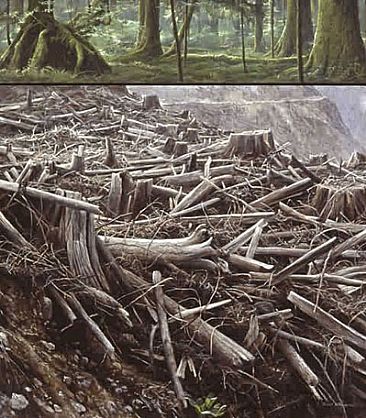
Carmanah Contrasts, 1989, Robert Bateman

The BC Liberal government has never seen a tree that it didn't want to cut or give away to their business buddies. Now, the bad news for our forests continues.

With our provincial government's continued giveaway of our public forests to corporate entities, how does a dedicated tree-lover find the time to enjoy what is obviously slipping out of our control? 

If we could get a break from this relentless assault on public forests we might be able to actually get out there and enjoy them before they are gone. 

Recently revealed is that our nefarious government plans, according to Canadian Centre for Policy Alternatives analyst Ben Parfitt writing in Sunday's Province, to:

"introduce a scant two-paragraph bill granting it powers to fundamentally alter the course of forestry in B.C.

"...the bill would give the provincial cabinet powers to grant forest companies de facto private control over public forestlands without first having to notify or consult with the public.

Instead of companies enjoying rights to log set volumes of trees on public forestlands, companies would gain dramatically expanded powers to log trees on defined areas that in effect become their own semi-private fiefdoms.


"...the provincial cabinet could grant forest companies the rights to roll over numerous volume-based forest licences into area-based Tree Farm Licences. TFLs bestow by far the most secure rights of access to publicly owned trees of any arrangement with the provincial government. The new legislation could massively expand their use, beyond the limited number now issued.


"...various government documents were leaked indicating that the provincial government was revisiting a controversial “rollover” idea first pursued 25 years ago. At that time it met with such a groundswell of political and public opposition that the initiative was scuttled.

Then-provincial forest critic and MLA for Prince Rupert, Dan Miller, called it “privatization on a massive scale” and warned: “Never before in the history of the province has this kind of giveaway been contemplated.”

The policy as then envisioned is precisely the one now being contemplated by the... Minister of Forests, Lands and Natural Resource Operations Steve Thomson.

"...giving what remains of our forests away is lunacy. A responsible government would delay implementing such contentious legislation and give the public time to digest the implications of such a move. Or the Opposition could signal now that should such a bill pass it would be immediately repealed upon a change in government."


Read more here.

Enough! It is time to let our pro-corporate, anti-environmental 'leaders' that we want responsible stewardship of our resources NOW!

Stop the further privatization of our public forestry resources. Everything is linked and interdependent. When trees die, people die. 


1/24/2013

Services Provided By Intact Old Growth Forests

We convert high quality old growth forests into low quality, over-sized houses

It is true that different people see the same tree in quite different ways.

The logging industry views old growth trees as a cheap source of valuable timber that will maximize their profits. From a business point of view it would be best to log 100% of old growth, then when the low cost, high grade timber is gone, move on to younger forests.

While investors and the BC government may prefer this view, it is one that fails in all other regards. What about those that see the forest as pristine nature to be protected for all time? What about all the creatures that see the forest as home?

Never calculated in the decision whether to cut or not cut our degraded primal forests, are the valuable services provided by healthy, intact trees and forests. The price of the trees from a clear cut can be accurately calculated, but what price tag do we put on the services provided by leaving the old growth standing?

We know the price of the trees, but know very little about their value.

Services Provided By Intact Old Growth Forests
William J. Reed, 1992

"The value of standing old-growth forest comprises many components. Old-growth forest can provide positive amenity services such as one or more of the following:

  1. a locus for recreational and tourism activities
  2. a habitat for wildlife
  3. a generator of oxygen
  4. an environmental sink for carbon
  5. a regulator of water flow
  6. a repository of genetic diversity
  7. a regulator of local and even possibly global climate

In addition many people are coming to recognize that old-growth has an intrinsic existence value (apart from the 'use' values listed above), simply because it is a part of a vanishing pristine Nature. Like diamonds or any other economic good it has value simply because it is simultaneously wanted and scarce."


Because of our massive miscalculation of the value of protected primal forests, we end up liquidating a high value resource that could continue delivering services we need, in a self-sustaining manner for centuries. 

We trade these irreplaceable services for low value products like cheap homes unlikely to last longer than a few decades.

If we continue on our present path we will fail to appreciate the true value of old growth until it is gone.  The price we will pay is too high.

Everyone will suffer, including the logging industry, governments, and investors. 

1/11/2013

Vandalizing Old Growth Forests


It is sad that those who would drive old growth forests to extinction for personal profit are lauded as leaders, while those who fight to protect the trees (with no personal gain), are derided as 'eco-terrorists'.

Really? Are we insane? This is vandalism on a grand scale.

The profit-terrorists are the ones of which we should be wary.

12/30/2012

Take Us To Your Tree People

"Sorry, we are looking for intelligent life forms with patience and a sustainable, cooperative attitude."

"Greetings gentle tree people, carriers of sustainable, cooperative approaches to living. You have so much to share. If we were looking for a cooperative, sustainable model to emulate, your forest ecosystem would be unsurpassed.
Thousands of species working together in perfect harmony resulting in a stable system that can last little unchanged for many eons. Until those pesky suit-wearing humans intervene."

Intelligent life forms know that driving entire ecosystems to extinction is not a good idea. Here is hoping that the new year brings you, the enlightened reader, plenty of forest experiences that motivate you to join the growing chorus to save the last of the old growth on Vancouver Island, British Columbia, and around the world.

Happy new year. Happy better year.


"Beam me up. After they killed all the trees there's no intelligent life left down here."

12/14/2012

The End Of Old Growth Logging


The photo above is the trunk of Te Matua Ngahere, the 'Father of the Forest'.

It is New Zealand's oldest living Kauri tree, and is estimated to be over 2000 yrs old with a girth of 16.41m.

Logging of old growth, or native forest, on public lands has been illegal in New Zealand since 2004.

When people say ending old growth logging "can't be done" in British Columbia, they fail to realize that exactly that has been done in many areas around the world.

[In 2004] New Zealand’s Labor government introduced hard-won legislation that ended logging of publicly owned temperate rainforests. In words unfamiliar to US politicians, Pete Hodgson, the minister responsible for timberlands, told parliament that, “These lowland forests are considered by many New Zealanders to be a unique and significant part of our natural heritage, too valuable for logging of any sort to continue.” 

Read more about New Zealand's forward thinking forest policy here. 

12/03/2012

Cortes Island Ancient Forest Defenders Force Island Timberlands To Table

"Cutting these ancient, threatened Douglas-fir is like shooting a black rino."
Cortes Island ancient forest defenders, led by the community alliance Wildstands, have successfully forced Island Timberlands back to the table in the ongoing struggle to protect the island's last remaining old growth forests.

The original Coastal Douglas-fir forest ecozone, small to begin with, has withstood 100 years of industrial exploitation to the point that only 1% remains. A small part of that 1% resides on beautiful Cortes Island.

The government of BC refuses to meaningfully protect this dwindling resource, and in some cases encourages its destruction through investments in the corporations that are slaughtering the last big trees. Responsibility for protection inevitably falls on the caring shoulders of regular folks in the communities being degraded by continued old growth liquidation.

The people gathered together on Cortes as human shields protecting the last veteran trees (250-500 years old) are often those most affected by the degraded conditions left in the wake of industrial clear cut logging.

Zoe Miles, a member of Wildstands, says, “For more than four years, community members have attempted to work with the company to develop an ecosystem-based approach to forestry.  As road-building equipment moves in, the community is now left with no choice but to stand in its path to defend these ecologically significant forests.”

The group aims to "protect the ancient bio-diversity of Cortes Island, and serves as a forum for discussion of the protection, legislation and conservation of this fragile eco-system".

Wildstands blockaded logging equipment in recent days rather than submit its old-growth temperate rainforest to unsustainable logging practices by Island Timberlands, the second largest private timberlands holding in British Columbia.

The first stage of the blockade has been successful, and IT has agreed not to ask for an injunction against the group for at least one week.

Send Island Timberlands an email if you support old growth protection on Cortes Island. Click here.

Our government should know of your wishes as well. Click here.
"People are here because they want to make it known that the industrial forestry model doesn’t work for local communities and it doesn’t work for the province. Island Timberlands will destroy ecologically sensitive ecosystems and leave nothing beneficial in its wake. We will be left with devastated ecosystems, a contaminated water supply and no long term jobs. All the benefit is going to people who live far away and who aren’t aware of the cost of their profits to our community and our province."  - Leah Seltzer

11/28/2012

Stopping Island Timberlands, Saving Cortes Island


 Will logging of ancient forest be halted before it can begin?

November 28, 2012 (Cortes Island, BC)  Residents of Cortes Island have formed a blockade to stop the BC based timber company, Island Timberlands (I.T.), from beginning logging operations in one of BC’s last stands of old growth coastal Douglas-fir forest.  For over four years, community members have attempted to work with the company to develop an ecosystem-based approach to forestry.  As road-building equipment moves in, the community is now left with no choice but to stand in it’s path to defend these ecologically significant forests.

Yesterday, Island Timberlands trucks were stopped at a logging road gate by two protesters lying on the ground. Company personnel filmed the protesters, likely in preparation for an application for a civil injunction. The protesters did not respond to their questions and community members remained on the site until the end of the day.

Adjacent landowners were among the community members present. One couple explained that they have a water license on Basil Creek which runs through Island Timberlands’ property.  I.T. plans to log in the riparian area and within 30 feet of the wetland that feeds the salmon-bearing creek. They wrote to Morgan Kennah, Island Timberland’s Manager for Community Affairs, stating their concerns about water supply and contamination. “I thought I would get a letter from Morgan assuring me that my water supply would be safe,” the landowner stated, “but that never happened. I got no response.”  Another community member showed up with Christmas decorations and a Christmas tree to lighten the protesters’ spirits.

Leah Seltzer explained the situation in this way, “People are here because they want to make it known that the industrial forestry model doesn’t work for local communities and it doesn’t work for province. Island Timberlands will destroy ecologically sensitive ecosystems and leave nothing beneficial in its wake. We will be left with devastated ecosystems, a contaminated water supply and no long-term jobs. All the benefit is going to people who live far away and who aren’t aware of the cost of their profits to our community and our province.”

The threatened lands contain some of the last 1% of old-growth Coastal Douglas-fir forests, and, according to Ken Wu of the Ancient Forest Alliance (AFA), are some of the most extensive stands remaining in the endangered "Dry Maritime" forests along BC's southern coast.  The forests also contain a number of documented threatened species and sensitive ecosystems.

At this time, I.T. has contracted several local workers but these jobs will only provide short-term employment.  More than 60% of I.T.’s raw logs are shipped out of the province to be processed overseas.  Standing exclusively to profit are I.T.’s corporate shareholders, which include Brookfield Asset Management and the BC Investment Management Corporation, the pension fund for provincial employees.

While I.T. claims to use sustainable forestry practices, long-time forest activist and Cortes Island land-owner, Tzeporah Berman, warns us not to be fooled: “The majority of their logging is traditional clearcut logging with devastating ecological implications that result in either a change of land use or a dramatically weakened and simplified ecosystem. The Sustainable Forestry Initiative (SFI) that Island Timberlands touts does not ensure strong environmental standards and has little support from First Nations or environmental organizations.”

Cortes resident and Greenpeace co-founder Rex Weyler agrees.  “There’s no excuse for industrial-scale logging in these times,” he says. “Forward-looking and economically-viable alternatives exist that are based on community health and ecosystem health. Island Timberlands’ plans are a step backwards. Cortes Island is moving forward.”  Residents have sought Island Timberland’s participation in this kind of forestry model but have been met with disregard.

Community members hope that the situation will not escalate, and that I.T. will recognize that Cortes holds a rare opportunity to work with a willing community to create a forestry model that benefits everyone.  Until then, islanders will be standing in the way of the equipment, and keeping a close eye on any further signs of I.T. activity on the island.
Several participants are available for comment.

Photo credits: WildStands, Facebook

For Immediate Release

For more information, please contact:

(Please be advised, there is limited cell phone service on the island but we will respond to your calls as soon as possible.)

Media Liasons: 
Leah Seltzer, Educator, Cortes resident 


Zoe Miles, Cortes-raised activist 

11/12/2012

Vancouver's Urban Streams See Biggest Salmon Returns In 80 Years


After decades of use and abuse, many former salmon streams in the Vancouver, BC area are again teeming with life. In one stream the returns are the biggest seen in 80 years as Chum return to rehabilitated waterways once again.

Stream rehabilitation projects since the 1990's are starting to pay off and salmon are being seen in waters previously degraded and suffering the effects of insensitive development and pollution.

Many projects, often run by volunteers, have improved gravel spawning beds, restored stream bank vegetation to prevent erosion, and added ladder improvements and Large Woody Debris to expand available habitat. Culverts are often a barrier to fish movement, and projects also remediate these blockages.

How much money do developers and logging companies add to these restoration projects that clean up the messes made as a result of their environmental exploitation? I would expect the answer is "little to none". As usual, the private sector gets the profits, and the public sector (the rest of us) pays to repair the damage.

But it sure is good to see that we can atone for their sins, and bring the salmon back.

Read more here.