Showing posts with label direct action. Show all posts

1/30/2021

MicroArk Project Invitation


An interesting comment was left here a few days ago. I am posting it to reach a wider audience because it sounds like an amazing opportunity to imagine and implement projects to make a difference. 

MicroArks! I love the sound of that.


Hi there! 

I'm lucky enough to have access to quite a number of native tree seedlings on an East Sooke property. The ones easiest to transplant are between 1-4 yrs old.

There are Red Cedar, Douglas Fir, Hemlock, Spruce, Alder,and Broad Leaf Maple in various quantities.


Also, Salal, Oregon Grape, Huckleberries, Ocean Spray, Salmon and Thimble Berries,and more.

At a Victoria location there are Garry Oaks, Arbutus, and Snowberries. 

There's also some duff infused with Mycorrhizal fungus and epiphytic moss, lichen and liverworts to innoculate the replanting sites. 

I'd really like to find carefully considered locations for replanting and long term care.

I transplanted about 50-60 with a small group of mostly kids a year ago but a repeat didn't happen due to Covid 19.

I'm hoping to connect with any people interested in some small scale, responsible, replanting collaborations in the next few months. Or even to simply discuss the concepts and processes involved.


I feel we need to establish some "MicroArks" consisting of groups of trees and their associated flora and fauna that are carefully considered and cared for.

They will provide examples to be replicated thus beginning the regrowth of truly natural forests for perpetuity.

Thanks for your interest!


Paul Winstanley

Spectrafocus

20/1/21


paul@spectrafocus.ca 250-899-9285 


1/28/2013

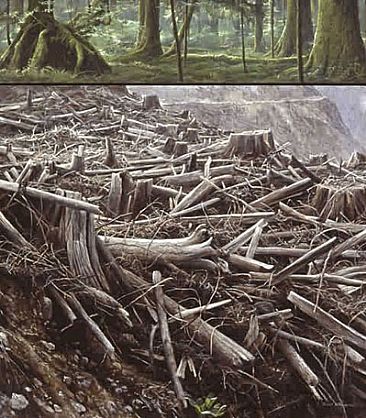
BC Government Planning Huge Forest Giveaway

You will be seeing a lot more Vancouver Island clear cuts if the BC government has its way. 
Carmanah Contrasts, 1989, Robert Bateman

The BC Liberal government has never seen a tree that it didn't want to cut or give away to their business buddies. Now, the bad news for our forests continues.

With our provincial government's continued giveaway of our public forests to corporate entities, how does a dedicated tree-lover find the time to enjoy what is obviously slipping out of our control? 

If we could get a break from this relentless assault on public forests we might be able to actually get out there and enjoy them before they are gone. 

Recently revealed is that our nefarious government plans, according to Canadian Centre for Policy Alternatives analyst Ben Parfitt writing in Sunday's Province, to:

"introduce a scant two-paragraph bill granting it powers to fundamentally alter the course of forestry in B.C.

"...the bill would give the provincial cabinet powers to grant forest companies de facto private control over public forestlands without first having to notify or consult with the public.

Instead of companies enjoying rights to log set volumes of trees on public forestlands, companies would gain dramatically expanded powers to log trees on defined areas that in effect become their own semi-private fiefdoms.


"...the provincial cabinet could grant forest companies the rights to roll over numerous volume-based forest licences into area-based Tree Farm Licences. TFLs bestow by far the most secure rights of access to publicly owned trees of any arrangement with the provincial government. The new legislation could massively expand their use, beyond the limited number now issued.


"...various government documents were leaked indicating that the provincial government was revisiting a controversial “rollover” idea first pursued 25 years ago. At that time it met with such a groundswell of political and public opposition that the initiative was scuttled.

Then-provincial forest critic and MLA for Prince Rupert, Dan Miller, called it “privatization on a massive scale” and warned: “Never before in the history of the province has this kind of giveaway been contemplated.”

The policy as then envisioned is precisely the one now being contemplated by the... Minister of Forests, Lands and Natural Resource Operations Steve Thomson.

"...giving what remains of our forests away is lunacy. A responsible government would delay implementing such contentious legislation and give the public time to digest the implications of such a move. Or the Opposition could signal now that should such a bill pass it would be immediately repealed upon a change in government."


Read more here.

Enough! It is time to let our pro-corporate, anti-environmental 'leaders' that we want responsible stewardship of our resources NOW!

Stop the further privatization of our public forestry resources. Everything is linked and interdependent. When trees die, people die. 


12/14/2012

The End Of Old Growth Logging


The photo above is the trunk of Te Matua Ngahere, the 'Father of the Forest'.

It is New Zealand's oldest living Kauri tree, and is estimated to be over 2000 yrs old with a girth of 16.41m.

Logging of old growth, or native forest, on public lands has been illegal in New Zealand since 2004.

When people say ending old growth logging "can't be done" in British Columbia, they fail to realize that exactly that has been done in many areas around the world.

[In 2004] New Zealand’s Labor government introduced hard-won legislation that ended logging of publicly owned temperate rainforests. In words unfamiliar to US politicians, Pete Hodgson, the minister responsible for timberlands, told parliament that, “These lowland forests are considered by many New Zealanders to be a unique and significant part of our natural heritage, too valuable for logging of any sort to continue.” 

Read more about New Zealand's forward thinking forest policy here. 

8/15/2012

Why We Can't Save Our Last Old Growth

Logging? What logging?
It may be cynical, but I often wonder if anyone is actually paying attention to what is happening globally to our original forests, the likes of which we may never see again.

It is a fact that life is complicated, with many distractions. But let us look at the facts of what we are losing while being consumed by all our trivial things.

  • Vancouver Island has lost over 75% of its productive old growth forests, including 90% of the valley bottoms where the biggest trees and richest biodiversity are found.
  • continued old growth logging below 30% of intact forests creates a high probability of massive species loss 
  • 99% of the old growth coastal Douglas-fir forest on Vancouver Island has been logged already 
  • some of the biggest, tallest, and oldest trees on earth are still being logged in British Columbia
Governments and multinational logging companies are planning on taking 100% of our original forests. If we don't wake up and stop them, who will?

11/22/2010

The Chipko Movement: Hugging And Saving India's Trees Since 1730

Villagers surround tree to protect it from the axe
"We have arisen, we are awake
No longer will thieves rule our destiny
It is our home, our forests
No longer will the others decide for us"

- Chipko protest chant 

The Himalayan region of northern India is a stunning land rich in natural resources. A wide diversity of forests cover regions from flat, low plains to the tree line in alpine areas of the highest mountain range in the world. This is also the land of the original tree huggers, the brave women of the Chipko Movement.

In India, as here in B.C., the forests have been under assault for a long time. The Chipko Movement is a decades old initiative of the people to address the serious problems of deforestation and corporate control. Chipko means 'to stick' or 'to hug' in Hindi.

Although the first recorded use of tree hugging to protect forests in India was in 1730, the movement took its modern form in the 1970's. At that time the state of Uttarakhand was experiencing heavy logging pressure from outside corporations after new roads made previously remote forests accessible. 

The people that lived in, or near the forests were suffering the consequences of the greedy industrial practices. The women, who were closest to the forest resources, suffered the most when they began to disappear.

Villagers had to walk farther to gather fire wood and fodder for their livestock. Water sources were drying up affecting availability of water for drinking and irrigation. Erosion on deforested areas during the monsoon was scaring the land and creating devastating floods. 

All the profit from the deforestation was taken away, rather than benefiting the local economy. The people were increasingly dissatisfied with commercial logging and government forest policy.

Artwork by Notnarayan
1973 saw the first confrontation over the looming ecological disaster. Tired of inaction on the part of the government, the women of the Chipko Movement decided to protest the destruction of their forest directly. 100 activists banged drums and shouted slogans where the logging activity was taking place. The loggers retreated, and eventually their contract was canceled and given to the villagers.

More protests took place in different areas. Where the people were threatened and ignored the protesters embraced the trees to protect them from being cut. They would often maintain their vigils for days at a time before the loggers retreated.

When news of the growing movement reached the state capital a commission was called which eventually ruled in favour of the Chipko activists and the people most affected by the environmental collapse. For them it was an issue of life or death.

In 1980 Prime Minister Indira Gandhi's government banned the cutting of trees in the Himalayan regions for 15 years to allow forests to recover.

The Chipko Movement is still going strong as a major socio-ecological movement, and has served as a model for similar groups across the world. The movement has been successful in returning forests to community control for the sustainable benefit of local communities. 

Fortunately they did not have to sacrifice their lives for the trees as did the 363 slain tree huggers in the original 1730 Chipko protest.