Showing posts with label preservation. Show all posts

9/10/2022

Old Forests Are Worth More Standing


In most forested places in the world logical thinking people have come to the conclusion that some trees are worth more when left standing in ecologically intact forests.

Puebla, Mexico is one of those places saving forest habitat for the many irreplaceable benefits they accrue to humans and other living things.


1,500-hectare park in Puebla designated natural protected area

The declaration shields the area from real estate development 

The Flor del Bosque park, located southeast of Puebla city, has been declared a natural protected area, the state government announced on Thursday.

This will mean that the park’s 1,501 hectares will be off-limits for real estate development and other kinds of new settlement, and that the communities already living on the land will be obliged to participate in its sustainable use and protection.


Read more here


3/08/2017

Ahousaht First Nation Saving Their Big Trees on Vancouver Island


"Environmentalists are applauding a move by the Ahousaht First Nation to ban mining and clear cutting in favour of sustainable development and conservation.

Under the first phase of the plan, announced Thursday, there will be no mining or industrial logging in Ahousaht traditional territory and about 80 per cent of almost 171,000 hectares will be set aside as cultural and natural areas “to conserve biological diversity, natural landscapes and wilderness and to provide to Ahousaht continued spiritual, cultural and sustenance use.”

The remote Ahousaht First Nation, near Tofino, has more old growth forests in its traditional territory than any other First Nation on the B.C. South Coast.

Ahousaht Band leaders have decided it needs to be protected and they took steps to do just that this week to preserve those forests for the future.

Under the first phase of the plan, there will no mining or industrial logging allowed in Ahoushat traditional territory.

About 80 per cent of the territory , that’s more than 170,000 hectares, will be set aside as cultural and natural areas.

The goal is to conserve natural landscapes and biological diversity. The Ancient Forest Alliance says it’s the largest leap in old-growth conservation in the last two decades on Vancouver Island.

The Nature Conservancy is calling it a blueprint for a sustainable future. Environmentalists say only about 20 per cent of old-growth forests are still standing on Vancouver Island."

- source

6/09/2014

Big Lonely Doug A Big Climb

Tree climbers on the first ascent of Big Lonely Doug near Port Renfrew.

How do you climb the 66 meters (216 ft) of the recently discovered second largest (known) Douglas fir tree in Canada?

Very carefully.


Tiny people give scale to the enormity of this amazing tree.

Why do you climb a tree like Big Lonely Doug?

To raise awareness of Vancouver Island's vanishing old growth trees and forests.


Climbers descended with samples of soil and moss from the tree's canopy. It is possible
that the samples may contain insects completely new to science.

British Columbia’s threatened old-growth forests are being logged to extinction by industrial logging aided by lax government regulation. But many people, including those in the former logging town of Port Renfrew, realize that trees like the Red Creek Fir and Big Lonely Doug are more valuable standing than cut down.

On Vancouver Island about 75% of the original productive old-growth forests have already been logged, including 90% of the valley bottoms where the richest biodiversity and biggest trees are found.

Once gone, the big trees and primal forests will never be seen again. What a wasted opportunity.

Read more about the first ascent of Big Doug here.

Join the fight to preserve these unique trees by writing a letter here.

1/30/2013

Big Trees, Not Big Stumps

We want big trees, not big stumps!

...unless after we log we replant, then let the forest grow unmolested for the next 250 - 1000 years.

Instead, "crop" rotations are in the span of a few short decades, ensuring that bleak mono-culture tree plantations replace vibrant, ecologically diverse old growth.

We want big trees, not big stumps.

9/15/2012

Community Concern Saves Oakland's St. Albans Sequoia


View St. Albans Sequoia To Be Saved in a larger map


Whether we are in the back country, or in urban areas, there is rarely good news when it comes to saving significant trees in British Columbia. Here, in Canada's most treed province, the value of our woody wonders has perhaps been diluted by the sheer volume of them.

Occasionally though, dentritic defenders win a battle, if not the war. Such is the case of the St. Albans Giant sequoia in the Victoria neighbourhood of Oaklands. It has been under threat since the property on which it grows was sold to developers.

Giant sequoia have a very long association with Victoria, even though the huge trees are native to California. That the trees exist here shows early Victoria's connection to the American state.

Some of the trees were brought as saplings by Californians moving north, and sequoia seeds were advertised in Victoria as early as 1860. Local nurseries also raised sequoias for sale locally. Many must have been planted by displaced Californians that missed their unique state tree.

Today, Victoria's Giant sequoias have become landmarks, and their conical tops tower above everything around them. The tallest sequoia, which may be the tallest tree in Victoria, is 52 meters (170 ft) tall. But let's get back to the sequoia on the St. Albans property.

Earlier this summer, Cindy, an Oaklands resident, contacted me to see if I might be able to offer some suggestions for saving several Garry oaks, and one sequoia. I responded with some ideas, and waited to hear of the fate of this landmark tree.

Recently I received a follow up email from Cindy. In it she says:
"Many people came out to the Community Association Land Use forum to speak out in favour of protecting the Sequoia tree. This resulted in these wishes being considered in the report drafted for recommendations associated with the approval of variance application being put forth by the developer. 
Over a month has passed and this morning, the application went before the Planning and Land Use Standing Committee.  I have good news!!  The committee approved staff recommendations that a restrictive covenant be registered on the Sequoia prior to a public hearing that will also take place! 
 In case you are interested, here is the report that the Committee considered, and upon which made its decision:
Planning and Land Use Standing Committee Report
Thank-you again for taking the time to help provide us with guidance.  This helped contribute to what looks like a happy ending!"
Loggers long ago removed the largest Western red-cedar and Douglas-fir from the Victoria area. With the native big tree competition gone, the biggest trees in town are Giant sequoias. All the old, huge sequoias have heritage value and deserve to be protected.

Congratulations to Cindy and the Oaklands neighbourhood for taking action on behalf of their neighbourhood giant, and saving it from becoming yet another victim of the relentless development that has been taking place here since the 1850s.

I am happy to have been a small part of the effort to successfully save what is probably the neighbourhood's oldest planted tree.

Are you trying to save a significant Vancouver Island big tree? Let us know in a comment, or contact us (see info on side bar). We are happy to help in any way we can.

7/22/2012

St. Albans Sequoia Needs Divine Intervention


Image shows St. Albans property with the church, behind which lives a Giant sequoia (the tallest tree) currently on death row. Slated to be cut for development, it may be the oldest planted tree in the Oaklands neighbourhood.  View Larger Map of St. Albans, Oaklands, Victoria, BC

Canadians are generally tree-defending people that consider significant trees to be community assets to be shared and enjoyed by all. We don't talk so much about "your" trees or "my" trees as much as "the community's" trees, since we all benefit from their presence. However, not everyone sees it that way.

Where some see history and beauty to be protected, others see distracting impediments to their plans. This often leads to clashes over trees and green space with a preservation-oriented public, and pro-development governments and business people taking sides in adversarial standoffs.

Such is the case in the community of Oaklands, where what may be the oldest planted tree in the neighbourhood is under threat of the chain saw. The sale of St. Albans, a former Anglican church property, is threatening the magnificent, and much loved, Giant sequoia as well as valuable green space with several Garry oaks. It looks like divine intervention might be needed to save the trees.

A concerned tree-loving citizen of the community contacted me via email shortly before a public forum (Thursday, July 19, 2012) took place to discuss the developer's plans, and the community's wishes. The email states:
"I am a resident of the Oaklands community (adjacent to Fernwood).  At the site of the St.Albans property (former Anglican church property, recently sold to a developer) there is a Giant Sequoia that is currently under threat of being taken down to accommodate the developers plans.  There is a public forum on Thursday at our Community Centre to discuss the variance application being put forward and it is believed that it will be argued that the Sequoia must come down (I understand that the developer will be bringing her arborist to the meeting).   
There are many in the community that feel very strongly about that property in general (and in fact an attempt by the community to acquire it was made in the spring) and the Greenways/trees that run along the front of the property in particular.
One of my neighbours believes very strongly that the tree, 'has /had a Heritage Tree Certificate.  But I have not seen it in recent years; it was presumably kept with other parish records which are now either lost or at the diocesan archives.'
I have sent a message to someone to make inquiries with the Anglican Church and I have also had it confirmed by the City Parks dept. that there is no covenant on the tree, but I wonder if there is somewhere else I should be looking to confirm this? Do you have any ideas on how we might argue that the tree must stay?  How do we convince the City that the developers plans must preserve this tree?"
Of course, the best protection for trees is education, but when a tree is about to come down, urgent action is required. Victoria has a tree protection bylaw (see an overview here), so the city is the first place I would start. Other avenues of action could include checking to see:
  • if removal defies your municipality's urban forest (or other) plan.
  • whether removal contravenes your municipality's tree bylaw.
  • checking to see if the permit for removal, if issued, considered all mitigating factors.
  • checking if the tree is a 'heritage tree'.
  • if all alternatives have been considered.
  • if removal makes aboricultural (tree) sense.
  • if anyone has talked directly with the developer/landowner to see if mitigation is possible.
If all negotiations fail, and the municipality will not intervene or rescind the permit to cut the tree, and you feel that there are still alternatives to be considered, further actions could include:
  • contacting the local media about the story, and being available for an on-site interview.
  • contacting a lawyer to ascertain your right to ask for a stop work order until the issue is resolved.
It is surprising that the sequoia is not already protected under Victoria's tree bylaw, since it has both heritage and landmark value. It could be over 100 years old, and may have been planted around the same time as many other sequoias that early settlers from California brought with them in the late 1800s. This one may have originally been planted on a farm as the Oaklands area was farmland from Victoria's inception right up until the 1920s when the last farmer's field was subdivided for residential development.

Also, any tree on private property over 80 cm in trunk diameter is protected by the bylaws. The community has expressed the importance of the trees on the property, both the giant sequoia and the Garry oak, a threatened species in the Coastal Douglas-fir eco-zone.

I see no reason why all these trees can not be incorporated into the new development. Indeed, they would make anything built there even more attractive to potential new neighbours.

Good luck to the community of Oaklands - you have taken on a difficult, but worthy struggle. It would be sad to see these trees taken down. The sequoia could live for 3000 more years!

Contact us at VIBT (see sidebar) if you have any ideas or skills that could be useful toward helping in this opportunity for citizen action, and tree preservation.

2/16/2011

Remind Forest Minister Pat Bell That He Works For You

Old growth trees such as this ancient cedar deserve full protection

The minister of Forests, Mines, and Lands, Pat Bell, usually looks out for the interests of big logging companies. Lately, though, he is sounding like he is getting ready to work for his real employers - the people of British Columbia.

All those letters, phone calls and emails must be having there intended effect, and it sounds like Bell is beginning to listen.

The Times Colonist reported today that Minister Bell said that the province is looking for new ways to protect ancient trees and groves containing forest giants.

The positive news caught Ancient Forest Alliance co-founder Ken Wu off guard.  “I have to admit this was an unexpected surprise considering the rocky relationship the B.C. government has had with our campaign for so long,” he said.

Does this signal big changes in the way BC exploits its old growth forests that are disappearing at an alarming rate in places like Vancouver Island and the lower mainland? Probably not. Bell says that there are no plans to end logging of old growth forests. Huge trees up to, and over, 1000 years old will continue to be killed for short term commercial gain.

Indeed, Bell was quoted as saying that, "There is more old growth today than we have ever had," and that "We are not running out of old growth on Vancouver Island or in BC". Considering how much old growth has been decimated already, and how poorly re-planting has been conducted, I find these statements extremely hard to believe.

"Hi, I work for you"
Photo by: Darren Stone
The government is fudging statistics to pacify the public, and justify the continued desecration of ancient forests.

The fact is that over 90% of the original old growth forest in valley bottoms on Vancouver Island has already been logged. These areas are the biologically richest, and are where the biggest trees grow. It takes 250 years for a forest to reach old growth status. The harvest cycle in BC is about 40 - 80 years, so how is it possible that we have more old growth now than when we started destroying the mighty Pacific coastal forest?

But the minister has said that his recent announcement of new protection measures is the result of public pressure. That means that if we keep the pressure up, we can push for a ban on old growth logging in BC, and especially on Vancouver Island.

The big tree/old growth advocacy IS working. It should be working because, after all, Pat Bell works for us, and we overwhelmingly state that we want old growth to be protected.

Other things that can be mentioned in an email or letter are:

- We need legislated timelines to quickly end old-growth logging on Vancouver Island and the Lower Mainland (ie. the south coast) where old-growth forests are now scarce.
 
- We must promote the sustainable logging of second-growth forests which now constitute 75% of the productive forests on BC’s south coast.

- Banning the export of raw, unprocessed logs to foreign countries to ensure a steady supply of logs for BC’s saw mills and pulp mills.

- The government must assist in the retooling and development of second-growth mills and value-added wood processing facilities.

Email Minister Bell here.

Keep up the pressure, tree lovers! Let's save the old trees, and create a sustainable forest industry in BC. Remind Mr. Bell that he works for you.


11/10/2010

Avatar Grove - Accessible Ancient Forest Marked For Logging

Baird Creek Bridge and Avatar Grove  (see truck on right)
As I approached the Baird Creek bridge 20 minutes north of Port Renfrew on the Gordon River Main logging road, I realized I had been here before. A few years ago I stopped, took pictures, and sat on the bridge for a while. I admired the view of the canyon below, as well as the tops of huge trees and candelabra Western red-cedar poking out of the forest canopy. But unlike a recent trip, back then I didn't take a few steps off the road and enter the forest. But back then it wasn't called Avatar Grove.

Shady, moist forest floor and big trees everywhere

Take those few steps off dusty Gordon River Main and you step into a different realm. From civilization, gravel and harsh sunlight you descend into a wild, moist, lush, shady forest. A forest that grows some of the biggest trees on Earth, and contains the most biomass of any forest anywhere. This is Avatar Grove.


Members of the Ancient Rainforest Alliance (AFA) stepped off the logging road in December of 2009, and when they did they found massive old growth trees. They were looking at a forest that has survived over 100 years of industrial logging in the Port Renfrew area.

Recognizing its value as a standing forest, they named it Avatar Grove after James Cameron's movie and began to push for protection. But they found more. The AFA team also discovered that the area was surveyed and flagged for logging.

A survey blaze on a small tree in Upper Avatar Grove
I thought I had better take a look before it was gone, and mounted a fall field trip to Port Renfrew on a glorious, crisp, sunny day.

Mushroom and moss


At the grove, as soon as I was through the thick barrier of bush growing alongside the road I stepped out under a shady canopy far above. The ground was moist and spongy and my feet sunk into the thick layer of debris. Everything was covered in moss, which can hold 1000 times its own weight in moisture. Once logged such areas all but dry out in the harsh direct sunlight.


In Lower Avatar Grove the ground is sloped gently down to the Gordon River. A rough trail has been flagged out, but there are also many logging survey flags so one must exercise caution. I forged ahead, excited to finally be checking out this wonder so close to home.

After my eyes adjusted to the shade I began to see giant trees spread around the forest below. All the tell-tale signs of old growth forest are here: a variety of ages of trees from seedlings to seniors, standing dead trees (or snags), large diameter woody debris (fallen giants), and a deep layer of decaying matter on the forest floor.

Large diameter woody debris is everywhere - downed logs can take centuries to decay
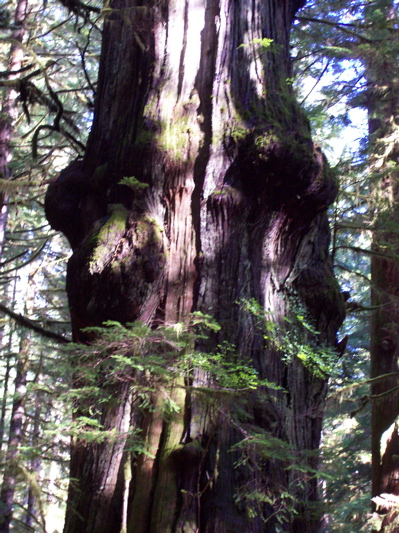
The rough path leads the big tree hunter to some spectacular individual behemoths. There are some very large Douglas-fir, but the real stars here are the amply aged and weathered Western red-cedars. They are big and gnarly, and unlike any cedars I have seen. Most of the largest cedars are festooned with burls and whorls that are unique in their twisted beauty.

Ancient Western red-cedar in Lower Avatar Grove
The big Douglas-firs are dark and ominous looking, and far above the twisted and broken tree-tops poke out of the canopy and catch the last light of the day.

Big Douglas-fir in Lower Avatar Grove

I lost the trail on the way back up to the road, but there is little undergrowth and many fallen logs to walk along. It is hard to get lost here as all you need to do is point yourself uphill and hike till you hit Gordon Main, which is what I successfully did.

Giant tree broken off at the top, but still tall enough to poke above the rest


Back on the dusty gravel it seemed hard to believe that I have drove right through the middle of this old growth forest several times over the years without ever knowing what treasures lurked just a meter off the road. I ran up into the upper grove for a few brief minutes and look forward to returning at a later date for a more extensive upper grove excursion.


Lower Grove - big moss covered trees everywhere

See Avatar Grove

Leave Victoria and take Hiway 14 to Sooke, check gas gauge, then continue to Port Renfrew.
At Port Renfrew turn RIGHT onto Deering Rd. Follow Deering Rd. until the T intersection, then turn LEFT (right is toward Lake Cowichan). Follow road until the bridge over the Gordon River. Cross the bridge and stay on Gordon River Main for about 1.5 km. Right after you cross over the single lane bridge at Baird Creek, pull off to the right and park. Trail access has been marked by AFA on both sides of the road. Visit gently - be respectful. Enjoy the trees.


View Avatar Grove in a larger map

Save Avatar Grove

You would think that a bit of ancient forest on a well kept main logging road only 20 minutes from Port Renfrew would make someone in government think about preservation and tourism potential. Avatar Grove is on Crown land, so saving this valuable forest treasure would not entail purchasing land from a greedy logging/development company.

Please consider contacting elected officials to let them know preservation is the most logical thing to do with this increasingly rare piece of primeval forest, and the massive trees that thrive in it. Let them know that cutting thousand year old trees for pulp, paper, and deck lumber is greedy and unnecessary.