Showing posts with label coastal western hemlock zone. Show all posts

3/26/2013

Sooke Hills: Parks, Peaks, and Rain Forest

Trees on rock, roots on rock, moss on rock

One of my favourite stretches of forest can be found along the Galloping Goose Trail from Sooke to the trail's northern terminus at the gold mining ghost town called Leechtown. The Goose runs along the western edge of a 12, 000 hectare protected wilderness.

In the vast expanse of wilderness covered by a patchwork of parks, one can find pockets of old growth, as well as individual old growth trees. Along the old rail right of way is no different, plus the access is excellent on the wide, flat, gently sloping trail.

In the area one can also find Roosevelt elk, wolves, black bears, bald eagles, and cougars.


Cedar, Douglas-fir, and Hemlock are major rain forest trees

"The Sea to Sea Green Blue Belt is a corridor of protected wilderness and parkland stretching from Saanich Inlet in the east to the Sooke Basin in the southwest. 

Lands extend from Saanich and Tod Inlets to Sooke Basin (north to south), and from the Sooke Hills Wilderness Regional Park Reserve to the Sooke River (east to west). The protected area covers approximately 11,500 hectares, making it the largest protected area in the CRD. 

It includes provincial, regional and municipal park land, including Gowlland Tod Provincial Park, Goldstream Provincial Park, Sooke Mountain Provincial Park, Sooke Potholes Park, and Sooke Hills Wilderness Regional Park Reserve."


There are many amazing moss species that live here

A variety of peaks, such as Mount Manuel Quimper, afford the energetic hiker amazing 360 degree views of the huge protected area, plus out over the ocean. Mt. Quimper has an old forest fire lookout structure at the summit. It can be handy on a windy or rainy day.

This beautiful hike can be accessed from the Harbourview Road parking lot.


View from Mt. Quimper looking south east over the park and Juan de Fuca Strait

In the early days the rail line went all the way through to the Lake Cowichan area. It hauled equipment and supplies from Victoria in to towns and lumber camps, then turned around and hauled huge logs out.


In spring seasonal brooks are full, as is the thick, spongy moss

Along this route there are many individual old growth trees that escaped the saws that took most of their contemporaries years ago.

While there are no record-breaking trees here that I know of, there are some nice sized Douglas-fir, Western red-cedar, and Western Hemlock. Sitka spruce can be found along the ocean, and along valley bottoms closer to the sea.


Moss and lichen cling to everything, including a Western red-cedar
Any time is a good time to hike or bike into the Sooke Hills Park rain forest. Whether you are cycling the Galloping Goose Trail, or hiking up Harborview Road, there are enough parks, peaks, and rain forest areas to keep you exploring for a lifetime.

5/27/2012

French Beach Park: Future Old Growth Forest

Old cedar stump along French Beach trail

Early History

Adventurer James French knew the country of Canada better than most. In the late 1800s he took two years to walk across the vast land mass between the Atlantic Ocean at New Brunswick, and the Pacific Ocean surrounding Vancouver Island.

After all the beauty he had seen of the country, and Vancouver Island, in 1885 he decided to settle among the big trees of the primeval forest on a 59 hectare waterfront property 25 kilometers west of Sooke.

French's pre-empted property was enjoyed by his family after his death in 1952. The family was active in local logging up to 1974 when the land was donated to make a park.

Protected Second Growth Forest 
Ensures Old Growth For The Future

Today the property is a protected  and healthy second growth forest of Western hemlock, Western red cedar, Douglas-fir, and Sitka spruce.

The forest at French Beach is no longer populated by the giant first growth trees (although a few survive) that grew here when James French first arrived, although the odd stump attests to the fact that they were once here.

However, this is a great place to see how the forest regenerates over time. Although French's land has been logged, there are some nice medium-sized second growth trees that will one day attain the lofty status of their predecessors.

In another 200 years the forest will have regained its old growth status.

Sitka Spruce Dominate The Park

Stunted, weather-beaten spruce fringe trees are genetically identical
 to the taller Sitka spruce in the park
Fronting the beach are pure stands of the salt-tolerant Sitka spruce, one of the only conifers that can survive the harsh conditions along the beach. The Sitka spruce in the park vary from lofty, soaring tall trees to the krummholz (literally 'crooked wood') of the wind and sand scoured spruce fringe.

Big stumps are not the only evidence of the big trees of old. Because the property was logged before heavy-duty industrial logging, much of the original forest profile was preserved, including nurse logs.

In many areas along the park trails through the forest one can make out the remnants of downed giants that are now becoming the forest floor. In many cases the ancient downed trees, that may have been decomposing on the forest floor for hundreds of years, have new trees growing from them. The old nursing and nurturing the new.

Big Beach Trees

Large Sitka spruce along the beach in picnic area
The beach and forest trails are available for both day trips and camping. The picnic areas just behind the beach are good spots to see the twisted trees of the spruce fringe, and the taller spruce behind them.

The campground, and some of the other trails, are good places to see some of the larger trees. Away from the effects of the wind and waves, the tree enthusiast will find nice hemlock, cedar and Douglas-fir.

Today you don't have to walk across the continent to get to French Beach, although it would be worth it if you did. This beautiful day use and campground site is conveniently located on Highway 14, and is a leisurely and enjoyable one hour drive west of Victoria.

Park Map


2/11/2011

The Trees And Surf Of French Beach Provincial Park

Big Sitka spruce on the edge of French Beach

Earlier this week the south island had winds gusting up to 90 km/hr. The morning after I headed out to French Beach Provincial Park to feel the spray coming off the thundering surf. As usual, along the way I would keep my eyes peeled for interesting trees.

It didn't take long to find evidence of the storm as just outside of Sooke a couple of  trees had come down on the highway overnight. They had just been cleaned up off the road, and power restored, before we drove through the sawdust.

French Beach is 20 km west of Sooke along West Coast Road, and encompasses 59 acres. It consists of a campground and day use area, both of which have a nice, coastal forest feel. From most areas of the park you can hear the pounding of the waves on the beach. Although it doesn't rain as much as farther up the coast, it is wetter here than in Victoria.

Sitka spruce bark chips and cones litter the ground
This park is located in a second growth forest of Douglas-fir, Sitka spruce, Western hemlock, and Western red-cedar. Close to the beach on the front line of the forest are the salt-tolerant Sitka spruce.

In some areas with this exposure the trees are blasted by wind-driven salt spray and sand into a wedge shape. This bizarre formation is known as a Spruce fringe. These leading edge trees protect the taller forest behind from the powerful gales off the ocean.

In December of 2006 the most powerful storm since the 1960s hit the coast of Vancouver Island. Many thousands of trees were blown down all along the coast. You can still see evidence of this storm in the forest behind the grassy picnic area just off the beach. Many nice, medium size Sitka spruce are laying down. Over the decades they will nourish the forest floor and eventually disappear among the moss and ferns.

A couple of Sitka spruce trees blown down during severe winds in the winter of 2006
The waves were huge on this visit, and the ocean spray was blowing through the forest in a fine, salty mist. Although it was not as windy as the night before, a steady breeze was continuing to pile up waves and knock spruce cones out of trees. An eagle called repeatedly, then hovered on the wind right overhead.

At lower tides you can get past the cobbles and on to the sand to beachcomb
for new driftwood brought in by winter storms.
Although not ancient forest, French Beach Provincial Park is an nice example of an older second growth forest. There are some nice medium size trees here, and the overall setting is classic coastal. I would love to see it in 200 years when it will achieve old growth status once again.

11/10/2010

Avatar Grove - Accessible Ancient Forest Marked For Logging

Baird Creek Bridge and Avatar Grove  (see truck on right)
As I approached the Baird Creek bridge 20 minutes north of Port Renfrew on the Gordon River Main logging road, I realized I had been here before. A few years ago I stopped, took pictures, and sat on the bridge for a while. I admired the view of the canyon below, as well as the tops of huge trees and candelabra Western red-cedar poking out of the forest canopy. But unlike a recent trip, back then I didn't take a few steps off the road and enter the forest. But back then it wasn't called Avatar Grove.

Shady, moist forest floor and big trees everywhere

Take those few steps off dusty Gordon River Main and you step into a different realm. From civilization, gravel and harsh sunlight you descend into a wild, moist, lush, shady forest. A forest that grows some of the biggest trees on Earth, and contains the most biomass of any forest anywhere. This is Avatar Grove.


Members of the Ancient Rainforest Alliance (AFA) stepped off the logging road in December of 2009, and when they did they found massive old growth trees. They were looking at a forest that has survived over 100 years of industrial logging in the Port Renfrew area.

Recognizing its value as a standing forest, they named it Avatar Grove after James Cameron's movie and began to push for protection. But they found more. The AFA team also discovered that the area was surveyed and flagged for logging.

A survey blaze on a small tree in Upper Avatar Grove
I thought I had better take a look before it was gone, and mounted a fall field trip to Port Renfrew on a glorious, crisp, sunny day.

Mushroom and moss


At the grove, as soon as I was through the thick barrier of bush growing alongside the road I stepped out under a shady canopy far above. The ground was moist and spongy and my feet sunk into the thick layer of debris. Everything was covered in moss, which can hold 1000 times its own weight in moisture. Once logged such areas all but dry out in the harsh direct sunlight.


In Lower Avatar Grove the ground is sloped gently down to the Gordon River. A rough trail has been flagged out, but there are also many logging survey flags so one must exercise caution. I forged ahead, excited to finally be checking out this wonder so close to home.

After my eyes adjusted to the shade I began to see giant trees spread around the forest below. All the tell-tale signs of old growth forest are here: a variety of ages of trees from seedlings to seniors, standing dead trees (or snags), large diameter woody debris (fallen giants), and a deep layer of decaying matter on the forest floor.

Large diameter woody debris is everywhere - downed logs can take centuries to decay
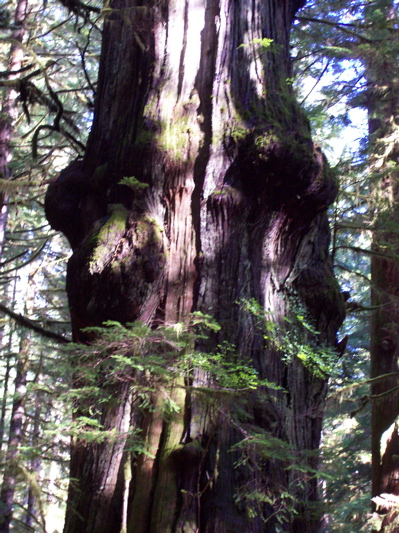
The rough path leads the big tree hunter to some spectacular individual behemoths. There are some very large Douglas-fir, but the real stars here are the amply aged and weathered Western red-cedars. They are big and gnarly, and unlike any cedars I have seen. Most of the largest cedars are festooned with burls and whorls that are unique in their twisted beauty.

Ancient Western red-cedar in Lower Avatar Grove
The big Douglas-firs are dark and ominous looking, and far above the twisted and broken tree-tops poke out of the canopy and catch the last light of the day.

Big Douglas-fir in Lower Avatar Grove

I lost the trail on the way back up to the road, but there is little undergrowth and many fallen logs to walk along. It is hard to get lost here as all you need to do is point yourself uphill and hike till you hit Gordon Main, which is what I successfully did.

Giant tree broken off at the top, but still tall enough to poke above the rest


Back on the dusty gravel it seemed hard to believe that I have drove right through the middle of this old growth forest several times over the years without ever knowing what treasures lurked just a meter off the road. I ran up into the upper grove for a few brief minutes and look forward to returning at a later date for a more extensive upper grove excursion.


Lower Grove - big moss covered trees everywhere

See Avatar Grove

Leave Victoria and take Hiway 14 to Sooke, check gas gauge, then continue to Port Renfrew.
At Port Renfrew turn RIGHT onto Deering Rd. Follow Deering Rd. until the T intersection, then turn LEFT (right is toward Lake Cowichan). Follow road until the bridge over the Gordon River. Cross the bridge and stay on Gordon River Main for about 1.5 km. Right after you cross over the single lane bridge at Baird Creek, pull off to the right and park. Trail access has been marked by AFA on both sides of the road. Visit gently - be respectful. Enjoy the trees.


View Avatar Grove in a larger map

Save Avatar Grove

You would think that a bit of ancient forest on a well kept main logging road only 20 minutes from Port Renfrew would make someone in government think about preservation and tourism potential. Avatar Grove is on Crown land, so saving this valuable forest treasure would not entail purchasing land from a greedy logging/development company.

Please consider contacting elected officials to let them know preservation is the most logical thing to do with this increasingly rare piece of primeval forest, and the massive trees that thrive in it. Let them know that cutting thousand year old trees for pulp, paper, and deck lumber is greedy and unnecessary.
 

10/17/2010

The San Juan Spruce: Canada's Largest Sitka Spruce

Looking down into San Juan Bridge campground and Canada's largest Sitka spruce

There is nothing like a big tree road trip. VIBT hit the road recently on a perfect fall day, and headed for the big trees of Port Renfrew, B.C. Destination? The San Juan Spruce, Canada's largest Sitka Spruce (Picea sitchensis).


There are many giant trees lurking around the Port Renfrew area, some well known, and others yet to be discovered. One of the more well known trees resides next to a bridge about 20 km up the San Juan River east from Renfrew. There are few known trees of its proportions anywhere, and if it were in some other country, it would undoubtedly be more celebrated than it is here.


This massive building-sized tree is Canada's largest spruce tree when measured by wood volume (333 cubic meters). You can see the 62.5 meter top of it from the bridge as you cross the river. It is in an area where other large Sitka spruce can be seen poking up like islands in the sea of second growth around them.


As you turn left at the end of the bridge and descend down to the San Juan River Bridge Forestry Recreation Site, the full 3.71 meter diameter of the champion spruce comes into view. 


The San Juan Spruce is all out of proportion compared to what one normally thinks of as a typical tree. It would take several adults holding hands to circle the 11.6 metre circumference base. This is the second largest Sitka spruce in the world after the Queets Spruce in Olympic National Park, Washington. 
 
At first the visitor will be struck by the sheer size of the giant, but after a while may also come to appreciate its interesting architecture. It has a complicated canopy, including a side trunk that is a large tree in its own right.

Hanging gardens of moss and fern living on a Bigleaf maple in the campground        


The San Juan Spruce is much more than just a tree - it is an entire vertical community of rain forest life. A large bracket fungus graces its lower trunk, and ferns grow in splashes of fluorescent green everywhere on the trunk and in the canopy. A Red-backed vole could live its entire life in this one tree. Forest debris builds up thickly on branches supporting a variety of spongy mosses, and even other trees.


A pilgrimage to this living monument is a tribute to the logging survivors that remind us of our connection to the ancient forest. A visit to the San Juan Spruce can also be seen as a tribute to Randy Stoltmann. He discovered, then worked to protect, this amazing tree. Stoltmann was compiling the beginnings of British Columbia's Big Tree Registry when he died in a back country accident in 1994.


Bonus: See the Red Creek Fir (biggest Douglas-fir in the world) while you are back here, if you are driving a 4X4 or other high clearance vehicle. Watch for signs along the way once you leave Harris Creek Main. It should be possible to loop back to Port Renfrew via Red Creek Main (edit: Red Creek Main is no longer passable).

Getting There 

Take Highway 14 from Sooke to Port Renfrew, a distance of about 88 km. From Port Renfrew take Deering Road to Harris Creek Main. Turn right toward Cowichan Lake until the Y intersection shown on the map. Watch for signs that will lead you to San Juan Bridge Recreation Site, a small, rustic 6 unit campground next to the San Juan River. Drive carefully and always be prepared with supplies and an emergency kit while driving logging roads in the back country.


View San Juan Spruce Near Port Renfrew in a larger map