Showing posts with label wildlife. Show all posts

5/10/2014

Dead Wood Is Good Wood

A large diameter fallen tree along Upper Goldstream Trail in Goldstream Provincial Park. Over hundreds of
years the fallen Western red cedar will provide nutrients for the large Douglas fir behind it.


In the Pacific rainforest dead standing and fallen trees may make up more biomass than the living giants towering above the soil. If it weren't for these dead trees, and the decomposers that break them down, the forest would cease to exist.


According to renowned forester Chris Maser, ‘decaying wood serves as a savings account of soil organic materials and nutrients in forest ecosystems’. This is one reason landowners should not try to "clean up" forested areas. They need to be messy in order to function properly.


Sometimes messy old growth forests are deemed "decadent" to justify cutting them down. But you can't improve on the natural cycles of life and death.


Fallen large trees enhance fish habitat by providing shade and structure.
These downed trees are over the upper Goldstream River.


Dead wood is also a boon to forest wildlife.

In the words of forest scientist Charles Elton, "dying and dead wood provides one of the two or three greatest resources for animal species in a natural forest...if fallen timber and slightly decayed trees are removed the whole system is gravely impoverished of perhaps more than one fifth of its wildlife component".

The healthiest forest is an untouched forest, in all its messy, "decadent" glory.


3/05/2013

Rolling Over Crown Forests


BY BRIONY PENN, MARCH 2013 Focus on Line http://www.focusonline.ca/?q=node/513BC


Liberals go ahead with another giveaway of publicly-owned land to corporations.


Three years ago, in a feature report entitled “The Big Burn,” Focus revealed the findings of a dozen retired forest service professionals about BC Liberal plans to privatize BC’s forests under pressure from what are called “distressed asset managers.” These are the mega-corporations like BAM (Brookfield Asset Management; now the top performing company in Canada) and TAM (Third Avenue Management) that buy up majority interests in distressed logging companies (including Canfor, Weyerhauser, Catalyst, Western Forest Products, TimberWest, Island Timberlands etc).

Through political pressure for deregulation (eg lobbying to get rid of riparian zone and watershed regulations), they manage to enhance their lands’ value. Then they strip off the timber and rationalize the lands into categories of real estate, bioenergy plantations, etc. Then they flip them. They’ve been incredibly successful in liquidating hundreds of thousands of hectares of heavily-subsidized private forests on Vancouver Island.

Now the BC Liberal government is amending the Forest Act in ways that will help such companies gain more control over public forestlands.

Distressed asset companies have been lobbying behind the scenes for a decade for their ideal tenure reform: changing volume licences—where they just get the trees, to the more lucrative area licences—where they get everything, including the underlying land.

The aftermath of a tragic fire at a Burns Lake sawmill and the perceived need to leverage money for a new sawmill to restore jobs in a distressed community—with an election looming—was just the prompt the Liberals needed to introduce “area-based tree farm licences at the minister’s invitation.”

Of course this legislative change may also open up a Pandora’s box for the Liberals just before an election. In 1988, the Socreds tried sneaking in this form of privatization—which is called “rollover”—and failed.

Forest licences were originally set up with checks and balances to limit companies from creating excessive “shareholder value” and to ensure some benefits came back to the public—either in the form of royalties or leaving the forest standing to provide all the ecosystem services that we enjoy. In the last 10 years, however, regulations governing licence holders have been eroded to such an extent that those checks and balances just aren’t there anymore.

With forest legislation and regulations gutted, licence holders don’t even have to provide management plans anymore. The natural next step for an aggressive, corporate-friendly government has now been taken: allowing companies to roll over their volume-based licences into area-based Tree Farm Licences. Many see this process as de facto privatization of public forests. Anthony Britneff, a retired government forester, says, “These tenures are like the granting of fiefdoms in which the company can strip and sell whatever they want without any requirement to invest in local infrastructure and to manufacture timber locally as a condition of holding tenure. There is no social contract in the public interest.”

A leaked Ministry of Forests, Lands and Natural Resource Operations document dated April 7, 2012 revealed the Liberals were considering tenure reform back then to address an apparent request from Hampton Affiliates, the American company that owns 89 percent of Babine Forest Products, for government assurance of an adequate, secure timber supply before it would rebuild the mill at Burns Lake.

The memo suggests the annual allowable cut to feed the mill could be expanded far beyond what the region can sustain, leaving it decimated even by Ministry of Forests’ own internal accounts. The document also posits reducing the rules around old-growth timber, wildlife management and viewscapes. It notes that it may be necessary to suspend the chief forester’s authority to set the annual allowable cut and have those decisions made by the cabinet instead, without any public consultation. And it warns that such a dramatic policy change could trigger legal challenges.

Bob Simpson, independent MLA for Cariboo, first drew attention to the leaked document and correctly predicted new legislation would consist of “a few short paragraphs that will enable a designated politician to set the rules by which a private corporation can be given exclusive rights over areas of our public forests.”

Hampton Affiliates has a history of acquiring distressed forestry assets, stripping the timber and later selling the sawmills and underlying land. Their website currently features three sawmill sites in Washington and Oregon, levelled and ready for sale. One wonders how many jobs disappeared with closure of the sawmills in Leavenworth, Fort Hill and Packwood. Hampton also has a relationship with Brookfield Asset Management, having sold 67,700 acres of North Cascade Tree Farm to them in 2008 after it was stripped.

The details of Minister Thomson’s capitulation to Hampton’s demands are confusing. In a September 2012 letter to Hampton Affiliates, Thomson stated: “Based on the recommendations of the Timber Supply Committee regarding conversion of volume-based licenses to area-based licenses, we will bring legislation to the House at the next session.” And the Timber Supply Committee’s “approval” was front and centre again at the February 20 press release announcing the Forest Act amendments.

But the report of the bipartisan Timber Supply Committee, which is made up of sitting MLAs, didn’t make any such recommendations. Instead, it called for maintaining the past, cautious approach under the Forest Act, and if any conversions of tenure are to be made, the Committee suggested they should be towards more community-based tenures with public consultation. There’s also a discrepancy in timing. Thomson claims in the September letter to be listening to the Timber Supply Committee, but the leaked document from April suggests his mind was already made up a month before that committee was even struck.

But problems with the Liberals’ plan go deeper than the bad optics of misrepresenting the facts. No proper inventory of forest resources has been done in the last ten years in BC, so the Liberal government has no idea of the value of the forest being traded. As well, Thomson seems to be guaranteeing Hampton Affiliates—in addition to an increased annual allowable cut of saw logs—virtually every standing stick or shrub for their bioenergy plant. That kind of scorch-and-burn policy doesn’t leave any room for climate and biodiversity protection. And Thomson is offering this to a company that has a record of consolidating assets, dismantling sawmills and flogging the underlying land for higher earning ventures. Hampton will also be eligible for what such companies refer to as “entitlements in progress,” including potential compensation from First Nations’ claims, having say over other resource uses, and, of course, selling their TFL to whomever they want.

The worst-case scenario sees Hampton getting its TFL, decimating the region in search of fibre, not finding enough, coming up against legal challenges from everyone, launching a few of its own by claiming the fibre supply was misrepresented to get them to invest in the mill, and then walking away with compensation from taxpayers. The public would be left with devastated lands and “For Sale” signs for the abandoned sawmill.

There is also this precedent-setting issue: If one corporation gets a more secure forest tenure then what about all the others? And what expensive legal challenges will result if British Columbians vote for a new government in May, one that wants to change course?

Perhaps the most predictable aspect of the Hampton tenure question is that a debate over how Crown land is used was hijacked by the separate issue of how to get Burns Lake millworkers and others in the pine-beetle-impacted areas back to work. It’s a typical “shock doctrine” maneuver in which an important debate gets suppressed because of the urgent necessity of dealing with an emergency. Who wants to get between a man and the prospect of a return to his job?

But if we continue to carve up and lose our forests to short-term, private interests, our ability to fight climate change and keep functioning ecosystems that sustain life will be gone forever.

Briony Penn has been reporting on Crown land issues for many years; she believes a public forum on how we value our Crown lands is long overdue.See “The Big Burn” (August 2010) at http://www.focusonline.ca/?q=node/71.

2/13/2013

Forest Creatures: Wolf

Wolves call the forests and beaches of Vancouver Island home

One of the most heartening news items I have read in a while was a few days ago. The piece told the tale of a lone wolf living on a small island just off shore from the city of Victoria.


Wolves are a symbol of wilderness wherever they live. The same as other top predators like bears and cougars, the presence of wolves is an indicator of a functioning ecosystem. Indeed, the top predators are necessary for optimal ecosystem management.


A recent survey looking at the loss of top predators (especially wolves) in the Northern Hemisphere found "that the loss of major predators in forest ecosystems has allowed game animal populations to greatly increase, crippling the growth of young trees and reducing biodiversity. This also contributes to deforestation and results in less carbon sequestration, a potential concern with climate change."


It goes on to say that "large predators can help maintain native plant communities by keeping large herbivore densities in check, allow small trees to survive and grow, reduce stream bank erosion, and contribute to the health of forests, streams, fisheries and other wildlife".


The forest needs the wolf.


View Staqeya The Wolf in a larger map


The islands off Victoria are in Songhees First Nation territory. The band gave the animal on Discovery Island the name Staqeya, which means wolf in Lekwungen.


The wolf has also been seen on Trial Island, perhaps in a bid to return to the wild. But there are a few kilometers of danger before the edge of the forest begins, and the wolf returned to Discovery Island.


Wolf is an important symbol in Coast Salish culture, and has been for eons. Many stories are told about this amazing forest creature that coexisted peacefully with the people.


Historical 60 ft Wolf Head Canoe

The most important wooden canoe design in Coast Salish territory is known as the Wolf Head Canoe.


These giant ocean going vessels are carved from huge old growth cedars more than 300 feet high. Such trees are becoming increasingly difficult for native canoe builders to find today.


Nuu Chah Nulth legend believes that the Killer Whale will come to the rescue of the Sea-Wolf when in trouble, and therefore the wolf is the figurehead on their canoes.


The design (by bands on the rough outer coast of the island) proved so seaworthy that it gained acceptance and use throughout the Salish Sea area.


That wolves can still exist on Vancouver Island after 150 years of European contact and exploitation is good news. Top predators, like wolves, are a necessary part of the ecosystem on the south coast, and are a direct link to eons of Coast Salish history.


Staqeya is reportedly lean and healthy, and could conceivably stay on the island indefinitely. She has been eating a varied diet including seals, bird, clams, crabs, and possibly river otters.


The Songhees would like to see the wolf stay. Fish and Wildlife however, has already tried to trap the animal with no success, and may try again.


But wolves, being very smart creatures, are wary of anything smelling of certain humans. I'm cheering for the wolf, and the wilderness it requires and helps maintain.

4/05/2012

Garry Oak Habitat Threatened

Garry oak habitat, Saanich, BC
Garry oaks (Quercus garryana) are large deciduous trees with lobed leaves, grey bark, and a twisted, gnarly branching pattern that gives the trees a stately, ancient look. They are the only native oak species in British Columbia, and their showy flowering habitat is one of the most threatened in the province.

Garry oak habitat covers a tiny area found within the Coastal Douglas-fir zone covering southeast Vancouver Island, part of the Gulf Islands, and a tiny bit of the mainland. The land on which the city of Victoria was built was almost all Garry oak meadows in pre-contact times.

The grassy meadows contain relatively open forests of oak trees. These rich areas are important to the area's original inhabitants who have long collected Camas bulbs as an important food staple. The spectacular blue wildflower grows from bulbs that were cooked in pits and eaten, or dried for trade or storage.

The oak trees are surrounded by grasses that are dotted with delicate wildflowers during a 3-4 month flowering period. Companion trees in this eco-zone are Douglas-fir, Arbutus, and Shore pine.
Garry Oak Meadow Flowers

The Coastal Douglas-fir zone is one of British Columbia's smallest, covering about 4% of the province. Garry oak habitat is a smaller area within that, so has always been extremely rare.

Already, 95% of this spectacular ecosystem has been altered. They are constantly under threat of being developed since their habitat overlaps with the most populated areas of Vancouver Island.

Little studied, we may never know what we have lost in this biologically diverse area. Garry oak habitat contains more plant species than any other terrestrial ecosystem in Canada. Many of the residents can not live anywhere else, including the mighty oaks.

However, beautiful meadows endure, and remain a place where garter snakes and alligator lizards bask on sunny rock outcrops. A rich assortment of wildflowers, including Camas, flower every spring over several scented months.

The Garry oak meadows that are left can be found in the Victoria area, Duncan, Nanaimo, Comox, and most southern Gulf Islands.

To learn more about Garry Oak Preservation, see here.

1/15/2012

12/11/2011

Ravens - Rainforest Roosters

Ravens are rain forest roosters

Here in the northern hemisphere we are just about through the darkest days of the year. In less than 2 weeks we will celebrate winter solstice, the darkest day of them all. These are magical times, and humans are not the only ones to notice.

I live in a semi-rural part of a small south Vancouver Island coastal village of 10,000. Here, among the fog-cloaked tall trees, people have not yet taken over. Our town is shared with harbour seals, orcas, black bears, cougars, bald eagles, and big, black ravens.

Out here, on the far western edge of the continent, you can experience the folly of feeling like an all-powerful, highly evolved ape. In comparison to the vastness of the stormy sea on one side, and the impenetrable, deeply green, mossy forest on the other, the affairs of humans are mere scurryings of ants, and the watchful ravens reside over it all.

Over the past few long nights the ravens have been orchestrating the elements from their lofty laboratories in the tree tops within earshot of my bedroom window. Dressed in their black cloaks, these early risers are the mysterious roosters of the rain forest.

Each morning for the past couple of weeks I have been woken by the raven's guttural and commanding call. I hear it as an invitation to stand up and face the magic of the rising sun, and new day.

A day that will soon be a little more magical, and a little more sunny than the one before.

12/01/2011

Surfing The Drift Wood

Bufflehead riding the driftwood during recent high spring tide

Nice platform for preening and relaxing

Even after trees fall and enter local waterways they continue to provide habitat for local wildlife.

I caught this Bufflehead (Bucephala albeolata) taking advantage of a piece of driftwood in the Sooke Harbor recently.

Wintering Buffleheads prefer the shallow water shelter of the coves, estuaries, beaches and harbors along the coast of southern Vancouver Island.

These tiny birds are the smallest diving ducks in North America, and also one of the fastest in flight.

Drift wood in the estuary and harbour is a magnet for Buffleheads and other creatures such as: eagles, vultures, ducks, river otters, kingfishers, cormorants, and gulls.


Multiple seagull captains surfed this big log away

11/20/2011

Hiking In Cougar Country

If you encounter a cougar, face it, look into its eyes, and
make yourself look big. Illustration: Backwoods Home

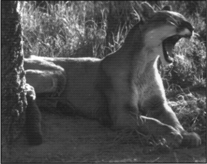
The forests of Vancouver Island are home to Puma concolor, more commonly known as puma, mountain lion, or cougar, as they are called here. This amazing relative of domestic cats has the greatest range of any large wild terrestrial mammal in the Western Hemisphere. The island has one of the highest concentrations of cougars in the world.

If you are planning a trip to visit the big trees of the island, an encounter with a cougar is possible. Hiking in wilderness areas increases the likelihood of having an encounter. You can help yourself (and the cougars) by learning a bit about these elusive creatures before you go into their forest home.

While doing research on these stalk and ambush predators I found some potential ways to protect myself while out hiking. One of my favourites was a recommendation to wear a hat or hoodie with large eyes painted on the back. Another was to frequently look up, around, and behind you as you hike to show a cougar that you are being alert. Ambushes happen when the prey is not paying attention.

The BC government website has some good, comprehensive information in their Safety Guide To Cougars. I have included some of their tips below.

When in Cougar Country:

We have little understanding about what might trigger an attack, but following these general guidelines will reduce the risk of cougar conflict and prepare you in the unlikely event of an attack.

 Hiking or working in cougar country:
  • Hike in groups of two or more. Make enough noise to prevent surprising a cougar.
  • Carry a sturdy walking stick to be used as a weapon if necessary.
  • Keep children close-at-hand and under control.
  • Watch for cougar tracks and signs. Cougars cover unconsumed portions of their kills with soil and leaf litter. Avoid these food caches.
  • Cougar kittens are usually well-hidden. However, if you do stumble upon cougar kittens, do not approach or attempt to pick them up. Leave the area immediately, as a female will defend her young.
Cougar
If you meet a cougar:
  • Never approach a cougar. Although cougars will normally avoid a confrontation, all cougars are unpredictable. Cougars feeding on a kill may be dangerous.
  • Always give a cougar an avenue of escape. A cougar that feels trapped is unpredictable.
  • Stay calm. Talk to the cougar in a confident voice.
  • Pick all children up off the ground immediately. Children frighten easily and their rapid movements may provoke an attack.
  • Do not run. Try to back away from the cougar slowly. Sudden movement or flight may trigger an instinctive attack.
  • Do not turn your back on the cougar. Face the cougar and remain upright.
  • Do all you can to enlarge your image. Don't crouch down or try to hide. Pick up sticks or branches and wave them about. Hold your back pack above your head.
If a cougar behaves aggressively:
    Cougar
  • Arm yourself with a large stick, throw rocks, speak loudly and firmly, or growl. Convince the cougar that you are a threat not prey.
  • If a cougar attacks, fight back! Many people have survived cougar attacks by fighting back with anything, including rocks, sticks, bare fists, and fishing poles.
Cougars are a vital part of our diverse wildlife. Seeing a cougar should be an exciting and rewarding experience, with both you and the cougar coming away unharmed. However, if you do experience a confrontation with a cougar or feel threatened by one, immediately inform the nearest office of the Conservation Officer service.

3/20/2010

Large Old Snags Very Important To Wildlife


Snags, or standing dead trees, like the one near the center of the above photograph, provide food and shelter for a richness of life. Birds nest in snags, and small mammals make homes there as well. Moss and lichen will live on the bark, while fungus and insects soften the core of the tree. A large snag could stand for 150 years or more before it finally topples to the forest floor.


At right is a blow up of the above tree showing a large diameter hole near the top. Woodpeckers, like the Pileated woodpecker, excavate holes in snags for feeding and nesting. The woodpecker digs a new nest hole each year so in subsequent years other birds or mammals may move into old cavities.


Snags are so important to forest ecology that British Columbia has a program to tag and protect such trees as "Wildlife Trees". These valuable resources are marked with a yellow symbol which identifies and protects them.


Many forest creatures can only live in large, old trees, and snags can provide the height and structure they require. The Spotted owl is an example of a bird that requires old trees for nesting, often setting up in snags, living in the hollow of the broken top.


Bald eagles use large trees for perching and nesting, often having a second nest nearby in a companion big tree. Eagle nests can weigh up to 1000 pounds - you need a big tree to be able to hold such a massive structure of branches.


The threatened Marbled Murrelet also needs old growth trees.

"Throughout the murrelets’ North Pacific range, most occupied nests have been found in tall trees. They were simple cups in the moss on thick branches, 20 to 40 m above the ground. Only fairly old Douglas fir and Sitka spruce have branches thick enough for murrelet nests, although other trees may offer suitable platforms or cavities.

Trees with thick branches near the top usually occur in stands of old growth and mature forests that are rapidly being cut for timber. If it turns out that British Columbia’s murrelets are not concentrated in colonies and have no alternative nesting habitat, the need to protect sites for murrelet nests will be another reason to preserve more of British Columbia’s coastal old-growth forests. However, a great many areas still remain to be explored for nests." http://www.hww.ca/hww2.asp?id=55&cid=7

When we save large old trees, whether they are dead or alive, we are also saving a vast richness of life that depend on such trees. Each ancient tree is an ecosystem to itself, and we are just now realizing their true importance. The snag pictured at top enriches Francis/King Regional Park, Saanich B.C.

9/27/2009

Forest Creatures: Snakes and Slugs (Warning: graphic photos)


I was touring one of my favourite big tree haunts recently when I spotted thissssss beautifully patterned forest resident. It reminded me that I was visiting the homes of many creatures that reside in the rain forest, and make up the web of life here. The occasional pile of purple poo from passing black bears was also a reminder that I must be aware of the larger forest residents. Cougars are regular visitors, too. Out here I am prey.

Today the garter snake was the one to make its presence known. Found under the Sooke River Super Cedar of Gargantuan Proportions (I really must streamline this naming thing), this snake was surprisingly fast. When I slowed down, so did the snake. It stretched out before me and sunned a bit in a shaft of light piercing the forest canopy. We stared at each other for a while, his beady black eye to my blue one.


Here is how I envision a garter snake deciding on potential prey:
  • Is it alive?
  • Will it fit in my mouth and down my throat?
  • Can I catch it?
If the prey satisfies these criteria, it is on the menu. I found out on a hike last year, that the garter menu includes the second biggest slug in the world, the Banana Slug (more than 20cm). I didn't think anything ate slugs. Compared to dung beatle fare, slug could be considered a delicacy. After all, slugs are basically snails without shells - large escargot.


The snake did not move while I photographed it attempting to consume this large lunch. How could it? I was simultaneously mesmerized and mortified. I continued on my hike. Both snake and slug were gone when I returned. Note: you can click on any of the photos to get a blown up view of this amazing natural phenomena. Just thought you would like to know...

The garter snake will also eat small birds, leeches, amphibians, small rodents, and other snakes. This snake is very aquatic and in coastal areas fish makes up a large part of their diet. The snake I saw recently was next to the Sooke River, so the tiny salmon I was watching that day were no doubt in trouble when the snake hit the river.

Garters are fast on land and in water. As I watched the snake it slithered off quickly. I had to move fast to follow, hunched over and moving through the understory. About 10 meters away the snake bee-lined (snake-lined?) for a hole at the base of a fallen tree, right under the root ball. Had I discovered a snake den, or "communal hibernacula"?
Garter snakes spend the winter in communal dens, sharing space and warmth through the cold temperatures. This looked like one. I had a sudden urge to stick my hand in. Why? I resisted. One should not harass wildlife. Especially snakes. Do not touch garter snakes unless you want to see their defense mechanism - they will poop on you (it is very smelly). If they feel threatened they could also bite. Best to enjoy them from a distance, like all wildlife.

Here is a group that is trying to improve life for another coastal snake, the sharp-tailed snake, on Salt Spring Island. They remind us that snakes are an important part of our ecosystem and should be treated with respect. The Salt Spring group educates the public on habitat conservation and builds hibernacula for sharp-tailed snakes. You can build a hibernacula in your own yard or garden. How fascinating would that be?

I will be watching the Sooke River Cedar Hibernacula location in the spring when the snakes will be out on warm days to stretch their bodies (adults are 46cm to 1.3m) and warm in the sun. After being bundled in a coil with a hundred friends all winter, they will be ready for mating. Mating involves bundling up in a ball again, this time with many males surrounding a single female. Garter snakes are live-bearing and give birth in July or August. Baby snakes are born fully developed, and litters range from as few as 5 to as many as 80.

Every creature in the forest ecosystem is important, and that includes snakes and slugs. Slugs are the recyclers of the forest and clean up dead and decaying matter and return nutrients to the soil. Snakes keep insect and rodent populations in check. Many forest animals feed on snakes, including raccoons, blue herons, eagles, and owls. If you can respect slugs and snakes, and recognize their important place in the cycle of the forest, surely you can respect everything in the forest. Such respect is sssssorely needed today.