4/18/2012

Nanaimo Mill Workers Lose To WFP

The  first sawmill in BC, 1848. Sawmill is on the right,
and a grist mill is shown on the other side of Millstream, near Victoria.

British Columbia's old growth forests are not the only victims of years of mayhem in the woods - forestry workers are suffering as well.

Based on data from the BC Ministry of Forests and Range, from 1991 - 2000, the average rate of closure was 3 mills per year. From 2001 - 2009 it rose to 6 mill closures per year. The closures account for the loss of thousands of jobs, and takes millions of dollars out of forestry-based communities.

The following article is a recent example of how forestry workers are suffering from bad policies and corporations looking out for #1 and the bottom line.

Mill workers lose court battle

Labour arbitrator sides with WFP in longstanding fight

By Robert Barron, Daily News April 16, 2012

Hundreds of laid-off workers at Nanaimo's two Western Forest products' sawmills won't receive severance packages after labour arbitrator David McPhillips recently ruled in favour in the forest company in a longstanding dispute.

Darrel Wong, president of the United Steelworkers Local 1-1937 which represents workers at the two mills, said the union sees no point in appealing McPhillips' decision even though it feels many of its arguments in the case are still valid.

WFP spokeswoman MacKenzie Leine said she's not surprised by the arbitrator's decision.

The union began court action against WFP over their concerns that the forest company may have reopened its two sawmills in Nanaimo with skeleton crews in 2010 to avoid having to pay severance packages, totalling more than $6 million, that the company would be mandated to pay if the mills remained closed.
Read full article here.

With old growth forests being rapidly depleted, raw log shipments, lack of government oversight in the woods, and logging companies using questionable business practices to avoid their responsibility to workers, it is hard to see how the citizens of this province are benefiting from the harvesting of our forestry resources.

4/13/2012

Cooperation In The Forest

A forest is the ultimate sustainable cooperative community
Trees are but part of the larger forest, 2/3 of which is unseen under our feet. Also unseen is the incredible amount of cooperation that takes place in the forest.

There are many mutually beneficial relationships between species, creating a web of working together to form an entity much larger than any of its parts.

Everything has a role to play in building and maintaining the forest. It would continue in perpetuity, if we would allow. A forest is the ultimate sustainable, cooperative community.

Instead of wiping trees and forests out, we should be studying them and learning their valuable lessons.
Mushroom (mycorrhiza) Cooperation
"In the early 1990s mycologist Suzanne Simard and her team at Oregon State University discovered that cobwebby networks of mycorrhiza could connect not only many trees of the same species but also trees of different species.
They encountered birch connected to fir trees by up to ten different species of fungi. Moreover, birch trees growing in bright sunlight seemed to be subsidizing fir trees in the shade by sharing sugars via their mycorrhiza network."  - source: backyardnature

4/12/2012

Liberals ignoring committee on raw log exports: Dix

Overseas shipment of raw logs
I was wandering through the Ancient Forest Alliance's website and came across an important news item. I thought it worthy of sharing so the citizens of BC can learn what the present government is doing with our forests. The raw log export situation in the province should enrage both environmentalists and forestry workers alike.

NDP leader demands explanation for decision to send timber overseas rather than sell it to B.C. producers

The Vancouver Sun - Jonathan Fowlie, March 14, 2012

The B.C. Liberal government has, since December, been exporting raw logs that its own advisory committee has been saying should be going to producers in B.C.

On Tuesday, New Democratic Party leader Adrian Dix said the Timber Export Advisory Committee (TEAC) deter-mined last December that logs from Quatsino Sound on Vancouver Island should be sold to Teal-Jones of Surrey instead of being shipped overseas.

But Minister of Forests, Lands and Natural Resource Operations Steve Thomson overruled that recommendation, Dix said, allowing the logs to be sold into foreign markets.

"The minister owes people an explanation for his decision," Dix said during question period Tuesday.

"The committee made the determination that keeping those logs in British Columbia was better for our economy than exporting them, and the minister overruled them."

Thomson said his ministry rejected the recommendation because TEAC had changed the way it was evaluating whether or not logs should be sold to foreign buyers.

"Without just taking their advice directly, in this case because we knew there was policy implications that needed to be considered, we administered the policy the way that it had always been administered and the way they had previously been providing advice to us," Thomson said Tuesday, adding the committee has no regulatory function, and is an advisory body only.

"It's not a process of overruling TEAC," he continued, "it's a process of a shift in policy advice being received from the advisory committee."

Ministry staff said the issue stretches beyond Teal-Jones, and has affected about 150 applications since December, comprising about 116,000 cubic metres of timber.

The ministry said that staff overturned TEAC recommendations on 86 applications in December and January, covering 70,145 cubic metres.

In February, the ministry stopped referring anything to the committee from the west coast of Vancouver Island, as they expected the decisions would be overturned. There were 47 offers in February, comprising 35,532 cubic metres.

In March, TEAC requested it be allowed to review cases again, and government agreed. The committee has so far reviewed 18 offers for 10,168 cubic metres, staff said.

Thomson said he has met with members of the committee and is reviewing the change they made in December to deter-mine if it's something government is willing to adopt.

"We're continuing to review that with [TEAC] and we've committed to get back to them," he said, adding he will have an answer before the committee's next meeting in April.

"But because there was a change in determination and a change in policy in terms of their advice we know we needed to look at this and have a discussion around the implications of the policy."

At issue in the matter is the way TEAC judges fair market value for logs.

As of December, the commit-tee began looking at domestic offers for coastal logs that did not include the costs to ship the logs to the buyer. This represents a change from before, where the offer made for the logs had to include the cost of freight.

It means domestic offers can potentially be more competitive than before.

On Tuesday, NDP forest critic Norm Macdonald said the issue goes beyond the details of how to calculate market value, adding the key is all about jobs.

"You have manufacturers that are ready. You have Teal-Jones that has gone through the process. This is a company that produces jobs," said Macdonald. "You have a host of companies that are ready, and these are the crumbs we're talking about that go through this advisory committee. These are the crumbs, and even them - this minister will deny those mills."

In 2011, British Columbia exported 5.87 million cubic metres of coastal raw logs. That was up from the 3.86 million cubic metres that were exported from the coast in 2010.

Stop old growth logging, now. Stop the export of BC raw logs and BC jobs. Retool sawmills for sustainable 2nd or 3rd growth smaller-log forest industry. Replant the backlog of logged-off lands.

4/05/2012

Garry Oak Habitat Threatened

Garry oak habitat, Saanich, BC
Garry oaks (Quercus garryana) are large deciduous trees with lobed leaves, grey bark, and a twisted, gnarly branching pattern that gives the trees a stately, ancient look. They are the only native oak species in British Columbia, and their showy flowering habitat is one of the most threatened in the province.

Garry oak habitat covers a tiny area found within the Coastal Douglas-fir zone covering southeast Vancouver Island, part of the Gulf Islands, and a tiny bit of the mainland. The land on which the city of Victoria was built was almost all Garry oak meadows in pre-contact times.

The grassy meadows contain relatively open forests of oak trees. These rich areas are important to the area's original inhabitants who have long collected Camas bulbs as an important food staple. The spectacular blue wildflower grows from bulbs that were cooked in pits and eaten, or dried for trade or storage.

The oak trees are surrounded by grasses that are dotted with delicate wildflowers during a 3-4 month flowering period. Companion trees in this eco-zone are Douglas-fir, Arbutus, and Shore pine.
Garry Oak Meadow Flowers

The Coastal Douglas-fir zone is one of British Columbia's smallest, covering about 4% of the province. Garry oak habitat is a smaller area within that, so has always been extremely rare.

Already, 95% of this spectacular ecosystem has been altered. They are constantly under threat of being developed since their habitat overlaps with the most populated areas of Vancouver Island.

Little studied, we may never know what we have lost in this biologically diverse area. Garry oak habitat contains more plant species than any other terrestrial ecosystem in Canada. Many of the residents can not live anywhere else, including the mighty oaks.

However, beautiful meadows endure, and remain a place where garter snakes and alligator lizards bask on sunny rock outcrops. A rich assortment of wildflowers, including Camas, flower every spring over several scented months.

The Garry oak meadows that are left can be found in the Victoria area, Duncan, Nanaimo, Comox, and most southern Gulf Islands.

To learn more about Garry Oak Preservation, see here.

3/27/2012

Urban Big Trees: Sooke Giant Douglas-firs

Big Douglas-fir veterans behind new development on Phillips Road, Sooke, BC
At one time the traditional lands of the T'Sou-ke Nation grew some of the largest trees in the world. That all changed when Vancouver Island was first opened to settlement by the Hudson's Bay Company in 1849. Walter Grant became the first settler when he bought 200 acres of land on the current site of the town of Sooke.

Grant must have been pleased with the trees on his new property. It would have been a sight unparalleled anywhere in the world - 300-400 foot Douglas-fir ancients approaching 1000 years old were probably fairly common in the area.

New houses  - old trees
One of the first buildings that Grant built was a sawmill. It was a move that signaled the beginning of the end for the primal forest on T'Sou-ke lands, and over most of Vancouver Island.

Amazingly, some of the ancient giants still stand in the ex-logging town of Sooke. After 163 years of near-total transformation, the remaining big tree survivors face a different threat today - booming residential development, and a lack of a tree protection bylaw.

Other municipalities in the region have given a nod to the historical importance of trees by instituting bylaws to protect heritage trees, and other trees of significance. The largest two trees shown in the photos above would most certainly be covered by such legislation.

3/23/2012

The Wonder Of Trees


"The wonder is that we can see these trees and not wonder more..."

- Ralph Waldo Emerson

I often wonder about the old growth Douglas-fir above. It hangs over the beach of the spit formed by the waters of the Sooke River interacting with the tides in the estuary. The massive bulk of this tree defies gravity and several other formidable and relentless forces of nature.

Exposed roots, forced out of hiding by the scouring of freshets and high tides, now provide a visible scaffolding under the slumping trunk. Other roots, as thick as the major branches above, sink deep into the bank for support and nourishment.

At the other end of this hardy survivor, the top of the tree, or leader, does a sharp bend back from the water, in a slow-motion counterbalance intended to keep the tree from toppling into the sea.

I am comforted every time I see that this old timer continues on in defiance of the elements. It stands, tough, resilient, patient, and steadfast.

I wonder how long it can continue.

3/20/2012

Save The Great Bear Rainforest

Chief Qwatsinas of the Nuxalk Nation with friend visiting Great Bear Rainforest giant cedar
near Bella Coola, photo: Cristina Mittermeier
The Great Bear Rainforest, on the BC mainland across from northern Vancouver Island, is once again in the international spotlight. In 2006 various stakeholders agreed to work together to protect this precious resource, home of the Spirit Bear, old growth cedars, endangered animals, and numerous indigenous communities. The collaboration was unprecedented, and hopes ran high.

4.4 million acres, 50% of the forest, was protected. Additionally, another 11.6 million acres is managed under an ecosystem management plan. However, in spite of initial successes in moving toward sustainability, a less rosy picture is starting to emerge.


The website savethegreatbear.org reports:
"Overall, the agreements amounted to an ambitious and much-celebrated plan that’s yielded some notable success. Sustainable economic development is starting to take root in communities within the Great Bear Rainforest, which is now better protected from logging than it was before.
But these efforts have also been beset by delays that call into question whether the full vision of the agreements will be realized in time to safe-guard the forest as we know it."
The Great Bear Rainforest encompasses one of the largest areas of intact coastal temperate rainforest left on the planet, and is therefore of global significance. In order to maintain the environmental integrity of this ecosystem, scientists using ecosystem based management, say that at least 70% of the natural old growth areas must be protected.

TimberWest clear cuts in the southern Great Bear in 2011, photo: Garth Lenz

50% is good, 70% is better, but 100% is what our goal should be. Logging old growth, regardless of where it is, is not sustainable or in the best interests of humanity.

The BC government and other stakeholders set new ground with the 2006 Great Bear Rainforest agreement. It is time to honour those agreements, and set the stage for further protection.

See government contacts here. Let officials know how you feel about saving old growth, white bears, salmon-bearing streams, and keeping the Great Bear as an intact global treasure.

Get more information about the "Take It Taller" Campaign at  savethegreatbear.org.

3/15/2012

Strong Winds Topple Trees

80 year old Islander clearing his driveway after Monday's wind storm, photo:TimesColonist
Vancouver Island's big trees have few threats as potentially life-ending as a wicked winter wind, and Monday's maelstrom proved to be the end for many. Tall trees shallowly rooted are constantly in danger from a stiff breeze, but are especially vulnerable in strong winds such as in Monday's storm.

During southeast winds the inside coast of Vancouver Island, including Victoria, gets hit the hardest. The highest winds were recorded across the Strait of Georgia along the Sunshine Coast at 187 km per hour. Powell River logged top gusts of up to 111 km per hour, and Victoria around 95 km.

Over 100,000 homes lost power in the storm, and most of those outages were caused by trees falling on power lines. As a matter of fact, most of the problems associated with the storm were tree-related with big conifers falling on power lines, roads, houses and vehicles.

Truck crushed by wind-tossed big tree, photo: TimesColonist
Three men driving on Ardmore Drive near Victoria Monday morning were prevented from proceeding by a large tree across the road. After getting out of their truck to survey the area, a second tree fell and crushed their vehicle.

Tree: 1, Van: 0, photo: CTV

Monday's storm reminded many of the whopper winds that occurred on December 15th, 2006. That storm was one of the worst since the 1960s, and knocked down about 41 acres of trees in Vancouver's Stanley Park, as well as thousands of trees along Vancouver Island's West Coast Trail.

The difference between the two storms was that the 2006 storm was out of the west rather than a southeaster like Monday. Sooke was hard hit in 2006s west gales, but was little affected by the southeaster Monday. Because of that, the power stayed on, and I have not seen any trees down in the area.

However, any time the wind blows, I tend to be aware of the trees swaying around me.

3/08/2012

The Dry Beam: Bulk Log Carriers and Whole Log Exports

The Dry Beam bulk log carrier, one of the largest in the world,
in Victoria, BC after being damaged at sea. Photo: GVHA
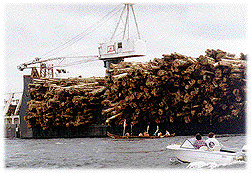
I saw a Washington forest last week without leaving Canada. It was a horizontal forest of raw logs that was laid out on Pier B at Ogden Point in Victoria, BC. Although these weren't trees from Vancouver Island, they reminded me that BC, like Washington, is increasingly sending raw logs to oversea markets.

The forest of logs on Pier B was from one of the world's largest bulk log carriers, the 186 meter (610 ft) Dry Beam. It ran into trouble last December early in its trip from Washington to Japan when a 10-15 meter (32-50 ft) rogue wave hit it, knocked the timber off track, and severely damaged the ship. Many logs went overboard into the north Pacific swells.

Logs on Ogden Point Pier from Dallas Road
The Dry Beam limped into Victoria, unloaded its cargo onto the pier, and underwent repairs so it could continue on its dangerous 8000 km (5000 mile) voyage. But it's not just dangerous for the ship's crew. The more important dangers are in British Columbia's forests.

Our forests, and forest industry, are being irreversibly altered by short term planning. Since 2002, the BC Liberal government has slashed more than 1100 jobs from the Forests ministry, gutting its ability to monitor this precious resource.

During the same time the forest industry lost over 20,000 jobs, and 70 mills shut down. As this has been happening, whole log exports have increased.

Deregulation of coastal forests has relieved forest companies of the requirement to mill their logs locally. This has caused a massive increase in the export of BC whole logs to foreign mills on giant ships like the Dry Beam.

Cutting down trees thousands of years old
is not sustainable, photo: TJ Watt

In 2006, the forests ministry recorded 320,000 cubic metres of whole log exports, rising to 534,000 cubic metres in 2010. Exports jumped 160% last year.

Bulk log carriers are floating our forests, via port facilities in Prince Rupert, to destinations such as China, Japan, and Korea. Along with our whole logs go the jobs that would employ thousands of British Columbians in a variety of value added activities.

We should be as outraged about the practice of shipping whole logs to foreign markets as the Haida were in 1996 when bulk log carriers were leaving Haida land with the very trees that made much of Haida culture possible - its sacred cedars.
"On August 1, 1996 Christian White and crew paddled out into Masset Inlet in a cedar canoe to confront the log carrier the "Haida Brave." The log carrier was loaded with cedar trees that had been cut from MacMillan Bloedel's TFL 39. This action by Christian and crew, and supported by 8 other boats and 70-odd witnesses on the beach was to give notice to MacMillan Bloedel and other forest companies on Haida Gwaii that the current policy of clearcutting the Islands is not acceptable." - from a conversation with C. White, and R. Stocker, spruceroots.org
Read more about the Haida blockade that helped popularize the plight of old growth forests on Haida Gwaii here. The Haida provide a way of viewing nature and the forest that the rest of BC would be wise to follow. They gave notice, as should we.

Haida giving notice in 1996 - "We are re-assuming control
of our forests in order to preserve them for the future"
photo: spruceroots.org
Let's give notice to the government and forest companies that current forest policies are unacceptable. Let's tell them we expect complete protection of all remaining old growth forests in places like southern Vancouver Island where the original forest is near-extinct. Let's tell them we want to stop whole log shipments, and keep forestry-related jobs at home.

Let's become a rogue wave of protest and stop the ships of destruction that are sailing unchecked through our faltering forests.

3/05/2012

100 Years Of The BC Forest Service


“The B.C. Liberal government has left the fox to guard the hen house, and has washed their hands of responsibility to effectively monitor and enforce forest regulations. This centennial should serve as a wake-up call, that our government is not fulfilling its duty to properly manage our public forests.”  - Darryl Walker


The provincial government is 'celebrating' the 100th anniversary of the BC Forest Service, but many feel that there is not much to celebrate in the province's forests. Even the government is just going through the motions, since its real 'gift' to the BCFS is not a big cake, but another massive funding cut in 2012 for this centenarian public service.

Many have weighed in to show support for this public watchdog, but I would be willing to bet they were not invited to the party.

BC's Auditor General has recently warned of the impact of cuts on forest inventory and research. The Association of B.C. Forest Professionals (ABCFP) warns that foresters may be using out of date data in their decision making.

The Forest Practices Board warns that the government is no longer able to track forest harvesting and restocking activities. These tasks have been turned over to the forest industry itself, and some think that this will spell disaster for the industry, and the environment.

Happy 100th anniversary to the BC Forest Service - here is to restoring it to its former glory and effectiveness once we get a more responsible government that is truly interested in protecting the public interest.