5/13/2013

Drift Logs Important For Beaches

Beaches on the Pacific coast are littered with bleached drift wood

Drift logs are important parts of beaches all along the Pacific coast.

The banner at the top of this blog is a photo that was taken on a beach in nearby Washington state. When the photo was taken the mammoth drift log was newly arrived on the beach and was still dark and hydrated.

After a while on beaches on the coast, drift logs age to a beautiful sun-bleached white-ish grey colour. The picture at the top of this post is of the very same drift log used for my banner, except the log has been desiccated by summertime sunny days.

But drift logs are good for more than having fun looking at them and climbing upon their prone trunks.


Drift logs closer to home on French Beach near Sooke
Often drift logs have sawn ends, an indication they are escapees from log booms or other logging operations. Regardless of their origin, drift wood acts as an important stabilizer of beaches.

In the winter these logs are tossed like tiny toothpicks by high tides and pounding waves. In the summer they settle into place and trap sand and organic material. This maintains the beach structure and provides habitat for all manner of living things.

In this way, the trees continue to do work even as they slowly decompose back into the environment.


Drift log near my home shows evidence of logging

5/07/2013

BC Liberal Government Triples Raw Log Exports

Old-growth logs leaving the Gordon River area near Port Renfrew. The logs may also leave
British Columbia and Canada on their way to be processed in foreign mills.   
Photo by TJ Watt

BC Liberal Government More Than Tripled Raw Log Exports to Foreign Mills

Media Release, May 7, 2013 
The BC Liberal government more than tripled the amount of unprocessed, raw logs leaving the province to foreign mills during their reign of power, according to recent figures provided by BC’s Ministry of Forests, Lands, and Natural Resource Operations (Min. of FLNRO) to the Ancient Forest Alliance (AFA). 
From 2002 to 2012, over 47 million cubic meters of raw logs were exported from BC to foreign mills in China, the USA, Japan, Korea, and other nations. This contrasts to about 14.8 million cubic meters from 1991 to 2001 under the NDP government. Over the past two years alone, in 2011 and 2012, record levels of raw logs were exported from BC, 13.2 million cubic meters in total. 
“The BC Liberals have decimated the province’s forestry workforce through massive raw log exports, industry deregulation, and unsustainable practices. 30,000 BC forest workers lost their jobs and over 70 mills were shut down under the BC Liberals, yet they've allowed companies to cut at near record levels,” stated Arnold Bercov, national forestry officer of the Pulp, Paper, and Woodworkers of Canada. “Under the BC Liberals, we lost both our forests and our jobs, it’s nuts.”

Read the rest of the release at the Ancient Forest Alliance website.

5/03/2013

World's Largest Yellow Cedars Are On Vancouver Island

St. RandAlly, previous champion Yellow cedar

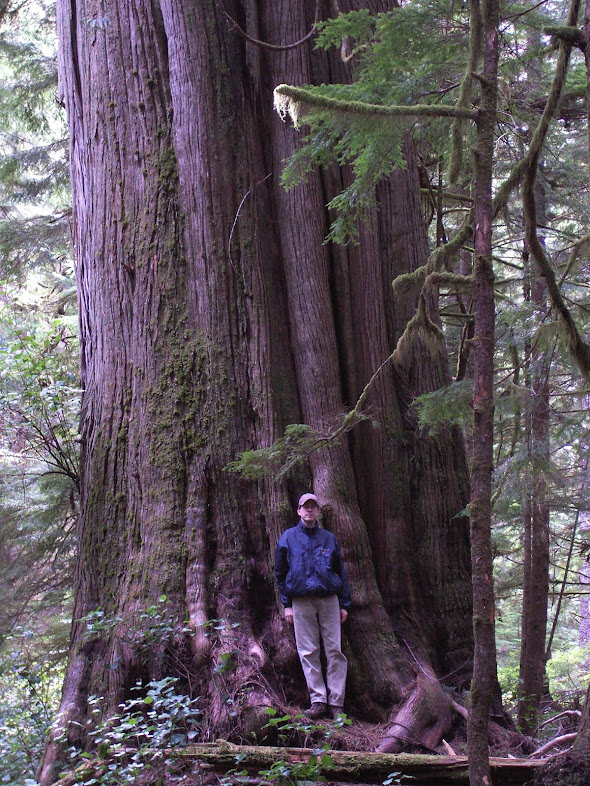
When it comes to the world's top six largest Yellow cedars, Vancouver Island is where it is at. Five of the top six are in British Columbia (the other is in the state of Washington). Of those five, at least three are on Vancouver Island.

The current largest commonly known specimen of Yellow cedar (Chamaecyparis nootkatensis) can be found near the small town of Sayward on the north west part of the island. It is in an area of big trees along Cooper Creek, and its name is Admiral Broeren.

The previous champion Yellow Cedar grew for many centuries close by to where today's champion stands. Shortly before the St. RandAlly recreational site was to open, the 2000 year old giant tree fell to the forest floor.

The tree was named after Randall Dayton and Ally Gibson, the forestry engineers that discovered the record breaker in 1993. It fell in 2004.

This fallen Yellow cedar boasted impressive measurements:
  • Height 61m (200 ft), 
  • Circumference 13.08m (42ft.11in), 
  • Diameter 4.16m (13.7ft), 
  • Crown Spread 16m (52.5ft), and 
  • Stem Volume 175 cubic meters (6,200 cu. ft). 
Note: Champion trees in North America are determined with a point system used by the American Forestry Association that awards 1 point per inch of circumference at breast height, 1 point per foot in height, and 1 point for every 4 feet diameter of the live crown.
Sgt. RandAlly's score in AFA Points was 728.

Admiral Broeren, current world champion Yellow cedar
Admiral Broeren, at 575 points, has more volume (188 cubic meters) than Sgt. RandAlly, but is smaller in height, crown and diameter.

The British Columbia Big Tree Registry lists a Yellow cedar with more AFA points (618) than Admiral Broeren. It is listed as a "recent addition", is not named and no location is recorded. I suspect it is on Vancouver Island somewhere, but at this time I can not confirm that.

The tree is recorded as having the following dimensions which would make it more impressive than Admiral Broeren, and the largest in the world:

  • Height  46.40 m (152 ft) 
  • Circumference 11.59 m (38 ft)
  • Diameter 3.68 m (12 ft), 
  • Crown Spread 12.2 m (40 ft), and 
  • AFA points 618

Yellow cedar wood

Yellow Cedar Facts
  • Yellow Cedar grows well in deep moist soils. 
  • They usually grow as single trees, but may also occur  in small groves. 
  • Can be found alongside western red cedar and western hemlock.
  • Their beautiful, rot-resistant wood is highly valued. 
  • Given optimum conditions, they can reach monumental proportions.
  • Many Yellow Cedars are dying in the northern part of their range - global warming has been fingered as the culprit. 
  • Chamaecyparis is derived from the Greek word for the ground cypress, an Old World shrub; nootkatensis refers to Nootka Sound on the west side of Vancouver Island where Yellow cedar was first identified by botanists.

Range of the Yellow cedar

These trees are common in old growth forests on Vancouver Island, but are rarer in the south island and east coast where it is too warm. In the southern part of their range they are found high in the hills where it is cooler, and where snow accumulates in winter.


Top Six Largest Known Yellow Cedars

(Chamaecyparis nootkatensis)

 Rank     Height            Diameter Volume Name and Location
               (m)  (feet)                                  m3 (ft3)
--------------------------------------------------------------------------------------------------------------------------------
1.            46.40 (152)  3.68 (12.0)        -                               Unnamed tree - unknown location in

British Columbia

2.            46.9 (154.0) 3.31 (10.9) 188 (6,650) Admiral Broeren - Memekay RiverValley,

Vancouver Island, BC

3.            61.0 (200.0) 4.16 (13.7) 175 (6,200) Sergeant RandAlly - Crown Land north

of Campbell River, Vancouver Island, BC. (tree fell in 2004)

4.            39.3 (129.0) 3.65 (12.0)         128 (4,530) Big Creek Cedar - Big Creek Trail near

Lake Quinalt, Olympic National Park, WA

5.            45.1 (148.0) 3.32 (10.9) 128 (4,520) General Buxton - Kelsey Bay, Crown

Land, TFL#39. Vancouver Island, BC

6.            39.6 (130.0) 2.28 (7.5) 103 (3,650) Cypress Park Cedar, Cypress Provincial

Park, Vancouver, BC

Related Posts

Related Posts with Thumbnails