11/15/2010

Ella Beach: Big Trees On The Edge

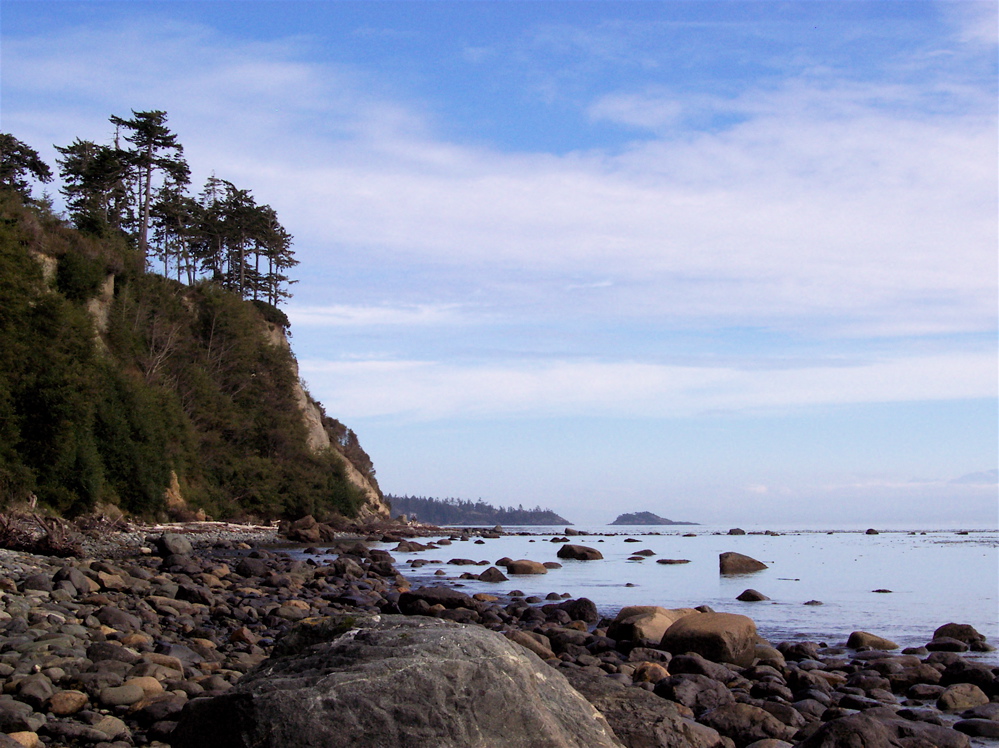
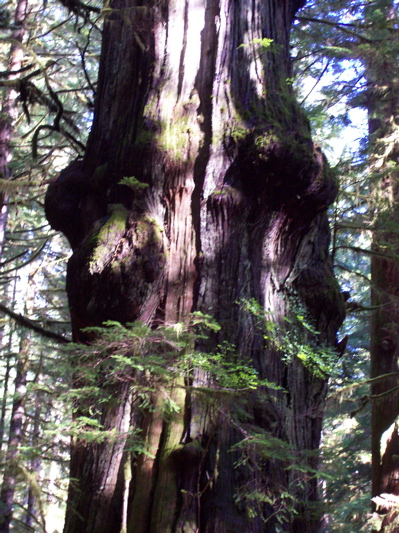
Big trees on the edge along the coast near Sooke
Vancouver Island has 3,500 kilometers of coastline, and along much of that you will find trees. These trees are at the edge living a very precarious existence. This is where the sea meets the land, and the water meets the wood. It is a wild and ever changing battlefield, and ultimately the land and trees give way to the persistence of the wind and waves. Sooke's west-facing Ella beach is a great place to see the interaction of land and sea, and witness how big trees cope in this dangerous zone.

Looking up at a downed Sitka spruce waiting to slide into the ocean
Wind, rain, and waves all slam into land here, constantly shaping the trees while eroding the land around them. On the night of December 15, 2006 a mega-storm hit the south coast. Hurricane force winds of 158 km/hour were recorded at Race Rocks, not far from here. The storm knocked down thousands of trees along the coast that night, and many ended up in the ocean becoming drift logs.

Eventually the tree in the distance will join others on the beach
Many of the biggest trees along Ella beach are Sitka spruce. These trees are not found further than about 80 km from the ocean, and have adapted to the salt spray near the surf. It is believed that not only do these trees tolerate salty or brackish conditions, but actually benefit from the various minerals found in ocean spray and salty soil.

Sitka spruce often have shallow root systems as many begin life on top of downed trees or 'nurse logs'. This makes them susceptible to blow down later in life. Sitka spruce can live for up to 800 years, but it is unlikely that those growing in exposed, easily eroded areas will make it that far. The oldest trees I saw along Ella beach are probably half that age.

Big Sitka spruce along Ella beach in a low bank, sheltered setting
There are also big Douglas-fir along the coast here. Many of them are also being swept into the ocean. Some will end up on the beach somewhere in the area. Others may make a major crossing on ocean currents and wash up on beaches on the Hawaiian Islands. Historically such logs making the crossing from North America were sought after by the Hawaiians for building canoes.

This Douglas-fir holds on against all odds
The terrain along this stretch of coastline varies from walk-on beach at the Ella Road access, to towering sheer cliffs closer to town. Hiking here you can see the graphic results of the ocean/land interface as everything is eventually eroded away.

This Douglas-fir, anchored by roots growing into the cliff, hangs suspended in the air
This ever changing, dynamic zone where the ocean meets the land constantly provides interesting surprises. Ella beach in Sooke is an excellent place to view big trees on the edge - a perilous spot where the ocean always wins.

Getting There


View Ella Beach in a larger map

11/10/2010

Avatar Grove - Accessible Ancient Forest Marked For Logging

Baird Creek Bridge and Avatar Grove  (see truck on right)
As I approached the Baird Creek bridge 20 minutes north of Port Renfrew on the Gordon River Main logging road, I realized I had been here before. A few years ago I stopped, took pictures, and sat on the bridge for a while. I admired the view of the canyon below, as well as the tops of huge trees and candelabra Western red-cedar poking out of the forest canopy. But unlike a recent trip, back then I didn't take a few steps off the road and enter the forest. But back then it wasn't called Avatar Grove.

Shady, moist forest floor and big trees everywhere

Take those few steps off dusty Gordon River Main and you step into a different realm. From civilization, gravel and harsh sunlight you descend into a wild, moist, lush, shady forest. A forest that grows some of the biggest trees on Earth, and contains the most biomass of any forest anywhere. This is Avatar Grove.


Members of the Ancient Rainforest Alliance (AFA) stepped off the logging road in December of 2009, and when they did they found massive old growth trees. They were looking at a forest that has survived over 100 years of industrial logging in the Port Renfrew area.

Recognizing its value as a standing forest, they named it Avatar Grove after James Cameron's movie and began to push for protection. But they found more. The AFA team also discovered that the area was surveyed and flagged for logging.

A survey blaze on a small tree in Upper Avatar Grove
I thought I had better take a look before it was gone, and mounted a fall field trip to Port Renfrew on a glorious, crisp, sunny day.

Mushroom and moss


At the grove, as soon as I was through the thick barrier of bush growing alongside the road I stepped out under a shady canopy far above. The ground was moist and spongy and my feet sunk into the thick layer of debris. Everything was covered in moss, which can hold 1000 times its own weight in moisture. Once logged such areas all but dry out in the harsh direct sunlight.


In Lower Avatar Grove the ground is sloped gently down to the Gordon River. A rough trail has been flagged out, but there are also many logging survey flags so one must exercise caution. I forged ahead, excited to finally be checking out this wonder so close to home.

After my eyes adjusted to the shade I began to see giant trees spread around the forest below. All the tell-tale signs of old growth forest are here: a variety of ages of trees from seedlings to seniors, standing dead trees (or snags), large diameter woody debris (fallen giants), and a deep layer of decaying matter on the forest floor.

Large diameter woody debris is everywhere - downed logs can take centuries to decay
The rough path leads the big tree hunter to some spectacular individual behemoths. There are some very large Douglas-fir, but the real stars here are the amply aged and weathered Western red-cedars. They are big and gnarly, and unlike any cedars I have seen. Most of the largest cedars are festooned with burls and whorls that are unique in their twisted beauty.

Ancient Western red-cedar in Lower Avatar Grove
The big Douglas-firs are dark and ominous looking, and far above the twisted and broken tree-tops poke out of the canopy and catch the last light of the day.

Big Douglas-fir in Lower Avatar Grove

I lost the trail on the way back up to the road, but there is little undergrowth and many fallen logs to walk along. It is hard to get lost here as all you need to do is point yourself uphill and hike till you hit Gordon Main, which is what I successfully did.

Giant tree broken off at the top, but still tall enough to poke above the rest


Back on the dusty gravel it seemed hard to believe that I have drove right through the middle of this old growth forest several times over the years without ever knowing what treasures lurked just a meter off the road. I ran up into the upper grove for a few brief minutes and look forward to returning at a later date for a more extensive upper grove excursion.


Lower Grove - big moss covered trees everywhere

See Avatar Grove

Leave Victoria and take Hiway 14 to Sooke, check gas gauge, then continue to Port Renfrew.
At Port Renfrew turn RIGHT onto Deering Rd. Follow Deering Rd. until the T intersection, then turn LEFT (right is toward Lake Cowichan). Follow road until the bridge over the Gordon River. Cross the bridge and stay on Gordon River Main for about 1.5 km. Right after you cross over the single lane bridge at Baird Creek, pull off to the right and park. Trail access has been marked by AFA on both sides of the road. Visit gently - be respectful. Enjoy the trees.


View Avatar Grove in a larger map

Save Avatar Grove

You would think that a bit of ancient forest on a well kept main logging road only 20 minutes from Port Renfrew would make someone in government think about preservation and tourism potential. Avatar Grove is on Crown land, so saving this valuable forest treasure would not entail purchasing land from a greedy logging/development company.

Please consider contacting elected officials to let them know preservation is the most logical thing to do with this increasingly rare piece of primeval forest, and the massive trees that thrive in it. Let them know that cutting thousand year old trees for pulp, paper, and deck lumber is greedy and unnecessary.
 

11/05/2010

Mary Lake: Help Save Original Coastal Douglas Fir Forest


It is not often that people have a chance to help preserve a bit of the original Coastal Douglas Fir (CDF) ecosystem here on Vancouver Island. Mary Lake, in the rural and rugged Highlands district outside of Victoria, B.C., presents such an opportunity.

A group dedicated to preserving Mary Lake, and the surrounding 107 acres of undeveloped forest, are attempting to raise the money to purchase it. See more here, and consider lending them a hand in reaching their worthy goal of saving some of this beleaguered ecosystem.

The CDF ecosystem is tiny, the smallest eco-zone in B.C., yet it holds a greater variety of plant and animal life than any other ecosystem in the province. The zone is restricted to a small strip of southeast Vancouver Island, as well as parts of the Gulf Islands and bits along the coast on the mainland. On the island, this vanishing ecosystem runs through the rainshadow created by the Vancouver Island and Olympic ranges.

This dry strip along the east coastal plain, until fairly recently, contained some of the biggest trees in the world. The size and scope of the original forest was an irresistible economic gold mine to early European settlers. Today 99% of one of the world's most productive and massive forests is gone.

Even the 1% that remains is being exploited before it too disappears. Only about 5% of the CDF zone is protected in parks - the B.C. government's goals is 12%.

The government has known for a long time that the CDF forest is in peril. In 1999 the B.C. Ministry of Environment stated in its Ecosystem at Risk brochure that "nearly every type of old growth Douglas-fir forest on British Columbia's dry coastal plain is now rare or endangered".

Knowing this, the government gave the go-ahead earlier this year for logging to commence on District Lot 33 in Nanoose Bay. Lot 33, a 64 hectare plot in the CDF zone, contains huge old growth Douglas-fir and Western red-cedar. It has never been inventoried for its biological wealth, and is prime habitat for the Marbled murrelet and Spotted owl.

Industrial use, logging, and increasingly, residential development, threaten the dry coastal plain that lies next to Georgia Straight.

Indeed, it is residential development that threatens the Mary Lake forest in Highlands. But we currently have the opportunity to save this 107 acres of endangered forest. Please consider donating, and/or volunteering. Also, consider writing to our elected officials to tell them that you do not want to see Vancouver Island's CDF forest go extinct on their watch.

Where is Mary Lake? 

Mary Lake is in the district of Highlands off Millstream Road, a 20 minute drive northwest of Victoria, B.C. The land is currently private, and having not visited yet, I can not say what access is like. However, I did see somewhere online that said that there are area trails that locals have been using over the years. As always, be respectful when visiting the big trees.


View Mary Lake, Highlands, B.C. in a larger map

New On VIBT: Big Tree Art Button


Coastal Conifer, Gregg Koep
Yes, I am obsessed with trees - I can't even prepare a meal without being sidetracked by the allure and beauty of the coastal conifers. This piece almost made itself as I stood at the kitchen counter. The two dimensional sculpture is made from: Garbanzo beans, and dried kidney bean pods.

I posted 'Big Tree Art' back in January of this year. In the post I highlight some of my favourite big tree art, including examples of art works that my partner and I have done over the years. Doing art is a fun way of expressing our love of trees, and gives us something to do in between field trips. Coastal Conifer, shown above, is the most recent addition.

I have been adding to the original post as new art comes around, but the post remains buried in the archives, and somewhat inaccessible. Therefore, I decided to recreate the post as a button at the top of the VIBT page.

Check out the Big Tree Art button every once in a while to see if there have been any recent additions of artwork.

Do you have big tree art of your own that you would like to share? Send it to me and I will publish it here.

Let's celebrate, and pay homage to the contributions and beauty of trees through art.

11/01/2010

The Harris Creek Sitka Spruce

The heavily buttressed trunk of the Harris Creek Spruce
 If you are driving the 255 km Pacific Marine Circle Tour on south Vancouver Island, a stop at the Harris Creek Sitka spruce is highly recommended. Rarely are monumental trees this accessible, unless you are in an urban area or park. This tree is in neither, and grows without official protection in the middle of the semi-wilderness between Port Renfrew and Duncan.


On the trail approaching the giant spruce


That the Harris Creek Spruce is still with us is somewhat amazing. The first harvesting of the forest (by Europeans) in the Port Renfrew area was in the Harris Creek watershed back in 1893.


Occasionally, however, it is the loggers themselves that lay down the saws and are unable to commit the dendrocide their jobs require. So mighty are the specimens, and so great the loggers respect, such trees acquire a special status and are spared.


Sign at roadside
Now such trees, or small groves, exist as islands in a sea of smaller second or third growth - often as the sole survivors of the ancient forest. The Harris Creek Spruce next to Harris Creek Main northeast of Port Renfrew is one such tree. It is an 82 meter tall giant that dwarfs everything around it. This tree is all fat flared trunk and twisted moss draped branches.

Sitka spruce show very little taper which adds to the huge volume of wood found in old specimens
Sitka spruce are uniquely adapted to the coastline. They will not be found further than about 80 km from the ocean, their preferred habitat. These trees can tolerate salt spray from the pounding waves, one of few trees that can. When away from the surf, Sitka spruce grow in the low lying river valleys that dissect the coastal hills and penetrate inland.


A fence has been built to protect the roots at the base of the tree
This amazing Sitka spruce is beautifully situated right next to Harris Creek. It is a short distance from the road along a flat, well-kept, wheelchair accessible trail. Sitka spruce are fast-growing trees - it is difficult to date this one is. Certainly its age can be measured in the hundreds of years. Sitka spruce can live to 800 years making them one of the oldest trees in the Pacific coastal forest.

It is possible the Harris Creek Spruce could still be around for your great-great-grandchildren to visit.

Harris Creek runs next to the giant spruce

Getting There

The Harris Creek Spruce is about 20 km north-east of Port Renfrew on the paved Harris Creek Main. It will be found on the right side of the road 8 km past Lizard Lake while heading toward Lake Cowichan, and is marked by a small sign. Set your tripometer and watch for the sign when you get close.

Note: there are no gas stations between Sooke and Cowichan, and no services at all between Port Renfrew and Cowichan/Duncan. Drive safely - be prepared for emergencies.


View The Harris Creek Sitka Spruce in a larger map

10/25/2010

B.C. Forest Service No Longer Geared Toward The Public Interest


Things are not going well in B.C.'s Forest Service, or in B.C.'s forests. 3/4 of the logging in the coastal forest is of old growth, and over 3/4 of that is by clear cutting. Whole log exports ship trees and jobs overseas. Mismanagement by successive governments has meant that our public forest lands are in grave danger.

Grave danger of being turned into biocide-sprayed rows of non-native tree crops. Danger of being taken over by a ‘professional reliance’ management model in which there is essentially no government oversight. Danger of of being privatized, sold off, and rendered off-limits to the people that collectively own it.

The B.C. Forest Service took its modern form in April of 1945. At the time it was the steward of the timber, range and recreation resources of B.C.'s Crown forest land, which covers 2/3 of the province. The Forest Service mandate was to manage the land for multiple uses including recreation, forage, timber, heritage, and wilderness. Those days are officially over.

The Forest Service has seen such extensive budget cuts in recent years that it is no longer able to protect Crown forests for the public good. The brave new world of forestry has as its objectives the maintenance and enhancements of an economically valuable supply of commercial 'fibre' (they're not even TREES anymore), as well as to protect investor value. Therefore, the Forest Service is being systematically disbanded, paving the way for the fibre managers.
Since coming to office, the B.C. Liberals have slashed almost 1,100 forestry workers’ jobs in eight years — the very people who ensure our public forests are sustainably managed and harvested. From 2002-2004, the Campbell government eliminated 800 jobs in the Ministry of Forests and Range — 304 positions in compliance and enforcement alone. This year, 204 more forestry jobs are being axed — 62 per cent from compliance  and enforcement and field operations. Then on May 27, deputy forests minister Dana Hayden confirmed that an additional 42 positions would be eliminated, as the ministry moves forward budget cuts planned for next year.  May 27, 2010, BCGEU
If the people who have been looking out for our forests are no longer able to protect the public interest, who will? Throughout the massive changes to our forests and forest service, the government has ignored recommendations by government forestry specialists - the people that have been in our forests for the past 65 years, and know it best. Not only that, the Liberals have also restricted the opportunity for public input.

The Wilderness Committee has repeatedly reminded us that "75% of the original productive old-growth forests have been logged on Vancouver Island, including 90% of the valley bottoms where the largest trees grow. Only about 6% of the Island's original, productive old-growth forests are protected in parks."

A poll conducted in March, 2008 found that 88 percent of British Columbians polled agreed that protecting habitat for endangered species is important. But when the public indicates a desire for increased forest protection the government refuses to listen.

Maybe they will listen to artist/activist Briony Penn, who wrote "The Big Burn" (2010) after extensive research and investigation, and after interviewing those most knowledgeable about the state of our forests:
Since 1978, the Forest Service’s mission statement has stressed integrated management of the many values we ascribe to our forests, with a commitment “to manage, conserve and protect the province’s forest, range and outdoor recreation resources to ensure their sustainable use for the economic, cultural, physical and spiritual well-being of British Columbians, who hold those same resources in trust for future generations. In respecting and caring for public forest and range lands, the ministry is guided by the ethics of stewardship and public service".

Apparently, that’s now all history.

A recent internal Ministry of Forests and Range document titled “Response to the Changing Business Environment” lays out the new mission for the ministry as “To provide a superior service to resource stakeholders by supporting competitive business conditions” and gives priority to “Enhancing industry competitiveness” and “Identifying clear outcomes for investors.” An earlier internal memo dated June 9, 2009 from Jim Gowriluk, regional executive director, to his district managers, titled “Re: Advocating for the Forest Industry in the Coast Forest Region,” clearly articulates the new single-function mandate of the Forest Service of “fulfilling our role as advocates for the forest industry.”

Protecting the public interest has disappeared.
Penn's frightening article goes on to uncover a plan to privatize large sections of our public forest lands at the request of private industry. They are seeking a new forest tenure classification that would allow them long term leases to grow Frankentrees (fast growing poplar hybrids) to eventually convert into pellets as a fuel source. Because of a Kyoto Accord loophole, these companies will not have to account for the carbon production of the entire process, including the burning of the carbon-intensive pellets.

It is easy to privatize what rightfully belongs to the people. All the politicians have to do is give away public property to their friends, then wait for the kickbacks to flow in. It is much more difficult to reverse such decisions.

Will our old growth forests and big trees end up being liquidated entirely to make way for non-native GMO tree plantations? Will our Crown forests end up benefiting only private companies for the next 999 years, similar to the BC Rail deal? Already a small army of government 'fibre officers' are combing our province looking for sites suitable for conversion to hybrid poplar plantations in long term leases with biofuel companies.

It is up to us, now. We must all be Green Rangers and fight for our trees and forests. Future generations, and hundreds of at-risk species, will be grateful.

10/22/2010

Bald Eagles and Big Trees

You need big trees for birds this large

Bald eagles are forest creatures requiring large territories that contain big trees close to water for nesting and perching. Only large, old trees have the strength, height, and branching structure that eagles require. The loss of such trees has been partly responsible for their drastic drop in numbers. Eagles need big trees.

The nest of a bald eagle is known as an Eyrie. It is one of the largest bird nests in the world, and can weigh as much as 2 tons. The nest consists of sticks and branches wedged together to make a large mass of material. Only sturdy, old trees can support these heavy structures.

Bald eagles use the same nests every breeding season. They keep adding new materials year after year. They line their Eyries with twigs, moss, feathers, and grass. A new nest is typically 2 feet deep and 5 feet wide but can grow enormously over the years. If a nest is destroyed for any reason, then the bald eagles usually remake their nest in close by areas. Eagle pairs will often use the same nest site for their entire breeding life.

Eagles also use large trees that emerge from the surrounding canopy to perch on. From these emergent trees the eagle can survey their territory for prey and other eagles.

Bald eagle nesting territory

Some of the trees surrounding Sooke Harbour are large enough to support massive eagle nests. A couple of years ago the largest, tallest tree in a forested area in my neighbourhood was toppled in a storm. For many years this tree provided the scaffolding for a giant nest that a pair of eagles had used faithfully season after season. I watched several baby eagles fledge at that site, and was sad to see the tree laying on the ground when I went over to investigate. The ton of material forming the nest may have been responsible for the tree toppling over.

One year I watched a baby eagle from this nest learning to fly along the edge of the forest. It flew to a tree and landed on a branch. All of a sudden the young, inexperienced eagle lost its grip and swung upside down on the branch with its wings spread wide. It stayed hanging like this for almost a minute, not seeming to know what to do next. Then it released its grip, took flight again, and landed in a more upright position. Kids do the funniest things.

Local eagles love this big tree
After the neighbourhood nest was lost the eagle pair relocated to another large tree within their territory. Close to the new nest site is a very tall tree that was used this year by a fledgling eagle learning to fly. The eaglet, perching on a sturdy branch would spread its wings, catch the wind and hop up and down in brief mini-flights.

Most eagle nest trees on the east coast of Vancouver Island (81%+) are veteran Douglas-firs over 150 years of age, usually found within a kilometre of the shoreline.

99% of old growth Douglas-fir forests on southeast Vancouver Island have been logged, and a great deal has been developed. Until recently, enough small stands of old growth, or lone veteran trees amongst smaller second growth, have remained to support a sizable nesting eagle population. However, continued development and logging of lands have caused the loss of nest trees, threatening the long-term maintenance of their numbers. Eagles need big trees.

In British Columbia landowners having eagle nests on their property are required by law to develop a management plan showing how the nest tree is to be preserved.

10/17/2010

The San Juan Spruce: Canada's Largest Sitka Spruce

Looking down into San Juan Bridge campground and Canada's largest Sitka spruce

There is nothing like a big tree road trip. VIBT hit the road recently on a perfect fall day, and headed for the big trees of Port Renfrew, B.C. Destination? The San Juan Spruce, Canada's largest Sitka Spruce (Picea sitchensis).


There are many giant trees lurking around the Port Renfrew area, some well known, and others yet to be discovered. One of the more well known trees resides next to a bridge about 20 km up the San Juan River east from Renfrew. There are few known trees of its proportions anywhere, and if it were in some other country, it would undoubtedly be more celebrated than it is here.


This massive building-sized tree is Canada's largest spruce tree when measured by wood volume (333 cubic meters). You can see the 62.5 meter top of it from the bridge as you cross the river. It is in an area where other large Sitka spruce can be seen poking up like islands in the sea of second growth around them.


As you turn left at the end of the bridge and descend down to the San Juan River Bridge Forestry Recreation Site, the full 3.71 meter diameter of the champion spruce comes into view. 


The San Juan Spruce is all out of proportion compared to what one normally thinks of as a typical tree. It would take several adults holding hands to circle the 11.6 metre circumference base. This is the second largest Sitka spruce in the world after the Queets Spruce in Olympic National Park, Washington. 
 
At first the visitor will be struck by the sheer size of the giant, but after a while may also come to appreciate its interesting architecture. It has a complicated canopy, including a side trunk that is a large tree in its own right.

Hanging gardens of moss and fern living on a Bigleaf maple in the campground        


The San Juan Spruce is much more than just a tree - it is an entire vertical community of rain forest life. A large bracket fungus graces its lower trunk, and ferns grow in splashes of fluorescent green everywhere on the trunk and in the canopy. A Red-backed vole could live its entire life in this one tree. Forest debris builds up thickly on branches supporting a variety of spongy mosses, and even other trees.


A pilgrimage to this living monument is a tribute to the logging survivors that remind us of our connection to the ancient forest. A visit to the San Juan Spruce can also be seen as a tribute to Randy Stoltmann. He discovered, then worked to protect, this amazing tree. Stoltmann was compiling the beginnings of British Columbia's Big Tree Registry when he died in a back country accident in 1994.


Bonus: See the Red Creek Fir (biggest Douglas-fir in the world) while you are back here, if you are driving a 4X4 or other high clearance vehicle. Watch for signs along the way once you leave Harris Creek Main. It should be possible to loop back to Port Renfrew via Red Creek Main (edit: Red Creek Main is no longer passable).

Getting There 

Take Highway 14 from Sooke to Port Renfrew, a distance of about 88 km. From Port Renfrew take Deering Road to Harris Creek Main. Turn right toward Cowichan Lake until the Y intersection shown on the map. Watch for signs that will lead you to San Juan Bridge Recreation Site, a small, rustic 6 unit campground next to the San Juan River. Drive carefully and always be prepared with supplies and an emergency kit while driving logging roads in the back country.


View San Juan Spruce Near Port Renfrew in a larger map


10/12/2010

Getting High For Big Trees - Climbing Mt. Quimper


 When you look down from the top of Mt. Quimper you look over an area that has been logged since the mid-1800s when Walter Grant set up the first water-driven saw mill in the Sooke area. When Grant returned overseas his holdings went to the Muir family who built a more powerful steam powered saw mill in 1855. It was the beginning of the end for Vancouver Island's big trees.


Barely a century and a half later, over 96% of south Vancouver Island's most productive forests have been affected by logging. These forests were in valley bottoms where conditions are optimal, and trees grow the largest. These areas are also the most accessible so the largest trees were the first to be cut down.

Considering that history, I decided to start looking at steep slopes and mountain tops in the Sooke Hills Wilderness (Sea to Sea Green Blue Belt) to see if I could find some original trees that escaped the fate of forests down below.

Looking southeast from Mt. Quimper

I started with the 4.3 km (one way) hike up Mount Quimper, which is a rocky knob on the front line of the Sooke Hills. This 546 meter hill gives the hiker a spectacular panoramic view over the southern tip of Vancouver Island.  Even if I didn't find old growth I would at least be able to enjoy a great view.

Several sizable trees on the way to the summit provide cool shade and a place for lunch
Steep hillsides and mountain tops are the most difficult to log, and this fact has protected a few remnants of the once-mighty Douglas-fir forest (although previously inaccessible trees are increasingly being heli-logged in some parts of Van. Isl.). Individual survivors, and small clumps of old growth persist in places throughout the Sooke Hills. I hoped I might find some going up Mt. Quimper.

Big Douglas-fir near the top
 The hike starts at the parking lot at the end of Harbourview Road in Sooke. Presently the CRD is doing upgrades to the Mount Quimper area so I imagine signage and trails will be upgraded. I hiked before the construction began. There was no signage at all, but I still found my way to the top of the mountain using nothing more than my GPS (Gregg Positioning System).

I hiked past the gate on Harbourview Rd. and watched for any obvious trails off to my right.  I found one a couple of kilometers up the trail, and followed it. After a few minutes on this trail I found a side trail on my left that climbed more or less straight up a steep slope.

The trail I was on, an old logging road continued ahead. I chose the steeper path, looking for a more direct route to the top. The trail was a direct route to the top, and soon I found myself on the summit enjoying fantastic views of both trees and the south island landscape.

Tall forest near top with one large, gnarly-branched ancient
Most of the hike is through second growth forest. There are occasional large trees on the bottom portion of the hike, but the mid-section is through dense bush and small closely spaced forest. For the most part the view is obstructed until higher on the mountain.

When the side trail leaves the logging road and starts to climb Quimper proper, the real tree treats begin.  Along the trail to the summit there are some interesting, twisted and stunted Douglas-fir that are most likely very old.

The trail passes through rocky outcrops and grassy areas. These are interspersed with patches of forest, which I was grateful for on the hot, sunny day that I was hiking. The cool shade of the forest was in stark contrast to the open spots where the relentless sun was beating down and the temperature soared.

Wind-snapped giant Douglas fir - this tree could take hundreds of years to decompose

In the patches of forest on Mt. Quimper there are a few impressively large trees. Growing conditions become harsher as the altitude increases, and the old trees are smaller up here. Still, there are several large, old trees that draw ones attention.

There is also an amazing forest of dwarfish, almost bonsai, Arbutus kept small by their location in an open patch near the top. Also taking advantage of the more open hot, dry exposures are Pine trees, which are also of a stunted stature.

The biggest trees on Mt. Quimper are the Douglas-fir, including one tree that was toppled by the wind. The huge wind-snapped trunk lays on the ground, a testament to the harsh winds experienced up here during winter storms coming off the Pacific.

It makes one thankful for our homes, mostly made out of trees, to protect us from these same storms. I hiked down the mountain in half the time it took to ascend, rode my bike back home, and started to look at other peaks to explore. Now that a large patch of forest and hills in this area is protected, one can feel good about this being old growth forest of the future.

Getting There

Harbourview Road is in Sooke, a short drive east from the middle of town. It is about 40 km from Victoria. Drive to the end of the road where you will find a parking lot. The trail to the top of Mount Quimper starts here. Enjoy the trees and the stunning view.


View Hiking Mount Quimper in a larger map

10/03/2010

Juan de Fuca Provincial Park: Hiking To China Beach Through Old Growth Forest


The Coastal Western Hemlock Forest

Thirty-seven kms west of Sooke on Highway 14 is the beautiful Juan de Fuca Provincial Park. This park stretches in a narrow strip along the coast from China Beach all the way to Botanical Beach near Port Renfrew. It was made to commemorate the 1994 Victoria Commonwealth Games.
 
China Beach is at the east end of the park, closest to Sooke. A short hike to China Beach takes the big tree hunter through a mature Coastal Western Hemlock forest, and down to an expansive, sandy beach (at lower tides).

The further west along the coast you drive the wetter it gets, and the more Douglas-fir gives way to abundant Western hemlock, and Sitka spruce. The forest beginning around China Beach is different from the drier Coastal Douglas Fir ecosystem to the east.

More precipitation falls here than in Sooke, only 37 km away, but not as much as in Port Renfrew. Sooke receives about 660 mm of precipitation a year, compared to Port Renfrew's rainforest-like 3600 mm.


Hiking To China Beach

The 1 km trail to China beach starts at the parking lot for the day use area. The upper trail area has been logged and the forest that has grown in is densely packed and dark. The wet climate here encourages the spongy green mosses and dripping lichens that hang from branches. This is the beginning of the coastal rain forest.

A few steps and the hiker will pass through a small clearing in the forest. There is some evidence of logging here, but the area was also affected by a major storm in the winter of 2006. Many trees were blown down, and the trail was inaccessible for a long time. The clearing gives good views of the tall trees still standing there, and the surrounding forest canopy.

A little farther and the trail enters the area of mature forest. It is hard to miss as it feels like you are going 'into' something. The trunks of thick trees are all around, and looking toward their tops gets tiring on the neck. It is special here. Hushed, muted songs of forest birds, the faint sound of the wind in the upper canopy. Waves breaking on the beach below can be heard while mist passes through the trees.

This is the domain of keystone species such as black bear, cougar, wolf, and the endangered spotted owl. These species play a critical role in maintaining the structure of this special forest. The Sitka spruce are a keystone species in this ecologically rich environment, too.

"Vancouver Island has one of the highest concentrations of black bear and cougar in the world."

Sitka Spruce

Sitka spruce,  the largest species of spruce, commonly grow to 70 meters and a diameter of 300 cm in mature forests. The largest Sitka spruce are over 90 m and 500 cm in diameter. These giants are among the fastest growing trees in the world. The cool, moist maritime climate over much of Vancouver Island grows some of the largest examples anywhere.

The second-largest known Sitka spruce, the San Juan spruce, is just a few kilometers up Highway 14 from China Beach. This tree grows at a campsite beside the San Juan River outside of Port Renfrew. The San Juan spruce boasts a diameter of 371 cm, a height of 62.5 m, and a wood volume of 333 m3 .

A little farther up the coast in Carmanah/Walbran Provincial Park big tree lovers will find the Carmanah Giant, Canada's tallest tree. This sky scraping Sitka spruce is 95m in height and 9.4 m in diameter.

A Sitka spruce on the Brooks Peninsula has a greater girth than either of the above trees. This massive spruce is 13.94 meters in diameter.


The dark trunks of the Sitka spruce can be seen along the rest of the China Beach trail. The spruce trees have grey to dark brown bark that forms large chips. There are many Western hemlock, a few Douglas-fir, and some very large Western red-cedar that make up this diverse forest. But the coast-hugging Sitka spruce is the premier tree here.

The spruce are at the front line of the battle between the sea and the forest, due to their salt tolerance and ability to withstand abrasive wind-driven sand. These tough trees brave the elements and cushion the blow for those standing behind them. The spruce trees at the waters edge are blasted into a low wedge called spruce fringe, or krummholz forest. Without it, the trees behind would be blown down.


Sitka spruce are not the longest lived trees here, attaining an age of 'only' four or five hundred years. However, what they lack in age they make up in size, height, and girth. The trunks of these columns of wood have very little taper as they disappear into the canopy. The lower parts of the trunks are free of branches so the great trunks are in plain view. One would need binoculars to see the trees' needles as they are so far off the ground.

China Beach Provincial Park contains a special mature forest. We should be saving more like it. Get a taste of what we are at risk of losing on the easily accessible China Beach trail.


At the end of the trail - China Beach

 Getting There

Drive 37 km past the town of Sooke along West Coast Road (Highway 14). When you drive through the small surfing village of Jordan River you only have about 4 km further to drive. Watch for the entrance to China Beach day use area on your left hand side, and turn in.

Drive past the parking lot for the Juan de Fuca Trail head (on the right), and to the lower day use parking lot. The China Beach trail takes you past a set of outhouses, through the old growth and on to the beach below. Watch for bear, cougar and rogue waves.


View China Beach - Juan de Fuca Provincial Park in a larger map